Halifax V9982 near Pickhill.
On 11th May 1942 this 102 Conversion Flight aircraft was being flown on a training flight and had left Dalton at 14.20hrs, two hours into the training the aircraft was being flown with two engines on the port side shut down to give the pupil experience on this type of flying. The instructor noticed that the weather was changing so, with the pupil at the controls, he attempted to un-feather the two engines but was unable to do this. Control was partly lost and with height also lost the aircraft was eventually put down in a field belonging to Roman Castle Farm, near Pickhill, north-west of Thirsk, at 16.30hrs. Of the five crew on board two are listed in a police report as being slightly injured while the aircraft was badly damaged and part of it caught fire. Sadly the first two named airmen were killed within six months of this incident at Pickhill. Air historians Ken Reast, Eric Barton and Albert Pritchard located small remains of the aircraft on the surface at the crash site in 2007, with permission from the landowner to confirm the crash location.
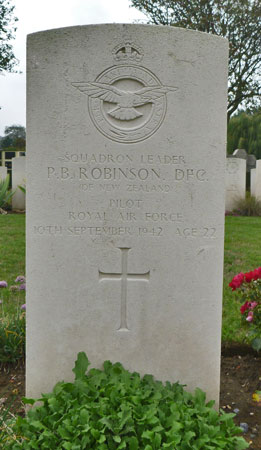
Instructor Pilot - Acting S/Ldr Peter Bettley Robinson DFC RAF (36274).
Pupil Pilot - F/Sgt Carl Clark Harris RCAF (R/62960).
Pupil Pilot - F/Sgt John Fielding Wrench Towse RCAF (R/72402). Injured and admitted to hospital.
Two un-named aircrew - Two slightly injured.
New Zealander Peter Robinson was granted a short service commission in the RAF on 13th April 1940. He was awarded the DFC for service with 78 Squadron on 7th March 1941 "for gallantry and
devotion to duty in the execution of air operations", the same date as Leonard Cheshire's DFC. On 13th April 1941 he rose to F/O (war subs) and F/Lt exactly a year later. He was
posted to command 102 Squadron Conversion Flight on 12th January 1942 from 35 Squadron. Acting S/Ldr Robinson was soon posted operational again; he arrived at 158 Squadron following
the loss of S/Ldr Hewitt to be appointed B-Flight Commander on 4th August 1942. Having only flown on Ops to Saarbrucken on 1st September 1942, Karlsruhe the following night, Bremen
on 4th September, Duisburg on 6th September and Frankfurt on 8th September he was sadly killed on 10th September 1942 flying in Halifax W7745 which was shot down by an Me109 on
Ops to Dusseldorf. He was twenty two years old and buried in Oostende Cemetery, Belgium. He was clearly a very able officer having risen through the ranks at such a young age. I thank Ade Harris for photographing his grave.
Carl Harris was born on 10th March 1919 in New Glasgow, Nova Scotia and was the son of Colin Clark Harris and Laura Stella (nee Morrison) Harris. The family later moved to Sydney, Nova Scotia. As a young man worked as a teacher for a couple of years before returning to college. His service file suggests he was a well educated young man; studying Maths, Chemistry, English and Latin at a number of colleges and also at university. He enlisted for RCAF service on 26th August 1940 in Sydney, Nova Scotia and underwent pilot training in Canada, being awarded his Pilot's Wings on 3rd July 1941. On arrival in the UK in August 1941 he was posted to 23 OTU, 27 OTU, 20 OTU and finally 19 OTU over the next few weeks. This fast transferring between so many OTU's doesn't appear common and I am not sure why it happened. He was posted to 102 Squadron on 21st December 1941 and flew operationally with them who were using Whitley's at the time. He was converting from Whitleys to Halifaxes with 102 Squadron's Conversion Flight (set up for this reason) in May 1942 when the incident near Pickhill occurred. He completed the conversion process and returned to the parent 102 Squadron. F/Sgt Carl Harris was killed flying with 102 Squadron on 26th June 1942 on a thousand-bomber raid to Bremen flying Halifax W7759, his body was never found and he is commemorated on the Runnymede Memorial. He was twenty three years old.
Halifax V9982 was built to contract B.982938/39 by the English Electric Company Ltd. at Samlesbury and was awaiting collection on 19th October 1941. It was taken on charge by 35 Squadron on 2nd November 1941 at Linton on Ouse and on 15th January 1942 it suffered a minor Cat.Ac/FA damage to the tail at Linton on Ouse. On 18th January 1942 a repair on site at Linton on Ouse by a team from Handley Page Ltd began and was back on 35 Squadron charge on 3rd March 1942. On 15th March 1942 it was transferred to 102 Conversion Flight at Dalton and as a result of a crash near Pickhill on 11th May 1942 Cat.E2/FA Burnt damage was the assessment. It was struck off charge on 20th May 1942.

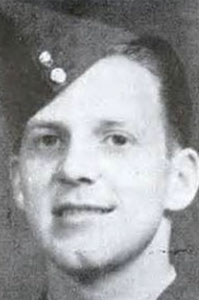
John Towse was born in 1917 in Toronto and lived in "Orillia" or "Oakville" before enlisting into the RCAF in Toronto on 24th September 1940. He was later posted to
102 Squadron after completed his conversion training. He was the pilot of Halifax W7910 that crashed near Huby, Easingwold on 3rd January 1943. He was awarded the DFC for
service with 102 Squadron, Gazetted 15th June 1943 and was invested with his DFC by King George VI on 21st March 1944. He survived the War and later returned home where
he died in Ottawa on 20th October 1988. His DFC citation reads.. "Warrant Officer Towse has a long operational record of attacks against a wide variety of targets and has
been conspicuous for sustained courage, determination and endurance. He has been successful in attaining the primary objective on most occasions. A very capable and reliable
captain of aircrew, this airman has earned the confidence of his crew by whom he has been a source of inspiration."