Magister L8162 near Pocklington airfield.
During the afternoon of 4th April 1942 this aircraft was being flown by two 405 Squadron airmen on an aerobatic training flight over the general Pocklington airfield area. The aircraft was on charge with the Station Flight at Pocklington as a run about aircraft for general use. The aerobatics were carried out at betwen 4,000 and 5,000 feet. The aircraft undertook a series of three slow rolls and then a series of three loops. On the fourth slow roll the aircraft was seen by people on the airfield to turn over on to it's back at around 4,000 feet but stayed inverted and lost height to around 1,500 feet, it was then seen to partly complete the roll but dive inverted into the ground. The aircraft crashed around a mile west of Pocklington airfield at 16.00hrs sadly killing the two experienced Bomber Command airmen. The pilot was B-Flight Commander, is believed to have flown at least twenty five operational flights with 405 Squadron. The passenger was the unit's Senior Navigation Officer. The resulting investigation stated that inexperience on the part of the pilot was the reason for the crash, one assumed it meant inexperience on the Magister type. It ordered a restriction on operational pilots flying only the Squadron aircraft types. The two airmen were buried on 8th April 1942 at the local church to the airfield at Barmby Moor.
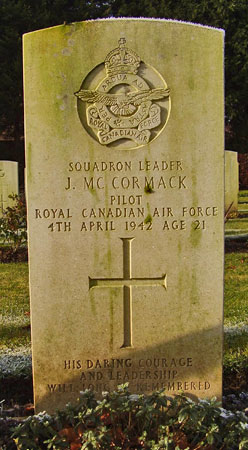
Pilot - S/Ldr John McCormack RCAF (J/4881), aged 21, of Toronto, Ontario, Canada. Buried Barmby Moor Churchyard, Yorkshire.
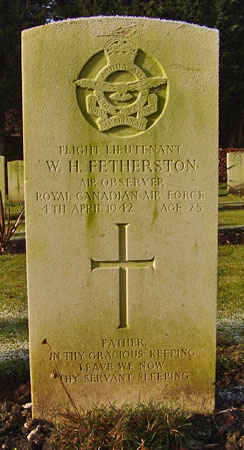
Passenger/Snr Navigation Officer - F/Lt William Henry Fetherston RCAF (J/4530), aged 25, of Arnprior, Toronto, Ontario, Canada. Buried Barmby Moor Churchyard, Yorkshire.
Magister L8162 was built to contract 706823/37 by Phillips and Powis at Woodley and was delivered to RNAS Lee on Solent Practice Flight on 31st May 1938. Whilst at Lee on Solent it is believed to have served for a short period with 17 Group Communication Flight but no dates for this are listed in it's published history. It was transferred to 102 Squadron on another unknown date probably for use as a "hack" aircraft and at the time they were based at Driffield. 102 Squadron moved to Leeming on 25th August 1940, to Prestwick on 1st September 1940, to Linton on Ouse on 10th October 1940 and to Topcliffe on 15th November 1940 and the aircraft was probably used by them at all of these airfields. On 16th July 1941 it was transferred to the Station Flight at Pocklington. As a result of the crash near Pocklington on 4th April 1942 Cat.E2/FA damage the damage assessment and the aircraft was written off.
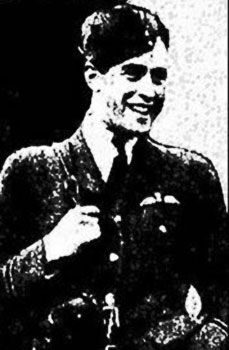
S/Ldr McCormack and his gravestone. John McCormack was born 28th September 1920 in Silverthorn, Toronto, Ontario, Canada and was the son of Leroy Meredith and Helen (nee Dodds) MacCormack. His father had served in the RFC and RAF in WW1 and while he worked as a school principle in Toronto before WW2 he served as an instructor in Canada during WW2. While John (or "Jack") was still at college in 1940 when he enlisted for RCAF service he had excelled at Rugby at school and coached younger boys during summer holidays. He enlisted for RCAF service on 19th September 1940 in Toronto and after training as a pilot in Canada was awarded his Flying Badge on 17th March 1941. He received a commission the following day and left Canada for service in the UK in early April 1941. He and William Fetherston flew together in the same Wellington crew on many occasions.
William Fetherston was born on 18th November 1917 in Ottawa, Ontario, Canada and was the son of Hugh Stanley and Alma Elizabeth (nee Lodge) Fetherston. The family moved to Arnprior when he was young and he attended primary and high schools there. He was working for the Royal Bank of Canada when he enlisted for RCAF service in Montreal on 1st July 1940 and after training in Canada he was awarded his Air Observer badge on 2nd February 1941. He married Helen Gertrude Clark in Toronto in February 1941. He was granted a commission in the RCAF on 5th March 1941 and left Canada on 5th April 1941 for service overseas. He then arrived in the UK on 1st May 1941 and was posted to 12 OTU three days later. He was posted to 405 Squadron on 24th July 1941 but flew his first operational flight on 7th July 1941 (while still at OTU?) and his last operational flight given in his service file was made with 405 Squadron on 28th December 1941. Between then and his death he was posted to Pocklington and also Driffield airfields, probably as a senior navigation officer having been grounded from operational flying.