On 10th October 1942 this 419 Squadron aircraft had been used for the crew to undertake a training flight in the mid-afternoon when the crew were landing at Croft airfield, the aircraft touched down but the pilot was forced to overshoot after the undercarriage had been damaged. The aircraft climbed into the air again. The port engine then failed as it was making a turn and may also have caught fire. The pilot lost control of the aircraft and it crashed near "South Walmire Farm" at 14.43hrs, sadly two of the crew were killed in the crash and the pilot died of his injuries the following day. The funerals of those who died in this incident were carried out on 13th October 1942 at Darlington Western Cemetery.
Wellington BK335 was built to contract B.124362/40 by Vickers Armstrong's Ltd. at Hawarden, Chester. It was immediately delivered to 419 Squadron at Croft on 30th September 1942 and was first used by them on operations on 5th October 1942. It was destroyed in the crash on 10th October 1942 with Cat.E2/FA burnt damage being recorded after the assessment. The aircraft was struck off charge on 16th October 1942.
Navigator / Air Bomber - F/Sgt Richard John Todd Colvin RCAF (R/110138), aged 27, of Prince Albert, Saskatchewan, Canada. Buried Darlington Western Cemetery, Durham.
Air Gunner - F/Sgt Herbert Ernest Hicks RCAF (R/113252), aged 20, of Edmonton, Alberta, Canada. Buried Darlington Western Cemetery, Durham.
Pilot - Sgt Lewis William Scobie RCAF (R/87422), aged 22, of Rosetown, Saskatchewan, Canada. Died of injuries 11-10-1942. Buried Darlington Western Cemetery, Durham.
Navigator - P/O Patrick Campbell RCAF (J/10420). Sustained head injuries.
Navigator - Sgt Griffith Arthur Lloyd RAFVR (1332039). Injured.
Wireless Operator / Air Gunner - Sgt Hans D'Aperng RCAF (R/73846). Injured.
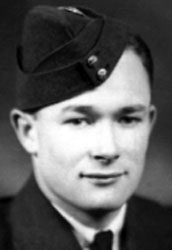
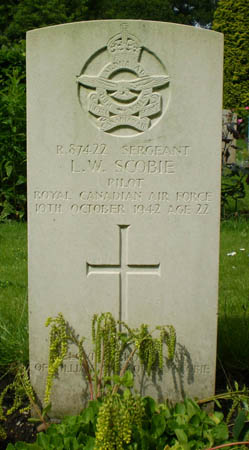
Lewis Scobie was born on 20th April 1920 at Rosetown, Saskatchewan, Canada and was the son of William and Colina (nee McIntyre) Scobie. His parents had emigrated to Canada from Bridge of Allan, Scotland. Lewis was educated at Rosetown and later in Saskatoon and was working as a welder in his father's shop when he enlisted for RCAF service at Saskatoon on 27th February 1942. After training in Canada he was awarded his pilot's flying badge on 5th December 1941. He arrived in the UK in February 1942 and trained at 6 (P)AFU and 23 OTU before posting to 425 Squadron on 16th September 1942. He was then posted to 419 Squadron on 25th September 1942. He sadly died of the injuries sustained in the crash of Wellington BK335 at the Darlington Memorial Hospital. The Scobie Peninsula in Saskatchewan is named in Sgt Scobie's honour.
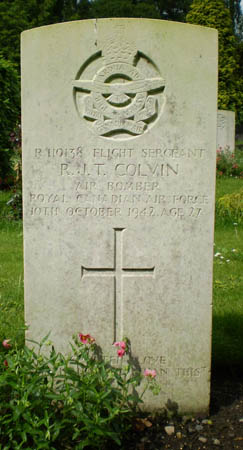
Richard Colvin was born on 11th November 1914 at Prince Albert, Saskatchewan, Canada and was the son of William James and Hettie (nee Todd) Colvin. Both his parents were born in Northern Ireland but had emigrated to Canada. As a young man Richard had studied pharmacy at the University of Saskatchewan and worked as a druggist (pharmaceutical chemist). In 1939 he started work for the Georgia Pharmacy company in Vancouver having studied at the British Columbia School of Pharmacy to obtain a license in British Columbia. He enlisted for RCAF service on 24th June 1941 in Vancouver and initially began training as an air observer, gaining his air observer's badge on 14th March 1942. On arrival in the UK in May 1941 he trained at 9 (O)AFU and 23 OTU but remustered as an air bomber on 23rd July 1942. He was then posted to 425 Squadron on 16th September 1942 but his stay there was a brief one as he was posted to 419 Squadron on 25th September 1942. The Colvin family lost another son, F/O David Alexander Colvin RCAF on 8th July 1943 following a flying accident in Bolingbroke 10072 at No.5 B.G.S. at Dafoe, Canada. He was twenty years old and is buried at Prince Albert Cemetery, Saskatchewan, Canada. Their parents later moved to Victoria, British Columbia, Canada. The Colvin Lake in Saskatchewan is named in both Colvin brother's honour.

Herbert Hicks was born on 26th October 1922 in Edmonton, Alberta, Canada and was the son of Herbert Ernest and Annie (nee Huberdeau) Hicks. As a young man he worked for the Edmonton Bulletin newspaper as a carrier and salesman and briefly for the Canadian National Railways. He enlisted for RCAF service on 9th April 1941 and following training in Canada he was awarded his air gunner's flying badge on 2st January 1942. Arriving in the UK in March 1942 he trained at 7 AGS and 23 OTU before posting to 425 Squadron on 16th September 1942. He was then posted to 419 Squadron on 25th September 1942.
Sgt Lloyd was killed flying with 419 Squadron on 18th February 1943 in Halifax DT639 on a mine laying flight in the Frisian Islands. He was twenty one years old, his body was never found and he is commemorated on the Runnymede Memorial.
Hans Aperng was born in 1922, WO2 D'Aperng was killed on Ops on 1st September 1943, he was twenty one years old and is buried in Hanover War Cemetery. He was flying in Halifax JD331 on Ops to Berlin.
Patrick Campbell was born in March 1911 in Londonderry, Northern Ireland but moved to Canada in the late 1920s or early 1930s and enlisted into the RCAF in Regina, Saskatchewan in May 1941. After training in Canada he received his commission in March 1942 and was posted to the UK aahortly after. He arrived at 419 Squadron just prior to the accident recorded above and sustained head injuries which took him off operational flying for a time. He later returned to 419 Squadron. On 23rd/24th May 1943 he was the navigator of Halifax BB384 that crashed near Dinsdale on return from Ops to Dortmund, the aircraft was returning with damaged fuel lines, the aircraft struck the ground, bounced over a stream (or the River Tees, sources vary), hit a tree which damaged one of the aircraft's wings and although the aircraft was badly damaged and caught fire the crew escaped serious injury. For service with 419 Squadron he was awarded the DFC, Gazetted on 7th December 1943. The citation refers to him as having been a navigator by this date, so either he was also a navigator when BK335 crashed at Croft and there is an error in him being a pilot, or he had re-trained as a navigator. The citation reads.. "Shortly after his arrival in this squadron Flying Officer Campbell was involved in a serious crash in which three members of his crew were killed and he sustained serious injuries. In spite of this he continued to take part in operational duty on every possible occasion. Whilst attacking Dortmund in May 1943, the aircraft in which he was flying as navigator was badly damaged by incendiary bombs and a crash landing at base became necessary, causing a fire from which he had to be extricated. This also did not deter him from again taking part in operations. His work as a navigator has always been exceptional and on more than one occasion his coolness, quick thinking and resourcefulness have been of great assistance to his captain." Post WW2 he returned to Canada and worked for many years in the Department of National Revenue. He died in Ottawa in July 1995. Hugh Halliday's RCAF awards research has been used in compiling this biography.
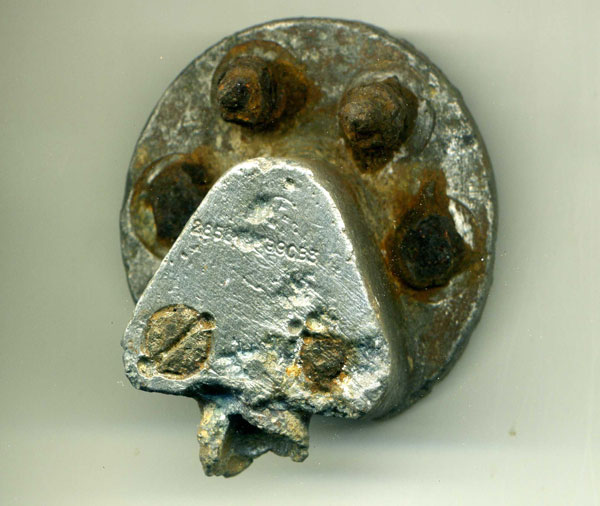
Local air historians Ken Reast, Albert Pritchard and Eric Barton located the crash site in May 1999 finding small pieces of the aircraft on the surface to confirm the location and aircraft type just off the south east corner of the airfield. The photograph above shows an item retained by Eric Barton that shows a Wellington part number.