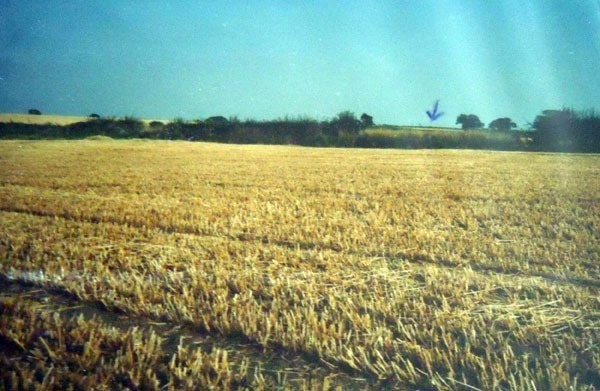
On 5th August 1942 the crew of this 1653 Conversion Unit aircraft took off from Burn airfield at 17.14hrs to undertake an air-to-air gunnery exercise with a Spitfire over the Rufforth area when. While executing a tight turn at around 2,000 feet to simulate taking evasive action the starboard half of the tail section broke off. The main part of the aircraft then crashed into a field just south of Tockwith and all ten in the aircraft were killed. The tail section landed near the Station Sick Quarters buildings at Marston Moor airfield. The Spitfires acting as the targets for the Liberator gunners may have belonged to 308 Squadron who had provided them for fighter affiliation flights in the weeks up until this incident. Immediately after the aircraft crashed the wreckage caught fire, the crash was witnessed by a number of local people and several of whom made their way to the crash site to attempt to rescue the crew.
Mr Gilbert Gingell, who suffered burns and Able Seaman George Hewick (C/JX154357) both received the British Empire Medal while Mr Alan Snowden received a Commendation for Brave Conduct. Notification of Gilbert Gingell's award and Alan Snowden's Commendation was printed in the London Gazette on 26th February 1943, the citation states.. "An aircraft crashed and caught fire. Gingell went at once to the scene where the flames were spreading fiercely and ammunition was exploding continuously. He forced a way into the burning fuselage and managed to recover the body of one member of the crew. He then went back in the hope of rescuing others. With help, Gingell broke further into the aircraft and recovered two more bodies. Work was continued until the intensity of the flames made further rescue attempts impossible. Gingell showed courage and determination in his efforts to save the lives of the crew." Able Seaman George Hewick had notification of the award of his British Empire Medal printed in the London Gazette on 9th March 1943 and the citation for his award states.. "for bravery in trying to save the crew of a burning aircraft." It also made mention the award related to Gilbert Gingell's award and his citation. Gilbert Gingell was only eighteen years old at the time of the rescue attempt, he later joined the Royal Navy and served as a submariner.
Liberator AL588 was built by The Consolidated Aircraft Corporation, at San Diego, California, USA and was purchased without contract by the British Purchasing Commission. It was collected by ATFERO and was ferried to the UK, arriving in December 1941. After acceptance it was taken on charge by 1653 Conversion Unit based at Polebrook on 24th February 1942 who then moved to Burn on 2nd June 1942. As a result of the accident on 5th August 1942 Cat.E2/FA Burnt damage was recorded on the paperwork and it was written off.
Pilot - F/Sgt Bryn Williams RAFVR (1312342), aged 27, of Weybourne, Farnham, Surrey. Cremated Leeds (Lawns Wood) Crematorium, Yorkshire.
Second Pilot - Sgt Alan Francis Bell RAFVR (1295005), aged 20, of Ilford, Essex. Buried Harrogate Stonefall Cemetery, Yorkshire.
Air Gunnery Instructor - P/O Thomas Henry Jones RAFVR (124260), aged 22, of Bradford Moor, Yorkshire. Cremated Bradford Crematorium, Yorkshire.
Observer - Sgt Wilfred Anthony Kup RAFVR (1309292), aged 26, of Gerrards Cross, Buckinghamshire. Buried Harrogate Stonefall Cemetery, Yorkshire. B.A.(Oxon.).
Wireless Operator / Air Gunner - Sgt Edward Thorley RAFVR (1112970), aged 19, of Mossside, Manchester. Buried Manchester Southern Cemetery.
Wireless Operator / Air Gunner - Sgt Sidney Sampson RAFVR (1380924), aged 22, of East Sheen, London. Buried Richmond Cemetery, Surrey.
Air Gunner - Sgt Edward Albert Smith RAFVR (1387824), aged 21, of Thundersley. Buried Thundersley Churchyard, Essex.
Air Gunner - Sgt Kenneth Caselton RAFVR (1270868), aged 19, of Yalding. Buried Yalding New Churchyard, Kent.
Air Gunner - Sgt William Henry Charles Booth RAFVR (1294878), aged 22, of Petts Wood, Kent. Buried Orpington Cemetery, Kent.
Ground Crew - Sgt Douglas Arnold Wood RAF (627322), aged 23, of Poole, Dorset. Buried Poole Cemetery, Dorset.
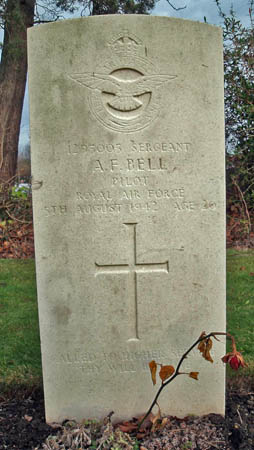
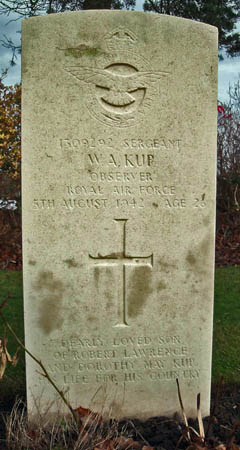
Gravestones of two of the crew at Harrogate Stonefall Cemetery.
Information elsewhere on the internet states that Wilfred Kup was born in Rio de Janeiro, Brazil and attended Haileybury School, Hertford.
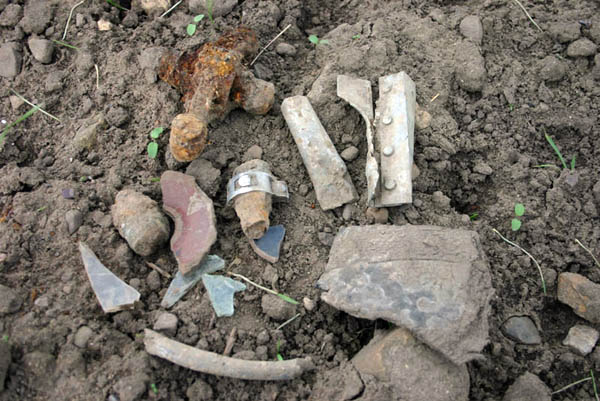
Air historians Ken Reast, Albert Pritchard and Eric Barton located the site in May 1999 with permission from the landowner finding small pieces of wreckage on the surface to confirm the location of the site. Nick Roberts also located the site in 2006 and the photograph shown below was taken by him of small finds located on the surface.