On 28th April 1941 the crew of this 114 Squadron aircraft took off from Thornaby at 18.00hrs for an escort duty of Convoy FN 59 in the North Sea, on their return to Thornaby the aircraft crashed two miles short of the runway at 23.14hrs, in the region of Whitehouse Farm / Barwick Lane. Sadly all three in the aircraft were killed.
Blenheim V6022 was built to contract 1485/39 by Rootes Securities at Blythe Bridge and was delivered into MU for acceptance in February 1941. It was issued to 114 Squadron in April 1941 but was with the unit only days before suffering this Cat.E2/FA (burnt) damage as a result of the accident detailed above.
Pilot - F/O John George Keith Long RAF (42374), aged 20, of Downend, Glocestershire. Buried Downend Churchyard, Glocestershire.
Observer - P/O Norman Frederick Dawson RAFVR (84729), aged 21, of Chelmsford. Buried Writtle Road Cemetery, Chelmsford, Essex.
Wireless Operator / Air Gunner - Sgt Norman Frank Taylor RAFVR (755472), aged 21, of Cheltenham. Buried Cheltenham Cemetery, Prestbury, Glocestershire.
John Long was married at the time of his death. He received a commission to the rank of Acting P/O on probation on an unknown date, he was graded as P/O on probation on 6th January 1940 and confirmed in the rank of P/O on 30th May 1940. He was later promoted to F/O (war subs) on 6th January 1941.
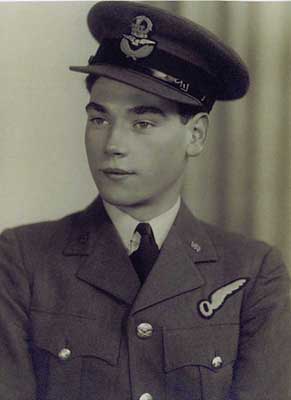
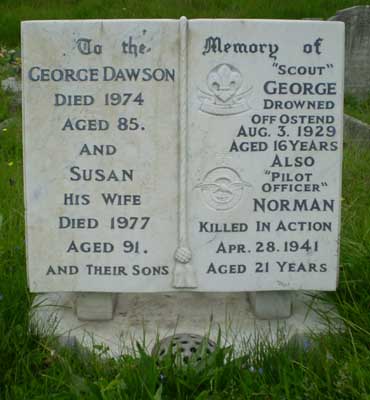
Norman Dawson and the family headstone. Norman received his commission to the rank of P/O on probation on 25th August 1940. His brother George's death was equally tragic. For a period in mid-2007 I was sent to Chelmsford to work and having little to do on an evening set about locating Norman Dawson's grave in Writtle Road Cemetery and researching him the best I could from newspaper archives kept in Chelmsford Library. His grave is not within the main Wargraves plot at the cemetery and on my first two visits I failed to locate it. Walter Cotton RAFVR, killed in the crash of Halifax LL178 near Kepwick, North Yorkshire (detailed on this website), is also buried in this cemetery so these two attempts were not without success; I was able to pay my respects at his grave, that loss I knew well. Norman Dawson was buried with his brother who was sadly killed in 1929.
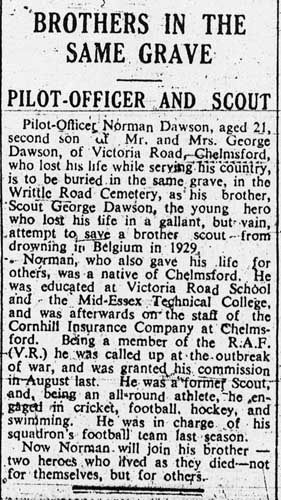
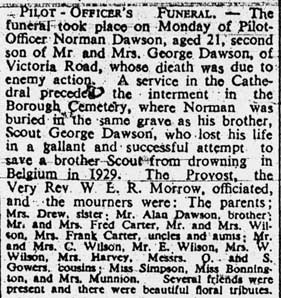
Two press reports found in the Chelmsford Chronicle in the weeks after his death. As one can read from these reports, he is buried with his brother, killed in 1929 whilst saving a fellow Scout from drowning in Belgium. Being a former Scout myself I begun researching his brother George to find out the events of his death and his gallant efforts. Not only did he rescue a fellow Scout in 1929 but he rescued another boy from drowning in Chelmsford in 1928.
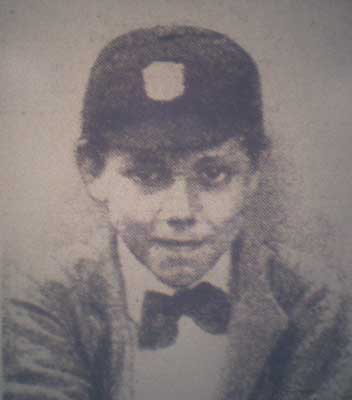
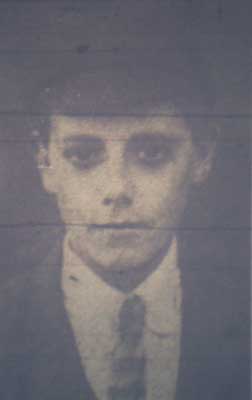
Two photographs of George Dawson, taken from the Essex Weekly News and Chelmsford Chronicle.
Scouts of the 6th Chelmsford (Cathedral) Troop begun their fortnight long summer camp on the 23rd July 1929, the 50 strong troop were camping three miles from Ostend, at Breedene-sur-Mer, in Belgium. On Saturday, 3rd August the troop had just finshed a "bathing parade". At 14.00hrs several Scouts were still paddling at the edge of the sea while two others remained swimming a short distance away - Scouts George Dawson and Stanley Groves. Two older scouts, Chappel and Bayley, were supervising from the shore. From the shore it was seen that Groves had got into diffulties and that Dawson was swimming to his aid, Groves had been hit by a strong wave and was over-come by it. Dawson was able to hold onto Groves and was seen to be lifting him out of the water. The two older scouts saw what was happening and rushed into the sea to assist, Dawson was lifting Groves out of the water and when Chappel and Bayley had swam to them they took Groves, who was by now insensible. Their shouts had also been heard by others on the shore and by now others had entered the water to try and help get those in the water to the shore. A leader and fellow scouts went to help in the water, by now four scouts were seen to be in difficulties, Groves was being held by Bayley at this stage. The second group of rescuers had to drag these four out of the water and all four had to be given mouth to mouth to bring them round. They were taken to a near-by hospital to be seen by a doctor. Because of the intense activity in the water rescuing Groves and three who had assisted in his recsue, the plight of Dawson was not spotted by the second group of rescuers. Twenty minutes later a un-connected visitor to the beach spotted a body floating some distance from the shore, the same Leader Harlow and one of the second wave of recsuers, Scout Haldane, went into the sea and brought Dawson to the shore. Mouth to mouth was tried for half an hour on the beach, and after the doctors arrival artificial respiration was continued for a further three and a half hours, without result in the hospital nearby. It was later stated that Dawson had fainted prior to going under the water, this fainting probably occured because of his initial frantic efforts in holding Groves out of the water. Groves would probably have drowned and Dawsons actions resulted in the life of Groves being saved, to which there is no doubt.
George Dawson was educated at Victoria Road School, he attended Chelmsford Cathedral Chior as a boy and was keen on swimming. He had joined the Scouts about a year prior to the camp after he left the Cathedral Choir when his voice broke. He worked for an oil and colour merchant on Rainsford Road in Chelmsford, a job his father probably got him - he worked for the same employer.
A fund was opened in the town to pay for Dawson's body to be returned home, it was brought by boat to Harwich on Tuesday 6th August and the following day to Chelmsford by train, a large number of people gathered at the station including many fellow errand boys with their bicycles, his body was taken to his home on Regina Road. The funeral was arranged for the following Monday, the day after his fellow Scouts returned from the their camp. The funeral must have been a massive event for the town. The cathedral was packed, as was the churchyard and surrounding streets. His fellow Scouts paraded from his home, to the cathedral and then from there to the Writtle Road cemetery, aboat a mile away. At the cemetery nearly 3,000 people had gathered for his interment, Scouts and Guides forming a square around the grave with each of the 50 Scouts carrying a wreath. A week later a memorial service was held in the cathedral, as part of the surmon, the Canon said "He has done his good turn, he has saved his friend...". A memorial plaque would later be sited in the cathedral. No reference to whether his actions were ever rewarded has yet been discovered. The King of Belgium was recommended to award a posthumous honour for his gallantry, it is not known whether this was done. I intend researching this further, and if nothing was done, seeing what, if anything, could be done nearly eighty years later.
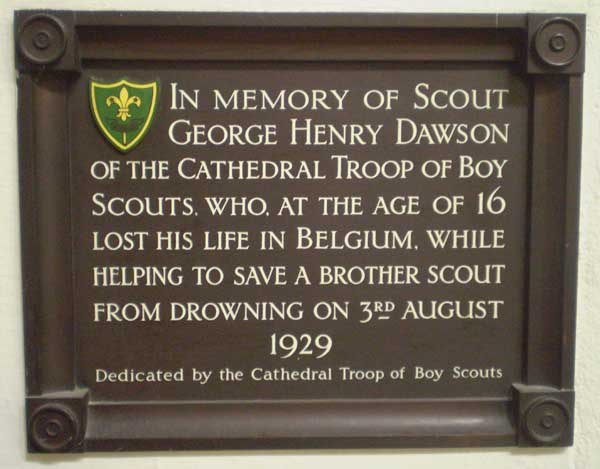
A plaque to be found in Chelmsford Cathedral.
Perhaps more remarkable is that a year prior to his death in the summer of 1928 he had rescued a young boy from drowning at Chelmsford, when, during a period of warm weather the boy had been playing near the water and had fallen in. Dawson had jumped in and pulled him to the river bank. He walked home and when asked why his clothes were wet said "I've just saved a boy from drowning".
I would like to thank Dr Johnnie Shipley for the photograph of P/O Norman Dawson and for copies of Forms AM1180 and AM78 used in creating this webpage.