Whitley T4212 at Topcliffe airfield.
At 00.25hrs on 31st July 1941 this 77 Squadron aircraft took off from Topcliffe with the crew detailed to fly an operational flight to Boulogne, as it left the
ground it failed to climb away, stalled and crashed close to the airfield (possibly on the airfield bomb dump) and caught fire. The crew escaped serious injury.
Pilot - P/O Douglas Iveson RAFVR (86384), of Sculcoates, Yorkshire.
? - Sgt W G Carter.
? - Sgt Lloyd.
Wireless Operator / Air Gunner - Sgt Ernest Wilson Burgess RAF (978860).
? - Sgt Morgan.
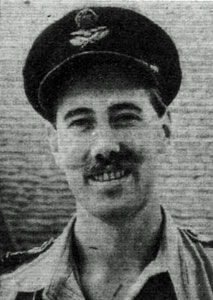
Bill Chorley reports in his superb Bomber Command losses book for the period that Douglas Iveson (picture found in Flight Magazine) was later
posted to and commanded 76 Squadron, he continued his RAF service in the Post-War period and flew Victor's with 10 Squadron in the 1950's. Further
research by myself yields that Douglas "Hank" Iveson was commissioned on 5th October 1940 and then rose to F/O on 29th September 1941. He was awarded the
DFC for service with 76 Squadron (Gazetted on 29th May 1942) as Acting S/Ldr. The citation reads..
"This officer has completed many successful sorties including two daylight attacks on Brest. During one of his night sorties, in full moonlight,
he was attacked by an enemy fighter but, by his skilful evasive action, his rear gunner was enabled to destroy the attacker. One night in April
1942, Squadron Leader Iveson was the captain of an aircraft detailed to attack the German naval base at Trondheim. He completed this mission,
despite intense anti-aircraft fire and a very light sky. After dropping his bombs, he remained over the target area for some time
in order to divert the fire from aircraft which were still attacking. He has displayed courage and keenness of an exceptionally high standard."
He was also awarded the Bar to the DFC (Gazetted on 11th June 1943) as Acting S/Ldr, the Citation reads..
"This officer has completed a long and sucessful tour of operations. He took part in the daylight raids against the German battle cruisers at
Brest in December 1941, and was awarded the D.F.C. for his part in the attack on the enemy naval base at Trondheim in April 1942. Since then
S/Ldr Iveson has taken part in numerous sorties over targets in Germany and the Middle East. On one occasion he skilfully led a section in
a daylight raid on Heraklion, and after securing excellent photographs withdrew without his aircraft having sustained any serious damage. On
another occasion he made a successful low-level attack en gun emplacements."
He was awarded the DSO (Gazetted on 1st September 1944 also for service with 76 Squadron. The Citation reads.. "This officer is an outstanding
squadron commander
whose magnificent leadership, great courage and zeal have inspired all. Since being awarded a Bar to the Distinguished Flying Cross, Wing Commander
Iveson has completed many Bombing missions against dangerous and difficult targets and the successes obtained reflect the greatest credit on the
skill and resolution of this officer. He has rendered much loyal and devoted service."
Post-War he remained in the RAF and was then made W/C on 1st July 1952 (and was Chief Instructor with 232 OCU in April 1956) and G/C on 1st July
1959. He also took command at Waddington and flew Vulcans from there in 1958. He died in 1986.
He later received his commission to the rank of P/O on probation (emergency) on 14th January 1944 (154990) and was promoted to F/O (war subs) on 14th July 1944.
Ernest Burgess was born on Vancouver, Canada and was living in Montreal when he enlisted into the RAF in February 1941. Sgt Burgess joined 77
Squadron on 19th May 1941 and was awarded the DFM (Gazetted on 15th January 1942) for service with 77 Squadron, the Citation reads.."Sgt Burgess
is a wireless operator-air gunner who has done consistently good work. On many occasions his skill has been the deciding factor in the safe return
of his aircraft to base. Sgt. Burgess has shown devotion to duty of a high order in very difficult conditions."
Whitley T4212 was built to contract 38599/39 by Armstrong Whitworth Ltd, at Baginton and was awaiting collection on 10th September 1940, it was
taken on
charge by 77 Squadron at Topcliffe later the same month. Following a landing accident on 17th November 1940 Cat.M/FB damage was recorded (this
incident is detailed on this website) and the aircraft was repaired on site by a team from Armstrong Whitworth Ltd and returned to the unit on
completion of the repairs. As a result of the damage sustained on take off on 31st July 1941 it was written off, Cat.W damage being recorded.