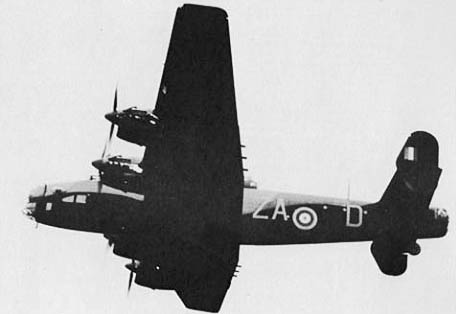
Halifax R9368 at Sherburn in Elmet airfield.
On 18th December 1941 10 Squadron received operational orders to bomb the German battleships Scharnhorst and Gneisenau in dry dock at Brest and to land at Boscombe Down on their return to England. The raid was a daylight one made during the morning. This aircraft took off at 09.19hrs and was over the target at 12.36hrs, dropping their load from 15,000 feet. The crew reported the flak as intense and a few minor holes cause by pieces of flak entering the fuselage were sustained. This aircraft was one of five of 10 Squadron's Halifaxes that landed at Boscombe Down and this landed there at 14.00hrs. On 19th December 1941 this aircraft was one of the five flying back to Leeming when poor weather was encountered. This aircraft landed at Sherburn in Elmet at 15.26hrs but the main undercarriage legs were not fully lowered. On touching down the undercarriage legs collapsed and the aircraft was slightly damaged.
Pilot - F/Lt George Eric Miller RAAF (402248).
Second Pilot - Sgt William Joseph Walter Wiseman RAFVR (1375338),
Observer - P/O Peter John Jagoe Roberts RAFVR (68129).
Wireless Operator / Air Gunner - Sgt John Brayshay Ryder RAFVR (1064072).
Air Gunner - Sgt William Jeremiah Porritt RCAF (R/58432).
Air Gunner - Sgt Brendan Curran RAF (548260).
Flight Engineer - Sgt Frederick Jack Wood RAFVR (1469413).
Peter Roberts received a commission to the rank of P/O on probation on 16th March 1941 and was promoted to F/O on 16th March 1942 and to F/Lt while a PoW on 16th March 1943.
Of those listed above Miller, Roberts, Ryder and Curran were flying together on 27th April 1942 in Halifax W1037 on Ops to bomb the German battleship Tirpitz moored in Norway.
The aircraft was badly damaged by gun fire at the time of dropping their bomb load and a wing caught fire. F/Lt Miller ditched the aircraft in a Fjord, sadly two of the crew died
but all five listed above survived and became PoW's.
Sgt William Wiseman was killed on 25th June 1942 when Halifax W1155 crashed at Leeming Bar, Yorkshire. He was twenty six years old and is buried in Ripon Cemetery.
William Porritt was awarded the DFM at the end of May 1942, the citation reads.. "As an air gunner, F/Sgt Porritt has displayed great skill and coolness in combat. During a daylight attack on the German battle cruisers Scharnhorst and Gnehenau, his aircraft was attacked by four Messerschmttt 109's. Using his guns most effectively, F/Sgt Porritt shot down one of the attackers in flames, probably destroyed another, and warded off the remaining two until fighter assistance arrived. In the encounter F/Sgt Porritt was wounded in the face and arms. One morning in May 1942, whilst returning from an operation over Germany, he engaged a Messerschmitt 109 from close range. Following a well-directed burst of fire, the enemy aircraft was observed to plunge vertically towards the ground, where, a few seconds later, it apparently burst into flames. On both these occasions this airman undoubtedly saved his aircraft from destruction." F/Sgt Porritt was killed flying in Halifax W7679 (on detachment from 10 Squadron to 10/227 Squadron) on 6th September 1942 on Ops to bomb Heraklion airfield, Crete. He is buried in Suda Bay War Cemetery, Crete.
Sgt Wood was posted into 10 Squadron in November 1941. He was part of the 10 Squadron group that flew to North Africa and joined 10/227 Squadron. He later flew with 462 Squadron in North Africa.
Halifax R9368 was built to contract 692649/37 by Handley Page Ltd. at Radlett and was taken on charge by 10 Squadron at Leeming on 29th October 1941. As a result of landing at Sherburn in Elmet with the wheels up on 19th December 1941 Cat.B/FA damage was the damage assessment. It was taken away for a repair in works by Handley Page on 31st December 1941 and on completion of repair it was taken on charge again by 10 Squadron on 12th March 1942. It was transferred to 1652 Conversion Flight at Marston Moor on 16th March 1942 and then quickly transferred to 78 Squadron at Croft on 17th April 1942. It was then transferred to the newly formed 405 Squadron Conversion Flight at Pocklington on 25th April 1942 and on 7th August 1942 it moved with this unit to Topcliffe. On 7th October 1942 405 Squadron Conversion Flight was absorbed into the newly formed 1659 Heavy Conversion Unit at Leeming. On 19th January 1943 it was in need of a repair in works by Handley Page but returned to 1659 H.C.U. once complete. The aircraft then moved back to Topcliffe with this unit on 14th March 1943. On 22nd March 1944 it burst a tyre on take off from Riccall, on landing the aircraft swung off the runway and the undercarriage collapsed. Cat.E2/FA damage was the damage assessment. It was struck off charge on 5th April 1944.