Spitfire R6986 at Driffield airfield.
On 15th April 1941 this 485 Squadron aircraft hit a Chance light on landing at Driffield airfield and was slightly damaged.
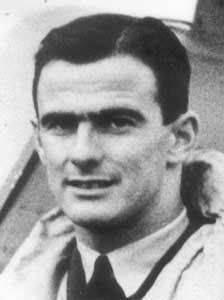
Pilot - P/O Edward Preston Wells RNZAF (58786), of Cambridge, New Zealand.
Edward Wells joined the RNZAF in October 1938 and was accepted in mid-April 1939 but was not called up until 26th October 1939. On 20th
November begun his pilot training which was completed in New Zealand on 15th January 1940. He sailed for Britain on 7th June 1940 and first
passed through 7 OTU at Hawarden on 4th August to convert to flying Spitfires. He joined 266 Squadron on the 26th August 1940 and was posted
to 41 Squadron on 2nd October 1940. He claimed his first enemy aircraft destroyed on 17th October 1940, and was the first British-based fighter
pilot to engage the Italian aircraft over the Channel on 11th October 1940, damaging a CR42 and probably destroyed a Hs126. He joined 485 Squadron
on its formation in March 1941 and scored the squadron's first victory on 5th July 1941. He was awarded the DFC, Gazetted on 7th August 1941 for
"the greatest courage and determination" and later the Bar to the DFC, Gazetted on 6th November 1941. He took command of 485 Squadron on 22nd
November 1941. On 5th May 1942 he was made Acting Wing Commander and soon after left 485 Squadron. He was awarded the DSO, Gazetted on 28th July 1942
for "courage and inspiring leadership" and was posted back to New Zealand. He returned to the UK on 4th April 1943 and attended a course at RAF
Staff College, after which he again took a number of desk jobs. He scored many victories in his career and was undoubtably a very fine pilot.
The RAF's most successful fighter pilot of the Second World War, Johnnie Johnson, considered him the "complete Wing Leader and the finest shot
and most accurate marksman in Fighter Command". After the War he transferred to the RAF and commanded the radar station at Bawdsey before retiring in June 1960 as Group Captain. He died in November 2005.
Edward Wells' life is well documented on the internet and although uncredited much of this research is no-doubt down to the efforts of Errol Martin.
Spitfire R6986 was built to contract B.19713/39 by Vickers Armstrong's (Supermarine) Ltd. at Woolston and was first test flown on 20th July 1940. It had a long service history. It was flown out on the same day to 6 MU at Brize Norton for preparation for issue to a squadron. On 28th July 1940 it was taken on charge by 609 Squadron at Middle Wallop and coded "PR-S". During the Battle of Britain on 25th August 1940 while operating out of Warmwell it was engaged by enemy aircraft over Swanage at 17.30hrs and was badly damaged by cannon fire from a Bf110. The then pilot made a flapless landing at Warmwell but over ran runway and it was further damaged. The pilot was one F/O Ostaszewski who was slightly injured in the arm (he was the pilot Spitfire R6699 that was damaged in September 1940 and ironically sustained damage in Yorkshire the day before R6986 was damaged at Driffield). After this incident at Warmwell to R6986 Cat.B/FB damage was recorded and it was inspected on 5th September 1940 by 50 MU from Cowley and prepared for transportation to a repair centre. Four days later it arrived at 1 CRU at Cowley for repair. The repair took two months and on 13th November 1940 on completion of the repair it was sent to 24 MU at Ternhill. On 24th November 1940 it was taken on charge by 611 Squadron at Rochford, on 27th January 1941 it moved with this unit to Hornchurch. On 14th March 1941 it transferred to the newly formed 485 Squadron RNZAF at Driffield and after this mishap there on 15th April 1941 Cat R(b)/FA damage was recorded. It was taken away to be repaired in works and on 20th April 1941 it was transported to Scottish Aviation Ltd. at Prestwick for repair. On 9th June 1941 on completion of the repair it passed into the hands of 45 MU at Kinloss then on 18th July 1941 it was taken on charge by 131 Squadron at Catterick. On 16th August 1941 it moved with this unit to Ternhill but on 17th August 1941 it suffered engine failure and crash landed in a field at the side of Ternhill airfield, Cat.B/FA damage was recorded and it was transported to Westland Aircraft Co. Ltd. at Yeovil for repair on 24th August 1941. On 11th December 1941 on completion of these repairs it was flown to 37 MU at Burtonwood. On 18th February 1942 it was taken on charge by 1 PRU at Benson, then transferred to 8 OTU at Fraserburgh on 19th June 1942 ( this was the PRU OTU but it was almost certainly still operating out of Benson as on 26th June 1942 the undercarriage collapsed on landing at Detling and Cat.A(c)/FA damage was recorded. Repair was started on site but on 29th June 1942 it was re-assessed as Cat.B and allocated for repair in works and was transported to Heston Airtcarft Ltd. at Heston on 13th July 1942. On 5th September 1942 it was awaiting collection and two days later was flown to 33 MU at Lyneham (and placed into staorage). On 1st October 1942 it was again taken on charge by 8 OTU at Fraserburgh and appears to have had a long spell with them. On 9th February 1944 it was flown to 6 MU at Brize Norton for storage and on 26th May 1944 it was taken on charge by 53 OTU at Kirton in Lindsey but was flown to 8 MU at Little Rissington on 24th August 1944 for storage. On 27th February 1945 it was flown to AST Ltd. at Hamble for assessment and on 6th March 1945 it was struck off charge and broken up to be returned to produce. A sad end to an aircraft that flew from the Battle of Britain to virtually the end of the War.