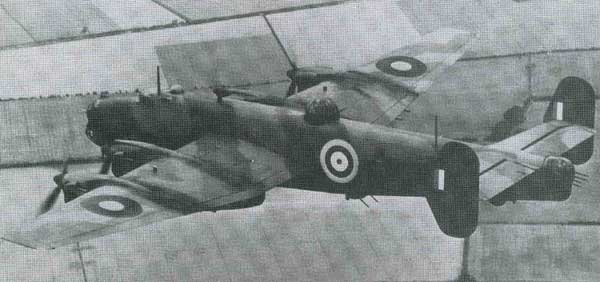
Halifax L9487 at Baldersby St.James.
Pictured above is Halifax L9485; the first production Halifax and the sister to L9487. L9485 was used to trial different turrets and as is
shown in the photograph above it was very well armed. L9487 was only the third production Halifax ever built.
This incident was the first Halifax accident in Yorkshire and there would be well over 1000 Halifaxes to crash in the County with all too many fatalities.
In the course of these
webpages I intend to detail each and everyone in tribute and respect of the young men, and a handful of women, who lost their lives in the Halifax type. The
Lancaster took much of the glory for Bomber Command but it was the Halifax that was the RAF's main work-horse and the type most widely used bomber in Yorkshire.
Ironically the last Halifax accident to occur in Yorkshire was at Baldersby, less than a mile from this, the first. Halifax L9487's loss was almost certainly
the first of many thousand fatal Halifax flying accidents. An AIB investigation was carried out following the accident, although rare this is understandable, it
was found during my research in the National Archives and has been drawn upon for compiling this webpage. As will eventually be seen on this website, not all
Halifax accidents are covered in as much detail and very little being known about a great number of these accidents.
On 13th January 1941 this brand-new aircraft was being given a fuel consumption test by 35 Squadron and carried a mixed crew but all were opertaionally experienced and qualified
to carry out the test. They were to carry out the test at 12,000ft at which they were to cruise at that height for an hour and measure the fuel consumption. The
aircraft took off from Linton on Ouse at 11.20hrs and climbed away. About half an hour later the aircraft was seen near Dishforth at around 3,000ft with the port
undercarriage down and a trail of vapour behind the port side of the aircraft. One of the port engines was also seen not to be working. The vapour then ignited
(probably as a result of being ignited by an engine exhaust flame) and a large fire was seen on the port side of the aircraft after which the aircraft entered
a steep dive before crashing from 2,500ft near Baldersby St. James, between Thirsk and Dishforth at 11.53hrs. All the airmen on board were sadly killed instantly.
The fire was thought to have burnt away the aircraft's tail control surfaces making the aircraft become uncontrollable. The crew were found to have all been
wearing their parachutes and all were probably preparing to bale out when the aircraft entered the spiralling dive and as a result they were unable to get out.
The cause of the fire was blamed on the failure of groundcrew at Linton on Ouse to put the fuel-filler cap back on one of the port fuel tanks after it had been
refuelled. The
vapour seen behind the port wing would also certainly have been fuel, which, by the time it ignited had soaked into the tail section of the aircraft. Also of note
is that the port outer engine had been suffering trouble since its delivery. It suffered a coolant leak on 3rd December 1940 which resulted in a new radiator being
fitted and then the same engine showed low oil pressure, it was run-up on 24th December 1940 and a new oil relief valve had to be fitted. Following the crash all the
engines were removed and taken away for inspection and this engine was found to have suffered an oil shortage in the air prior to the crash, part of the crankshaft
had broken causing the failure of the engine. Further investigation of other early Halifax's found that this was a design problem with early Halifax's. When full
of fuel and in a tail-down position the oil pumps on the outer engines were above the oil level. This oil system was later changed to stop the problem re-occurring.
Why the undercarriage had dropped or been lowered is not known.
35 Squadron were the first unit to became operational with the Halifax and they flew their first operational flight on 10th March 1941 to Le Havre. On this raid
they lost the first Halifax in an operational flight when L9489 was shot down by friendly fire by a British night-fighter having mis-identified it over Southern England.
Four of the crew were sadly killed.
Halifax L9487 was built to contract 692649/37 by Handley Page Ltd and first flown on in October 1940, it was allotted to 24 MU on 29th October 1940 and was received by them on 27th November 1940. The aircraft was then taken on charge by 35 Squadron at Linton on Ouse on 4th January 1941. Its total flying time upto the crash was less than four hours. Linton on Ouse O.R.B. makes reference to this accident and stated that an "aircraft of 35 Squadron took off at 11.20hrs on climb and consumption test. 30 minutes later was seen to be in trouble just north of Dishforth, with smoke coming from the port inner engine. Aircraft lost height and dived into the ground at an acute angle and caught fire. 6 killed." Air historians Albert Pritchard, Eric Barton and Ken Reast located small fragments on the surface at the crash site in 1997 with permission from the landowner, confirming the crash location.
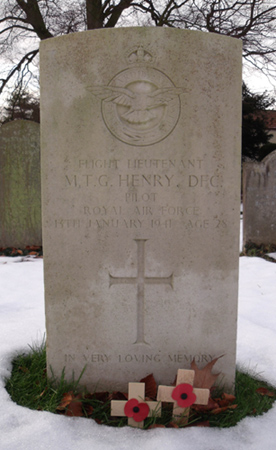
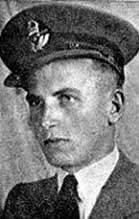
Pilot - F/Lt Michael Thomas Gibson Henry DFC RAF (39876), aged 28, of Compton Chamberlayne, Wiltshire. Buried Roecliffe Churchyard, Boroughbridge, Yorkshire.
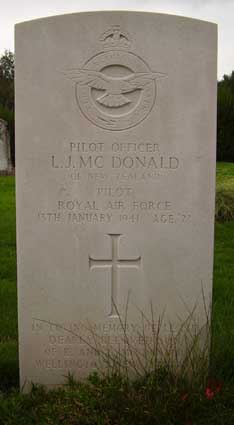
Second Pilot - P/O Leslie Joseph McDonald RAFVR (79513), aged 23, of Karori, Wellington, New Zealand. Buried Dishforth Cemetery, Yorkshire.
Observer - Sgt John Napier Hall RAFVR (743002), aged ? Buried Stoke (St. Michael) Cemetery, Warwickshire.
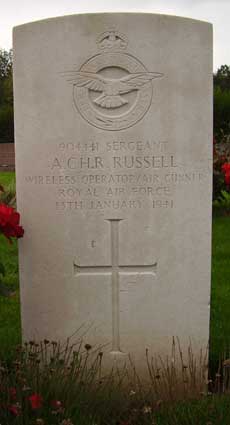
Wireless Operator / Air Gunner - Sgt Anthony Charles Henry Reid Russell RAF (904441), aged 22, of Wandsworth, London. Buried Dishforth Cemetery, Yorkshire.
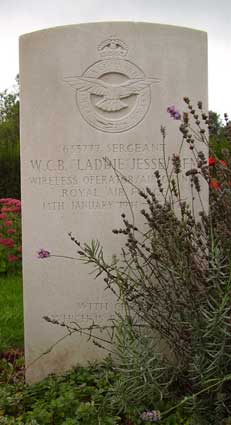
Wireless Operator / Air Gunner - Sgt William Charles Browne Jesse RAF DFM (633777), aged 22, of Dublin, Irish Republic. Buried Dishforth Cemetery, Yorkshire.
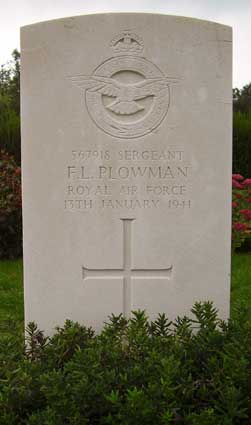
Flight Engineer - Sgt Francis Leslie Plowman RAF (567918), aged 21, of Doncaster, Yorkshire. Buried Dishforth Cemetery, Yorkshire.
F/Lt Henry's grave at Roecliffe Churchyard, Yorkshire on a snowy day. Michael Henry was born in Birkenhead, Cheshire in 1912 and had attended Sedbergh School from 1926 to 1930. He was granted a permanent Commission into the RAF as Acting P/O on Probation on 20th July 1937 and gained his RAF Wings in October 1937. He was promoted to F/O on 10th December 1939 and then a F/Lt on 10th December 1940. His DFC was Gazetted on 30th July 1940 but no Citation for this award has been found as yet but was almost certainly for service in completing a Tour with 10 Squadron. Clearly this aircraft type was new and F/Lt Henry had undertaken only eight hours solo flying on the Halifax at the time of the crash. He was however a very experience pilot on Whitley's, with 700 hours total solo flying on the Whitley aside from his Halifax hours. He had also flown afew hours on the Stirling. In the AIB report it decribes him as "a distinguished and capable officer" Why he is buried at Roecliffe is not known, only a few miles from his crew at Dishforth. He had married to Elizabeth Marion Ward in August 1939 in the Thirsk area and I speculate that he was living with his wife in the Roecliffe area at the time of his death. At the time of his death his parents were living in Wiltshire but given he had been away at boarding school and then joined the RAF it is doubtful if he would have refered to himself as being from the Wiltshire area.
Les McDonald and his gravestone at Dishforth Cemetery. At the time of his death he had completed 28 Operational trips.
Three of the other crew's gravestones at Dishforth Cemetery, Yorkshire.
Sgt Jesse's DFM was Gazetted on 22nd November 1940 for service with 58 Squadron but no citation has yet been found for the award. His birth was registered in Wandsworth, London in 1918.
Francis Plowman was born in Doncaster, Yorkshire in 1919.
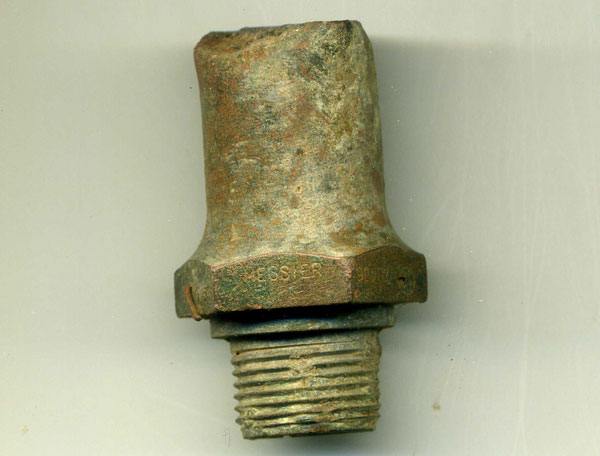
The crash site was located and some fragments of the aircraft found on the surface of the field by historians Ken Reast, Albert Pritchard and Eric Barton in 1997.
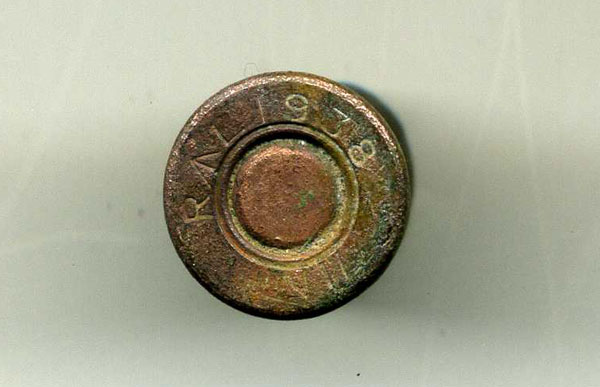
Two items retained by Eric Barton. The above item is from the Messier system that the Halifax used and below is the remains of a .303 case showing 35 Squadron were still using old stock ammunition in 1941.