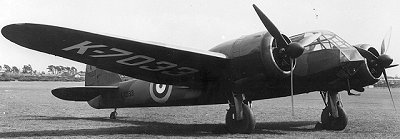
Blenheim K7132 near Ackworth, Pontefract.
On the night of 24th / 25th April 1941 54 Operational Training Unit had a number of aircraft in the air undertaking training flights and it is believed that the pilot of this aircraft was undertaking one such night flying training flight when, at 23.31hrs, he was attacked by an enemy aircraft. The Blenheim was struck around the port engine which was badly damaged and caught fire, the port fuel tank also appeared to have burst. The pilot abandoned the aircraft in the region of Ackworth, between Pontefract and Barnsley and he escaped serious injury. When this webpage was last updated the precise location of where the aircraft came down is not known, Ackworth is suggested, as is Skellow near Doncaster, however Church Fenton's ORB entry for this incident gives a map reference which plots to the area of Moorthorpe Common, near South Elmsall, and some three miles west of Skellow. The identity of who shot the aircraft down was probably 2/NJG2 pilot Fw Geisshubel.
Pilot - F/Lt Richard Warren Denison RAF (37596).
His brother P/O Arthur Cecil Denison RAF (42206)was reported as missing flying with 57 Squadron on 2nd September 1940 (and commemorated
on the Runnymede Memorial) and his father Major Herbert Richard Denison had been a pilot in WW1.
Richard Denison was born in Knightsbridge, London in 1916 but he had moved to Canada at a young age to live in Vernon, British Colombia.
He was appointed to a short service commission in the RAF as Acting P/O on probation on 2nd March 1936. As Acting P/O he was posted to 23
Squadron on 20th December 1936 based at Biggin Hill and was graded as P/O on 6th January 1937. He was then posted to 213 Squadron in March
1937. He was promoted to F/O on 6th January 1938. He was serving with 236 Squadron at the start of the Battle of Britain and after the death
of the commanding officer he was promoted to take temporary command of the squadron. He left 236 Squadron after the Battle of Britain having
been promoted to F/Lt on 6th August 1940. He was Mentioned in Despatches on 1st January 1941 for service with 236 Squadron and was promoted
to S/Ldr (temp) on 9th September 1941. Under the terms of his commission he transferred to the Reserve (RAFO) and was called up for air force
service on 6th January 1942. After a series of non-operational postings he was eventually posted to command 80 Squadron in the Western Desert
from April to September 1942. He was promoted from S/Ldr (temp) to S/Ldr (war subs) on 8th July 1943 and then served with 26 AACU in the same
Theatre of War from September 1942 until June 1944. He served briefly with 46 Squadron before taking a posting back to Canada to be a pilot with
the Trans-Canada Air Lines. He was Mentioned in Despatches again on 14th January 1944 then promoted to W/Co (temp) on 1st January 1945. As W/Co
he was awarded the AFC, Gazetted on 1st January 1945 for service with 26 AACU. PostWar he remained in the RAFO until resigning his commission on
5th August 1948 retaining his rank of W/Co. He later flew with the Canadian Pacific Airlines and Yellowknife Airways but was sadly killed in a flying
accident on 6th February 1951.
Blenheim K7132 was built to contract 43506/35 as a bomber version by The Bristol Aeroplane Compnay Ltd. at Filton and was awaiting collection
in December 1937. It was taken on charge by 44 Squadron on 17th December 1937 and based at Waddington. On 6th March 1939 it transferred to 139
Squadron at Wyton then on 11th September 1939 it was flown to 19 MU at St.Athan (ASU) where conversion to a MkIf status took place. On 24th
November 1939 it was taken on charge by 254 Squadron based at Stradishall and on 9th December 1939 it moved with the unit to Sutton Bridge.
On 23rd January 1940 Cat.M/FA damage was recorded when the undercarriage collapsed in a heavy landing at Sutton Bridge. It was repaired on site and
on completion of the repair, on 6th March 1940 it was transferred to 235 Squadron based at North Coates, this unit moved to Bircham Newton on 25th
April 1940 and it moved with them, then also to Detling on 26th May 1940 before transfer to 236 Squadron at Filton on 31st May 1940. On 12th June
1940 it was flown to 19 MU at St.Athan for storage where it remained throughout the Battle of Britain. On 22nd December 1940 it was taken on charge
by 54 OTU at Church Fenton and following the incident recorded above near Ackworth in April 1941 Cat.E2/FB(burnt) damage was recorded.