Hurricane L2002 near Bolton Percy.
The pilot's AIR81 casualty file is very detailed. The investigation and subsequent recommendations lay the blame for the accident on the Station Commanding Officer at Church Fenton and that he be removed from his post with immediate effect. The highly experienced officer was transferred to an administrative post.
242 Squadron had formed at the end of October 1939 and initially flew Blenheims but exchanged them for Hurricanes in January and February 1940. Poor winter weather effected conversion training so effectively 242 Squadron was not at an operational status until their pilots were fully trained on flying the Hurricane aircraft. No.13 Group who controlled Fighter Command in Northern England appear to have wanted all squadrons that were effectively only training squadrons to be at operational status without delay. Day training was well under way in late-February 1940 but night flying training was going less well with there being very little in the way of night flights made. On 1st March 1940 a senior officer from No.13 Group visited Church Fenton to review the progress of squadron training, to observer a full night flying training programme and also to give instructions from the A.O.C. of No.13 Group to the Station Commander of Church Fenton airfield to take every precaution and give every possible aid to night flying that was considered necessary and also to supervise the night flying training.
four pilots each carrying out the exercise for a period of an hour between 03.00 and 04.00hrs, then four different pilots flying between 04.30 and 05.30hrs, and a final four pilots between 06.00 and 07.00hrs. Each group of four pilots flew their circuit at different heights.
L2002 is "-O"
The night flying exercise on the night of 1st / 2nd March 1940 took place without incident with some lesser experienced pilot's carrying out a series of circuits and landings flights. This comprised of each aircraft making a west-east take-offs, then turning to fly a circuit of the airfield and to land and continue this routine until the order to stop the exercise was given. In addition to the regular flares used on the airfield approach and airfield to aid the lesser experienced pilots in learning to fly at night it was common practice to light a number of searchlights, light beacons or collections of parafin flares around the general area of the airfield to give the pilots some form of ground reference points. This was done on on 1st / 2nd March 1940 but the only flares that were lit off the area of the airfield were two sets of flares located three miles from the south-western corner and three miles from the south-eastern corner of the airfield and a light beacon roughly three miles east of the airfield. No additional lighting was supplied or available across the northern side of the airfield other than the lights on the runway.
The pilots who undertook the training programme completed the exercises without incident and while none directly complained about the positioning and number of external ground lighting features some later expressed
Flare lights were placed in searchlight sites at points around three miles south-east and three miles south-west of the airfield as well as a flashing beacon light south of the airfield to give the pilots some form of ground reference. P/O Henry Niccolls was not part of this training exercise on this night. The No.13 Group officer left during the morning of 2nd March 1940. On the evening of 2nd March 1940 P/O Niccolls was included on a programme of dusk landings, all his circuits and landings were recorded as being very satisfactory with his final landing being made in almost total darkness. Which direction around the airfield the circuit was isn't known but with some form of normal daytime ground reference available to the pilots any night lighting wouldn't be a major factor in the training. I presume the direction of the circuit changed between the night of 1st/2nd March and the night of 2nd/3rd March, with the southern / clockwise circuit on the 1st/2nd changing due to wind direction on the 2nd/3rd making it a northern / anticlockwise circuit.
After these dusk landings had finished the commanding officer of 242 Squadron had a discussion with the higher ranked airfield's commanding officer with regard the airfield lighting not complying with the instructions for night flying from No.13 Group that were received the previous day. He asked for further airfield lighting to assist his less experienced pilots with further ground reference points. The flare points were again used on the two southern corners of the airfield but because no pilots had any problems or complained of there being any difficulties with the lighting from the previous night the base commanding officer refused to accept any other flares needed to be lit.
some hanger obstruction lights were lit but this appears to have been in way of a compromise
Two further searchlight sites three miles off the north-east and north-west sides of the airfield existed but neither their flares or searchlights were in use.
242 Sqn co did not know that the flares on the northern corners of the airfield were not lit and he later stated that had he known that he would not have allowed his junior pilots in to the air.
The night flying exercise
In the early hours of 3rd March 1940 a number of the lesser experienced pilots of 242 Squadron were to undertake night flying training exercises as part of getting the squadron from a training squadron to be a fully operational fighter squadron.
aircraft was to have been undertaking a night training flight with other inexperienced pilots
took off and climb away from the flare path, he then made a turn to the north to begin to fly an anti-clockwise circuit of the airfield. It was thought that instead of using his cockpit instruments to climb to a safe height, making a turn using his instruments and then switching to looking out of the aircraft to use the visual lighting he took off and climbed away and then turned to the north but stopped using his instruments to look out of the cockpit and to try and fly using the airfield lighting as his ground reference.
look back at aerodrome lights after taking off
he lost sight of any airfield lighting but hadn't realised that the aircraft was
flares were placed at searchlight sights three miles out from the corner of each side of the airfield
when the aircraft flew into the ground near Bolton Percy, to the south of Tadcaster, at 05.10hrs. Sadly the Canadian pilot lost his life as a result of the accident which was his first solo flight at night in a Hurricane who had not flown at night for two months since .
junior pilots undertook night flying training on the night of 1st March 1940 under the supervision of W/Co Ryhs Jones of HQ 13 group
niccolls had 17.15hrs Hurricane day flying
zero night
night flying on the night of 2nd/3rd Niccolls was to Niccolls to undertake his first night solo flight in a Hurricane
prior to this exercise being started the CO of 242 Sqn asked the CO of CF for the external lighting to comply with that approved by the AOC of No.13 Group for training squadrons. W/c considered that no further lighting was necessary although it was agreed that some airfield obstruction lights could be left on.
took off at about 04.50hrs on the west-east runway, climbed normally to around 500 feet and then began a turn to the left, at the same time began to loose height
pilot did not fly using instruments to a sufficient height after taking off and before turning.
no lighting aids existed on the northern end / left hand side of the take off and climb. This was deemed the direct cause of the accident as the pilot had no guidance by external lighting, had he had this he would not have continued his shallow dive into the ground
Only lighting aids were placed on the south side of the airfield / right hand circuit from the take off runway, this was in the guise of two groups of flares (at two search light sites on the SE and SW side of the airfield and one flashing beacon.
A detailed crash investigation followed
lighting was only any use to flying a right hand circuit
Richardson then disputed the outcome of
based on way the CoI ha\d found him at fault and the way the evidence was submitted.
which was rejected
242 Sqn officer in charge queried the lighting
a major problem with the airfield lighting and night flying visual aids. It was damming of the station commander in that he had a "complete disregard of the essential principles of night flying training." It was said that a weather test by a far more experienced pilot should have been carried out who would then have realised the problem with the visual aids.
He was also requested by a No.13 Group order to be present and supervise the night flying
"shown himself unfitted to command a Fighter Station in War". ACM Dowding.
W/Co George Thomas Richardson 04190 was transferred to an administrative post
Hurricane L2002 was built to contract 527112/36 by Hawker Aircraft Ltd at Kingston and was awaiting collection in May 1939. It was delivered to 56 Squadron based
at North Weald on 19th June 1939 and then moved with the unit to Martlesham Heath on 22nd October 1939. It then allotted to 242 Squadron on 27th January 1940 but was not flown to them at Church Fenton until 12th February 1940. 242 Squadron was converting from Blenheim MkIf's to Hurricane MkI's at that time. Following the incident on 3rd March 1940 Cat.W/FA damage was recorded and the aircraft written off.
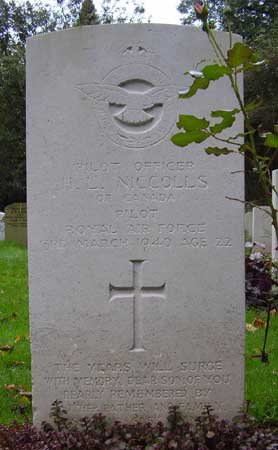
Pilot - P/O Henry Leslie Niccolls RAF (42145), aged 22, of Rosetown, Saskatchewan, Canada. Buried Kirkby Wharfe Cemetery, Yorkshire.
Henry Niccolls was born in Rosetown, Saskatchewan, Canada in 1917 and is believed to have enlisted in March 1939. He received a commission to the rank of Acting P/O on probation on 13th May 1939 and was later graded as P/O on probation on 6th November 1939. On the same date he was posted to 242 Squadron just a week after it's formation at Church Fenton. At that time 242 Squadron did not have any aircraft but over the coming weeks they took charge of a few Blenheims. Henry managed to gain just over nine hours flying experience in the Blenheim type before 242 Squadron exchanged for Hurricanes. All of 242 Squadron's pilot began conversion to fly the Hurricane type in January and February 1940 apart from P/O Niccolls who, it was stated in the squadron records, was sick. He had managed 17.15hrs flying by day in the Hurricane type up until the end of the dusk landing exercise on 2nd March 1940. The flight in which he was killed was his first night flight in the Hurricane type. His funeral took place at Kirkby Wharfe on 7th March 1940.