Whitley K9022 at Dishforth airfield.
On 3rd March 1940 the crew on board this 10 Squadron aircraft were undertaking a cross-country training flight when the aircraft overshot the flarepath on landing at Dishforth at 21.10hrs. The
aircraft went through the boundary fence, across a road running into a field and came to a halt with the undercarriage collapsed and the airframe damaged.
Pilot - Sgt Walter Stanley Hillary RAF (580022).
Second Pilot - Sgt Leslie Arthur Keast RAF (564740).
Observer - Sgt John Jacob Myers RAF (580910).
Wireless Operator / Air Gunner - LAC Robert Edward Nicholson RAF (611204).
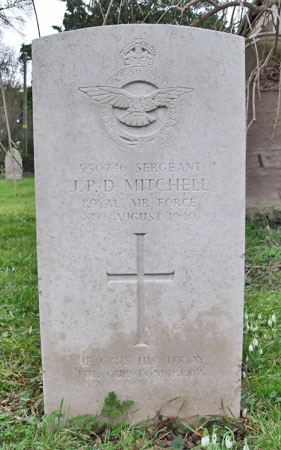
Wireless Operator / Air Gunner - LAC John Patrick D'Arley Mitchell RAF (550746), of West Heslerton, Yorkshire.
"Acting S/Ldr Hillary is a captain of aircraft and a flight commander of outstanding courage and ability. He has been operating continuously since war began,
and has never shown signs of tiredness or waning enthusiasm. He is always eager for any job he undertakes, and never leaves it until it is successfully completed.
When returning from Hanover on one occasion, the port inner engine of S/Ldr Hillary's aircraft failed completely when over the Dutch coast. He remained unperturbed,
set course for the Norfolk coast, and landed safely on three engines."
He was promoted to F/O on an unknown date, to F/Lt (war subs) on 15th December 1941 and to S/Ldr (war subs) on 3rd August 1942. He served in North Africa for pretty
much the rest of the war, he then left the RAF as S/Ldr, retaining his rank of W/Co on 11th August 1946. Post-war he became a civilian pilot first flying around
the Scotish islands before taking up positions with Aer Lingus, East African Airways and in 1952 he joined Sabena flying in the Congo. He worked for Air Congo and
returned to Sabena flying Dakotas around in the Libyan oilfields. He died in December 1995 in Denmark and is buried in Hundested, Denmark. His family also have a
French Croix d'honneur but the background behind the award of this is not yet known though it could relate to some flying fighter aircraft in North Africa. I thank
Mr Nigel Hillary for his contact.
John Mitchell was born in Brighton in 1920 to Capt and Mrs Mitchell but moved to the Rillington area of Yorkshire with his family when he was young. He attended
Rillington School and later Malton Grammar School and joined the RAF at the age of fifteen. He had flown regularly since the outbreak of the war up until around
the end of June 1940 when he contracted a serious illness (currently known). He sadly died in Ilkley of this illness on 8th August 1940 and is buried at Thorpe
Bassett Churchyard, Yorkshire. It is worth pointing out that he is one of my "local" casualties and that he attended the same school as I did. He appears to have
left 10 Squadron just after the incident in May 1940 detailed at the top of this page and his name is not featured in William Chorley's Bomber Command Losses Roll
of Honour book suggesting he was not serving in Bomber Command at the time.
I thank Walter Hillary's son for contacting me in March 2014 and for adding to an earlier biog I have created surrounding his father. Walter Hillary was born in
Lambeth, London in 1917 and had served with 78 Squadron from at least December 1936 flying Heyford, he converted to flying Whitleys with 78 Squadron in July 1939.
He was posted to 10 Squadron on 5th September 1939 and survived flying accidents involving Whitley K9020 at Dishforth on 5th January 1940, Whitley K9022 also at
Dishforth on 3rd March 1940 (detailed above) and Halifax W7816 at Marston Moor on 29th December 1942. For his service with 10 Squadron he was awarded the DFM,
Gazetted on 30th July 1940. He was later posted to 35 Squadron in January 1941 and then to 76 Squadron in May 1941. He left 76 Squadron and trained to become a
flying instructor at the CFS in November 1941. Having received his commission on 2nd January 1941 (with seniority of 4th October 1940) to the rank of P/O on
probation, as Acting S/Ldr he was awarded the DFC for service with 76 Squadron, Gazetted on 30th January 1942, the citation reads..
Leslie Keast trained at 2 FTS at Brize Norton, he passed out of his training here with distinction in June 1938. During the early months of WW2 he was the regular second pilot of F/Sgt Harcourt-Powell at 10 Squadron. He was involved in a number of minor mishaps in 1940. He was sadly killed on 11th June 1940 flying Whitley P4954 which crashed in the Somme region
of France. He was twenty five years old. Sgt Myers was also flying with him on this occasion and was also killed.
Robert Nicholson was awarded the DFM for service with 10 Squadron it was Gazetted on 26th August 1941 but with effect of 19th September 1940. By this date he
was already a PoW as on 1st October 1940 Sgt Nicholson was flying in Whitley T4130 on Ops to Berlin, the aircraft crashed near Badbergen, Germany. Sgt Nicholson
was taken prisoner of war.
Whitley K9022 was built to contract 522438/38 by Armstrong Whitworth Ltd at Baginton and was allocated to 10 Squadron on 13th March 1939. The aircraft was delivered to
10 Squadron based
at Dishforth on 25th March 1939 and subsequently coded "PB-M", this was re-coded as "ZA-M" on outbreak of WW2. Following the incident detailed above Cat.R(b)/FA damage
was recorded and
after inspection by 60 MU from Shipton by Beningborough on 24th March 1940 it was deemed to be repairable. It was then collected by 4 MU at Ruislip (Salvage and repair)
on 2nd April 1940
and transported away the same day to S.S. Cars Ltd at Coventry. (The Jaguar car factory). After a long period in limbo without repair being done
the aircraft was considered not worth repairing and was struck off charge on 18th April 1941.