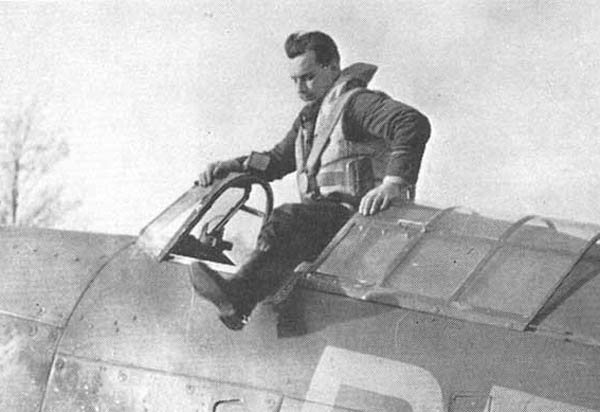
Spitfire K9835 at Catterick airfield.
On 2nd December 1939 this 41 Squadron aircraft was being taxied in a strong wind and rain when the aircraft was unable to stop before it collided with Spitfire L1041, both aircraft suffered slight damage and are believed to have been quickly repaired.
Pilot - F/O Howard Peter Blatchford RCAF (37715), of Edmonton, Alberta, Canada.
Howard "Cowboy" Blatchford was born in Edmonton on Fabruary 1912, he joined the RAF and received his commission to the rank of Acting P/O on probation on
6th January 1937 and was with 41 Squadron when war broke out. He later joined 212 Sqaudron on 20th April 1940, 17 Squadron on 30th September 1940 and
257 Squadron on 4th October 1940 where he became commanding officer in July 1941. He was later posted to 412 Squadron and then to the Coltishall Wing
rising to the rank of W/C. He was awared the DFC (Gazetted on 6th December 1940), the citation reads.."In November 1940 this officer was the leader of
a squadron which destroyed eight and damaged a further five enemy aircraft in one day. In the course of the combat he rammed and damaged a hostile
fighter when his ammunition was expended, and the made two determined head-on feint attacks on enemy fighters which drove them off. He has shown
magnificent leadership and outstanding courage." He was also Mentioned in Despatches in January 1941.
"Cowboy" Blatchford was lost on 3rd May 1943 escorting bombers to Holland, his aircraft, Spitfire EN971, was damaged by enemy aircraft and it is believed that
he ditched the aircraft in the North Sea but his body was never found and he is commemorated on the Runnymede Memorial.
He became famous for being the first Canadian pilot to shot down an enemy aircraft in WW2 on 17th October 1939.
Spitfire K9835 was built to contract 527113/36 by Vickers Armstrong's (Supermarine) Ltd at Woolston and was delivered to 41 Squadron at Catterick on 3rd January 1939. It moved with the unit to Wick on 19th October 1939 and back to Catterick six days later. Following this incident above Cat.M/FA was recorded, it was repaired on site and returned to the unit. It was damaged twice in early 1940, a Cat.U/FA on 2nd January 1940 (as detailed on this website at Thornaby), and a Cat.R/FA incident on 13th February 1940 (also as listed on this website again at Catterick), after the later incident repair was deemed to be beyond unit repair. It was repaired in works and was transported to 4 MU at Ruislip on 26th February 1940 for repair. On completion of repair it went to 6 MU at Brize Norton (ASU) on 9th June 1940 and was then issued to 7 OTU at Hawarden on 17th June 1940. 7 OTU became 57 OTU on 1st November 1940. It suffered a
further Cat.R/FA accident on 10th February 1941 when it suffered engine failure and hit a tree in a forced landing at Llandrillo-yn-Rhos, near Colwyn Bay. From here it was dismantled and removed to Vickers Armstrong's (Supermarine) Ltd at Woolston for repair on 26th February 1941. On completion of repair it was returned to 57 OTU at Hawarden on an unknown date in April 1941. It then suffered a Cat.M/FA accident on 12th April 1941 when the undercarriage collapsed on landing at Sealand. It was repaired on site and returned to the unit on an unknown date but probably did not take long to repair. It suffered a further Cat.R/FA mishap on 8th November 1941 when it was belly landed at Hawarden. Again it was repaired on site by a team from V.A.(Supermarine) Ltd from Woolston and returned to the unit on 13th December 1941. It then transferred to 61 OTU at Rednal on 1st February 1943 and then back to 57 OTU at Eshott on 13th February 1943. It then was involved in another accident, this time Cat.B/FA, on 16th June 1943 although no details are known. On completion of repair it went to 33 MU at Lyneham (ASU) on 3rd October 1943 and was then issued to 58 OTU at Grangemouth on 8th November 1943. It transferred to 1 TEU at Tealing on 26th February 1944 and was struck off charge as a time expired airframe on 22nd August 1944.