On Sunday, 10th February 1935 the pilot who would be flying this aircraft when it crashed at Linthorpe hired it from the owners at Leeming, he and a friend took off from Leeming landing ground and flew in the direction of Middlesbrough where they both lived. The pilot then began to fly very low over the Linthorpe area and the two men were seen to wave at people on the ground. The pilot made a very tight turn and whilst doing so the aircraft lost it's flying speed and side-slipped into the ground. To witnesses on the ground, they stated they thought the aircraft had had engine trouble and the pilot was attempting to make a forced landing on Linthorpe Golf Course. In the resulting crash, in front of the club house, the aircraft cartwheeled and the engine was torn away from the rest of the aircraft. A local doctor, Dr Brownlee, was playing golf at the time and gave first aid to the two until an ambulance arrived and took them to hospital. The pilot's condition being described as "satisfactory", his passenger however was described as "very poorly".
G-AADI was buily by D.H. in 1928 and originally registered on 4th February 1929. At the time of the crash the aircraft was owned by Yorkshire Air Services, of Newton House, Londonderry, Leeming who had bought it in July 1934. It was destroyed as a result of the crash at Linthorpe on 10th February 1935.
Pilot - Mr Herbert Victor Barker, aged 36, of Fairfield Road, Linthorpe, Middlesbrough. Received chest injuries.
Passenger - Mr Freddie Dixon, aged 40, of Cambridge Road, Linthorpe, Middlesbrough. Received head and facial injuries.
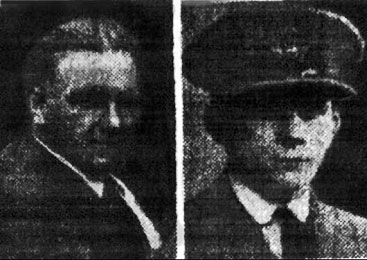
Freddie Dixon (left) and Herbert Baker (right). Photographs found in "The Northern Echo" newspaper. He was a famous motor cycle racer of his day, but gave this up when he reached forty to take up car racing.
Herbert Baker was born on 5th February 1899 in Middlesbrough. In the London Gazette he is listed as having transferred to the RAF when it formed in April 1918 and had probably served with either the RFC or RNAS prior to this. He was wounded on active service two months later in June 1918 and was de-mobed in 1919. The crash report for G-AADI stated that his probable hours of flying during this period were less than 200 hours. He had gained his Royal Aero Club certificate as a member of the RAF on 20th March 1918 (which is technically before the RAF formed). In the 1920s and 1930s did a little flying but although his licence had elapsed in 1924 he continued his reserve training throughout the next ten years. In the week prior to this crash he had visited Leeming and asked the aircraft owners if he could hire the aircraft for the flight in which the crash occurred, when he made his request, he claimed to have over 2000 hours flying, almost certainly not the truth. The crash almost certainly was caused by his inexperience on the aircraft type and that he was too rough with the controls in the final turn before the crash.