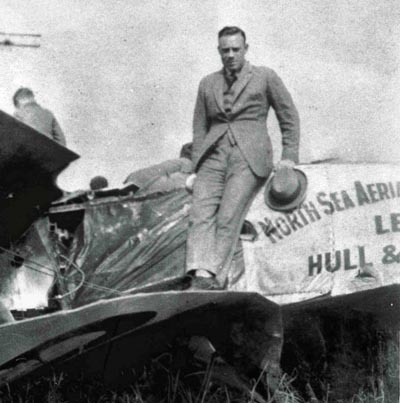
Avro 504K G-EAGV near Scarborough.
On Monday, 2nd August 1920 this aircraft crashed whilst making a forced landing on Oliver's Mount, Scarborough having suffered an engine problem earlier in the flight. The pilot escaped injury but the aircraft was badly damaged, the aircraft was also carrying two passengers at the time of the mishap. The photograph above shows the pilot standing on the wreckage at Scarborough.
This aircraft was built to contract 35a/2053/C2331 by the Humber Motor Company Ltd at Coventry as a military aircraft and given the serial number H6598 but was immediately declared 'surplus to requirements' and sold to The North Sea Aerial Navigation Company Ltd, Leeds on 14th July 1919. It was registered to them as G-EAGV on 31st July 1919 with it's Certificate of Airworthiness being issued on either 16th July 1919 or 2nd August 1919 (these dates vary between two written texts), this was later re-newed in July 1920. It suffered this accident on 3rd August 1920 at Scarborough and was then deemed beyond repair. At the time of the accident it is believed that the aircraft was being operated by Northern Air Transport Ltd based at Brough. The registration was cancelled in September 1920.
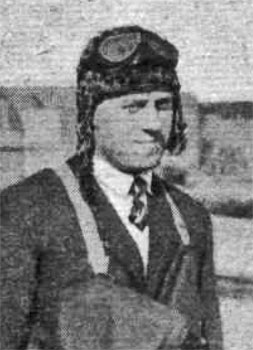
Pilot - Mr Reginald Watson Kenworthy (Blackburn test pilot).
Two Passengers - Names unknown.
Reginald Kenworthy was born at Wakefield, Yorkshire on 13th September 1891. He was working for the Blackburns as far back as 1912, he served as an instructor in the First World War and gained his RAeC certificate (Cert No. 1222) at the Ruffy-Baumann Flying School on 4th May 1915. He later took up the position as Blackburn's test pilot. With this company having its origins in Yorkshire it is likely that he was involved in a number of minor mishaps which have so far gone unrecorded.
In September 1923 he was to fly a Blackburn Pellet registered as G-EBHF, single-engined, single-seat bi-plane flying boat in the 1923 Schneider Trophy contest. The day before the race on 26th September 1923 he was its pilot, when it crashed on its take off run and was badly damaged avoiding a boat which had drifted into its path. Reg Kenworthy escaped serious injury. Flight Magazine recorded the incident it more detail... "The "Pellet" was seen to begin to turn to starboard slowly. The starboard wing tip float touched, and the machine turned over on its nose and sank. For what seemed a very long time there was no sign of the pilot, and fears were entertained that he had not been able to extricate himself. Suddenly, however, he appeared, bobbing up like a cork, and climbing on top of the wreck was picked up by one of the many motor launches which sped to his assistance as soon as the crash occurred. He promptly fainted on getting safely on to the wreckage, but was soon revived and brought back to his hotel, nursed by Mrs Kenworthy, who was in the motor launch Vivid which was among those standing by. He had had quite a marvellous escape, and seemed none the worse for his experience. It was stated that someone actually timed Kenworthy, who was said to have been under water for 61 seconds. He later related how, when the machine turned turtle, he found himself inside the cockpit with his head on the floor and his feet pointing towards the cockpit opening, which he could dimly see. Holding his nose with one hand he wriggled free and shot to the surface. With the Blackburn "Pellet" crashed (she was brought ashore during the night, by the way, and brought back to the Saunders' sheds."
He was elected as a committee member of the Royal Aero Club in May 1925 and he appears to have ceased being Blackburn's test pilot around this date. He also married in 1925 but divorced nine years later. His flying may have come to an abrupt end when, in October 1930, he was accused of conspiring with four Americans to "obtain" some £12,816 of shares from a Mrs Janet de Selincourt (wife of novelist Hugh de Selincourt) which hit the national news at the time. After a length court case he was found not guilty, at this date he was known as Major Kenworthy. He corresponded with Flight Magazine in 1951 but no further details about him are known other than by 1948 he was living in Wimbledon Hill Road, London and he probably died in Surrey in 1968. I would welcome further information to fully document this important person in the early years of powered flight in Yorkshire.
I found this article on the internet regarding Berkshire Aviation Tours and Northern Air Transport and it's copyright allows it to be reproduced here..."The Berkshire Aviation Company specialised in giving people short trips in aeroplanes for a few shillings per head - an activity known as “joyriding”. The firm was probably the most successful of the joyriding concerns which operated between the wars. In its early years it was based at East Hanney which was in North Berkshire at that time, hence the name of the firm. Fred Holmes and his brother, John, were born at East Hanney in a house called “The Mulberries”. When Fred left school he joined A.V. Roe as an apprentice and qualified as a mechanic in time to join the Royal Naval Air Service
at the outbreak of the 1914-18 war. John was commissioned in the Royal Flying Corps two years later and, like Alan Cobham, transferred from the Army
to the RFC in 1917. John was captured after being shot down behind enemy lines and ended up as a prisoner-of-war in Silesia. After a number of
unsuccessful escape attempts he was repatriated to England in January 1919. Three months later he and his brother teamed up with Alan Cobham to
form the Berkshire Aviation Company. The firm owned one aeroplane, an Avro 504K, which was purchased for £600 from a war surplus depot in Surrey.
On 27thMay 1919, the first joyriding tour started near Newbury and continued through the southern counties until the aircraft was damaged beyond
repair in a forced landing at Northampton. Compensation from the insurance company arrived just in time to enable the firm to buy a second machine
and thus stay in business. Additional aircraft were purchased as joyriding increased in popularity and more pilots were engaged so that tours could
be extended and their number increased. By the spring of 1922, after three years in business, Berkshire Aviation had carried nearly 34,000
passengers and had outlived most of its competition. Flying was still in its infancy despite experience gained during the war, and joyriding
helped to introduce people to a novel and exciting means of transportation. At first passengers were charged as much as a guinea, but later trips
were reduced to ten shillings and five shillings per head. The flying was done from grass fields which were rented from farmers by the day. As well
as joyriding the pilots gave demonstrations of their flying skills which included stunts such as hedge-hopping, wing-walking and looping-the-loop.
Because of their daring, the pilots were regarded as celebrities and they had many requests for autographed postcards of themselves and their machines.
A few of the flyers became world famous. They included Alan Cobham, who left after one year with Berkshire Aviation to join the De Haviland Aircraft Co.
, and was to pioneer air routes all over the globe. He wrote a number of books about his journeys and was knighted for his services to aviation. Another
was O.P. Jones, who joined Berkshire Aviation in 1920 and was well-known in later years as a captain in Imperial Airways and BOAC. In winter the aviation
company's machines were overhauled in a barn at East Hanney. Spare parts were obtained from the surplus store at RAF Milton and engines were usually
lifted out of the aircraft by means of a block and tackle slung from the branch of a convenient tree. Business continued to improve as the joyriding
tours were extended to take in the whole country. Fred and John were away from home for long periods, but they visited “The Mulberries” whenever they
could and on numerous occasions flew over the house to drop a bundle of dirty laundry on the lawn! John gave up flying in 1923 and took a job with
British Petroleum. Soon afterwards the company took on the title of Berkshire Aviation Tours and in 1926 moved to Witney. Three years later the company
amalgamated with Northern Air Lines to form Northern Air Transport Ltd. This firm worked from Barton in Lancashire with more than 20 Avro 5014Ks, all
of which were painted red and silver. In later years many of these aeroplanes toured with Sir Alan Cobham's famous Flying Circus. Northern Air Transport
went over to more conventional forms of commercial flying when interest in joyriding began to decline. At the start of World War II Fred Holmes became
the manager of a factory which made aircraft parts and John Holmes became a Squadron Leader, working in the operations room of
Fighter Command. Fred died in 1967, and his brother died at the age of 81 in August 1980. Until a few months before his death John still talked with
enthusiasm about his early days in flying. He was kind enough to supply much of the information contained in this article. This article was reproduced
from “The Blowing Stone” Autumn 1984.... The Museum encourages access to historical records for non-profit making purposes. This article may be used for
such purposes, however the information must not be edited or reproduced for commercial purposes without prior written permission. Reg Wilkinson".