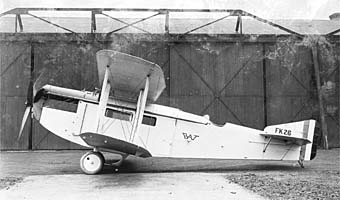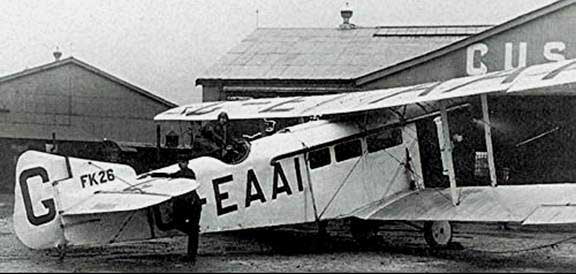
The aircraft damaged at Marske; G-EAAI.
At the beginning of October 1919 there was rail strike in the UK, on 2nd October 1919 this aircraft being used to carry mail
from Hounslow to Newcastle on Tyne when it was forced to land at Marske, during this landing it suffered repairable damage to the
undercarriage, propeller and lower wing. After the incident at Marske it's repair may or may not have been carried out, its Certificate of Airworthiness ran out on 28th July 1920, it was withdrawn from use and went into storage at Willesden where it remained until 1937, further details are given below.
Pilot - Name unknown.
Mr Frederick Koolhoven was running the factory of the British Aerial Transport (BAT) Company when he chose to create an
aircraft especially for the transport of passengers. The first day after the armistice was signed in 1918 he started
working at the drawings of the BAT F.K.26. It was for the first time in history that an aircraft had been specifically designed for
commercial aviation, it was to carry four passengers. This specific aircraft was built to contract c/n 29/K102 built by
BAT Company Ltd at Hendon. It was powered by a Rolls Royce 350 h.p. Eagle engine. This aircraft was the prototype and it
first flew at Hendon in April 1919 with Major Chris Draper at the pilot (who had crashed a number of other aircraft at Redcar in 1916).
It was registered as G-EAAI on 22nd July 1919 and to COBOR Airline, Hounslow soon after.
This aircraft was the world's first purpose built commercial airliner of which only four were built,
No orders were placed for the FK26, nevertheless it was decided to produce three more aircraft G-EAHN, G-EANI and G-EAPK.
These aircraft were registered to BAT and mainly used for charter flights in England and to Europe.
COBOR was a co-operation between BAT's owner Frederick Koolhoven and the Dutch Lieutenant L. Coblijn.
In September 1919 COBOR started a weekly service from Londen to Amsterdam (using the airfields at Hounslow and Soesterberg). The English Air Ministry did not favour these aircraft
and combined with the winter of 1919 COBOR were forced out of business. It became common thereafter for
commercial companies to buy ex military aircraft and convert them to carry passengers here after as it was cheeper to do this
than pay for new aircraft to be built. No further FK26's were built. Of the four produced, only one had been sold, G-EAPK was bought
in 1920 by Instone Airline, flew a regular service between Croydon and Paris until July 1922. G-EAAI was by now in storage.
In 1937 G-EAAI, the prototype FK26, was found back at Ogilvy Aviation, a trader in second hand aircraft and parts. Frederick Koolhoven brought the aircraft
to his factory in The Netherlands, had it restored and donated it to the Dutch Aviation Museum at Schiphol in 1938.
After the German invasion in 1940, all aircraft and parts had to be handed over to the Germans who either re-used or destroyed the material.
About ten aircraft from Schiphol, including the FK26 prototype, were loaded on flat deck boats for transport to the Fokker factory in
the north of Amsterdam. These boats were hidden from the RAF for a time and one night it is reported the FK26 prototype was pushed
overboard, along with the other aircraft. This aircraft still remains where it was pushed in Holland.