On 22nd January 1917 this RNAS Flying School aeroplane was damaged after it collided with a hanger at RNAS Redcar whilst taxying in it. The pilot sustained a broken right leg.
Pilot - Acting F/Lt Sidney John Woolley RNAS. Seriously injured.
Scout 9000 was built by Bristol's at Filton and was delivered to RNAS Redcar for erection on 28th October 1916. After testing it joined the RNAS Flying School. After sustained damage at Redcar aerodrome on 22nd January 1917 it was repaired and returned to service. It was damaged again in another flying accident at Redcar on 12th June 1917 but this time it was later assessed and deemed beyond ecomonic repair on 25th June 1917.
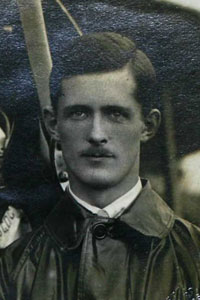
Sidney Woolley was born in Stepney, London on 26th June 1889. His father was a Captain in the Merchant Navy who was lost at sea commanding the SS Dora Forster which sunk in the Atlantic in 1899. Sidney and his brother Charlie were educated at the Merchant Seamans Orphans Asylum in Wanstead, East London. When old enough he went to live with his mother in Leeds and served his apprenticeship at the Leeds and Hunslet Engine Company building steam locomotives. His naval service record shows that prior to enlisting he was a motor engineer in Harehills Road, Leeds from 1910 to 1915, he and his brother traded as Woolley Brothers from the Olympia Garage, Leeds. He learned to fly as a civilian at the London & Provincial Aviation Co. at Hendon and gained his Royal Aero Club Aviator's Certificate (Cert.No.1806) on 25th September 1915.
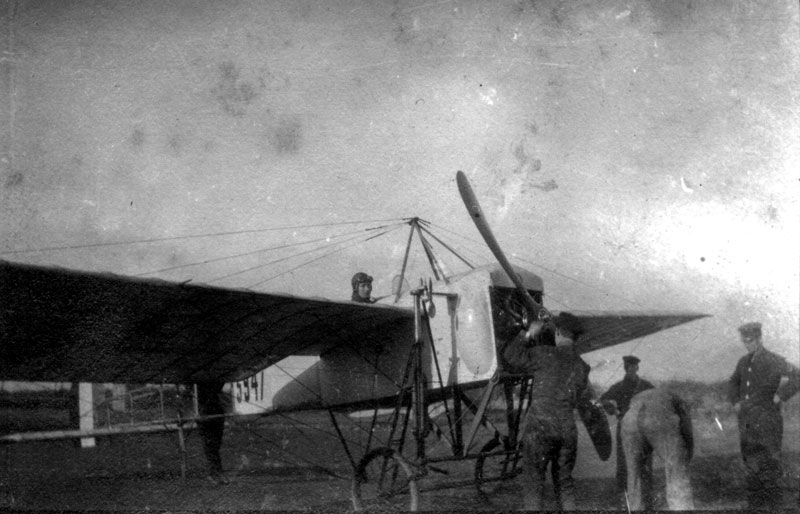
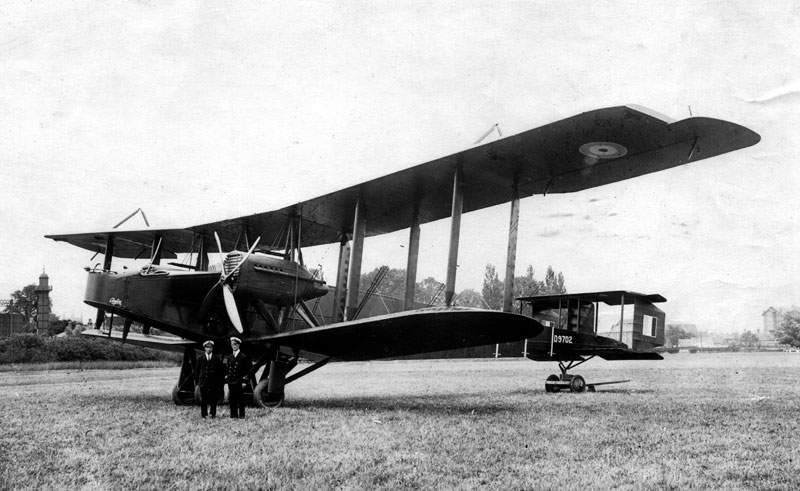
He enlisted for Royal Naval Air Service service on 22nd November 1915 and was posted to Eastchurch on the Isle of Sheppey as a Probationary Flight Sub-Lieutenant where he first flow a solo cross-country flight in a Bleriot Monoplane (the photograph above shown him and a Bleriot). On 25th April 1916 he was serving with No.5 (Naval) Wing RNAS at Coudekerque, France when he became lost on a patrol off Zeebrugge flying Caudron G.III 3899, he managed to cross the English Channel and made a landing on the beach at Deal. A party set the aeroplane up to take off and while a successful flight was begun, on reaching RNAS Dover the aeroplane crashed. He was thrown out but appears to have somehow escaped serious injury. He was later posted to RNAS Redcar to become an instructor at the RNAS Flying School on 2nd November 1916. He was seriously injured when Bristol Scout 9000 crashed at Redcar on 22nd January 1917 but recovered from his injuries to be posted to Manston on 14th June 1917 once fit. He transferred to the newly formed RAF in April 1918. He was posted to 211 Training Depot Station (TDS) at Portholme Meadow, Huntingdon as an instructor on 18th April 1918 with rank of Honorary Captain. The photograph shown below shows him with a Handley Page 0/400 taken around this time. He was then promoted to Temporary Captain on 1st May 1918 before being confirmed as Captain on 21st December 1918 and briefly served with 214 Squadron in April 1919 but transferred to the Auxiliary List (RAFVR) in June 1919.
Having returned to civilian life he took a job as a test pilot with Blackburn Aircraft at Brough but left this job during the depression of the 1920s and returned to garage work in Dewsbury. During WW2 he was employed as a civilian Link training instructor at Brough but returned to his garage work after the War. He died in Middlesbrough in July 1975. I thank his grandson Mr Andrew Woolley for contacting me in January 2014 and for supplying much of the information shown on this page and for both the photographs displayed here.