On 3rd January 1917 this RNAS Flying School aeroplane crashed on landing at RNAS Redcar aerodrome damaging in the propeller and undercarriage.
Pilot (instructor) - FSL Bert Sterling Wemp RNAS.
Pilot (pupil) - Probationary F/O John William Pinder RNAS.
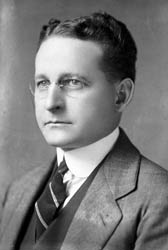
Bert Wemp was born on 3rd July 1889 at Tweed, Ontario, Canada and educated in Toronto. He began working in the offices of newspapers before WW1 and worked his way up to reporter, city editor and chief of The Telegram and the Toronto star. When the First World War broke out he volunteered as a pilot as gained his Royal Aviator's Certificate (Cert.No.1714) on 31st August 1915 at the Curtiss School, Toronto, Canada. He enlisted into the RNAS on 1st September 1915. While at RNAS Killingolme on 19th October 1915 he crashed Curtiss 8394 into The Humber escaping injury. He initially served at RNAS Redcar between 15th February 1916 and 5th March 1916 but was then posted to Eastchurch then Yarmouth. While based near Great Yarmouth he was one of a number of pilots to attempt to attack a German Naval squadron that attacked Lowestoft and Yarmouth on 25th April 1916, he flew B.E.2c 8612. He returned to RNAS Redcar on 10th June 1916. On 20th July 1916 he was flying Caudron G.III 8941 was injured force landing in the general Redcar area though the location is unknown. On 15th August 1916 he collided with housing landing at RNAS Redcar. On 3rd January 1917 he crashed Caudron G.III 8820 at Redcar. He appears to have remained at RNAS Redcar until July 1917 and was a flying instructor there. He was then allowed to return to Canada for a period of leave. On his return he was posted to France and later served as commander of 218 Squadron RNAS but was hospitalized in mid-1918 / early-1919. For his WW1 service was the first Canadian to win the Distinguished Flying Cross in the RAF, Gazetted on 3rd June 1918, though no citation has been located. He was also awarded the Chevalier, Order of Leopold (Belgium), Gazetted on 8th February 1919 and later returned home to Canada. He relinquished his commission on the grounds of ill health on 18th July 1919. On return to Toronto he continued his work as a journalist. In 1930 he ran for and was elected as Mayor of Toronto and was in office when the R.100 airship crossed the Atlantic. After a year in office he returned to the Toronto Telegram as city editor. In WW2 he worked as a war correspondent and on 1st July 1946 he was awarded the OBE (Civil). He died on 5th February 1976.
John Pinder was born on 14th February 1898 in Deal, Kent. He enlisted for RNAS service and was granted a commission on 23rd October 1916. He trained at RNAS Redcar between 27th November 1916 and 3rd February 1917, being then posted to Cranwell where he was awarded his Royal Aero Club Aviators' Certificate (Cert.No.4606) on 27th April 1917. He would go on to serve with No.9 and No.13 Naval Squadrons, transferred to the newly created RAF in April 1918 and then served with No.45 and No.213 Squadrons RAF. He was credited with seventeen aerial victories and was awarded the DFC, Gazetted on 3rd June 1918. He was also awarded the Bar to the DFC on 3rd June 1919 and received a Mention in Despatches. He died in Icara, Brazil on 16th August 1920 following an accident. He and Brazilian pilot Aliathar Martins were attempted to make the first flight from Rio de Janeiro, Brazil to Buenos Aires, Argentina in a Macchi 9 flying boat. A damaged propeller forced them down at Lagoa dos Esteves and after repairing it, they were attempting to restart the engine when Martins was hit by the propeller and fell into the water. John Pinder attempted to save Martins but both men drowned.
Curtiss JN-4 8820 was built by Curtiss in Toronto, Canada and shipped to the UK and was delivered to AAP Hendon on 11th May 1916. Here it was assembled, tested and accepted on 22nd May 1916 and transferred to RNAS Flying School Chingford on 23rd May 1916. It was later transferred to RNAS Flying School Redcar on 27th August 1916 via RNAS Cranwell and RNAS Scarborough on 28th August and it finally arrived at Redcar on 30th August 1916. Although it was deemed beyond repair after the accident on 3rd January 1917 it sat in an unrepaired state for some months it was finally deleted on 25th June 1917. This period may have been due to the possible consideration for repair although this work was never carried out.