Avro 504c 8600 at Scarborough.
The details surrounding this incident are very vague in so much all that is known is that this aeroplane was damaged while landing at RNAS Scarborough on 3rd August 1916. It was almost certainly on charge with the RNAS Redcar Flying School purely because the pilot was an instructor there at the time.
Pilot - FSL Louis Marcus Basil Weil RNAS.
Louis Marcus Basil Weil was born on 13th October 1898 in Port Elizabeth, South Africa. He later came to England when his parents returned to the UK from South Africa and he was educated at Clifton School. He enlisted into the RNAS on 11th October 1915 and received a commission to the rank of Probationary Flight Sub-Lieut. He began his flying at Chingford on 14th October 1915 before posting to RNAS Redcar to train at the Flying School on 2nd December 1915. He gained his Royal Aero Club aviator's certificate there on 27th January 1916 (Cert. No.2336). He was posted to Eastchurch on 26th March 1916 and to Dover the following month but was listed as "sick" by June 1916. On 19th June 1916 he was posted back to RNAS Redcar as an Assistant Instructor. His service record states he was still in this role when the mishap at Scarborough occurred in August 1916 and he was still serving at RNAS Redcar Flying School on 21st November 1916 when he was involved in a taxying accident to Longhorn N5037 there. On 17th January 1917 he was posted to Dover and it seems likely that he crossed the Channel and went into France shortly after. He was promoted to F/Lt also on 17th January 1917 and served in France with No.1 Naval Squadron.
Louis Weil was killed on 6th April 1917 following combat over Northern France while flying Sopwith Triplane N5448 which was attacked by Hauptmann Paul Von Osterroht. Weil's aeroplane crashed near Malakow / Malakoff Station and this is reported as being the first Sopwith Triplane to have been brought down by a German pilot. He was probably involved in the Battle of Hargicourt at the time. F/Lt Louis Weil is buried in Sauchy-Lestree Communal Cemetery, France and was only eighteen years old. The portrait photograph shown above was kindly supplied to this account by Rev Rupert Charkham.
In a very early stage, before the formal declaration of war, the enemy (Boers) had massed several commandos upon the western border, the men being drawn from Zeerust, Rustenburg, and Lichtenburg. Baden-Powell, with the aid of an excellent group of special officers, who included Colonel Gould Adams, Lord Edward Cecil, the soldier son of England's Premier, and Colonel Hore, had done all that was possible to put the place into a state of defence. In this he had immense assistance from Benjamin Weil, a well known South African contractor, who had shown great energy in provisioning the town. On the other hand, the South African Government displayed the same stupidity or treason which had been exhibited in the case of Kimberley, and had met all demands for guns and reinforcements with foolish doubts as to the need of such precautions. (taken from www.stopboergenocide.com)
Another account was written by Lady Sarah Wilson, who travelled to South Africa on a visit in May 1899. When it came time to leave, due to deteriorating political conditions, Benjamin Weil proved to be of great help to Lady Sarah, who had left it too late to escape ahead of the war clouds. She writes about his hospitality and his prescience in supplying provisions on a most timely basis: "I had delayed my departure too long; it was extremely doubtful whether another train would be allowed to pass South, and, even when started, it would stand a great chance of being wrecked by the Boers tearing up the rails. Under these circumstances I was allotted comparatively safe quarters at the house of Mr. Benjamin Weil, of the firm of the well-known South African merchants. His residence stood in the centre of the little town, adjacent to the railway-station." "We celebrated Christmas Day, 1899, by a festive luncheon-party to which Colonel Baden-Powell and all his Staff were invited. By a strange and fortunate coincidence, a turkey had been overlooked by Mr. Weil when the Government commandeered all live-stock and food-stuffs at the commencement of the siege, and, in spite of the grilling heat, we completed our Christmas dinner by a real English plum-pudding.
"The provisions sent to Mafeking by the Cape Government before the war were only sufficient to feed 400 men for a little over a fortnight. At that time a statement was made, to reassure the inhabitants, that the Cape Ministry held themselves personally responsible nor the security of the railway in the colony. Providentially, the firm of Weil and Company had sent vast stores to their dept in the town on their own initiative. This firm certainly did not lose financially by their foresight, but it is a fact that Mafeking without this supply could have made no resistance whatever. There were 9,000 human beings to feed, of which 7,000 were natives and 2,000 white people. It can therefore be imagined that the task of the D.A.A.G. was not a light one. Up to April the town consumed 4,099 tons of food-stuffs; 12,256 tons of oats, fodder, meal, and flour; and 930 tons of fuel; making a total of 17,285 tons. Of matches, the supply of which was soon exhausted, 35,400 boxes were used, and to take their place tiny paraffin lamps were supplied to all, which burnt night and day. Fortunately, the supply of liquid fuel was very large, and it would have taken the place of coal if the siege had been indefinitely prolonged. Among miscellaneous articles which were luckily to be obtained at Weils stores were 2 tons of gunpowder and other ammunition, 132 rifles, insulated fuses, and electric dynamos for discharging mines, etc." A fuller account of Lady Sarah's lively account of her imprisonment and release can be found at www.sakoman.net.
Benjamin Weil (aged 50) and his wife Ethel (aged 26) are listed on the 1901 Census. The presence of much younger wife could suggest that this wife was his second
and he could have had a family to a first wife, this however requires researching. On the 1901 Census, Louis Weil is aged two, born in the Cape Colony, quite possibly
whilst Lady Sarah was staying at the family residence. Louis has an infant brother, Frederick, born in Capetown, and less than a year old (who it is suggested served
in WW1). There are six servants in their Kensington Gardens Terrace house, two of whom are a nurse and nurserymaid. By the time Louis was killed the family are listed
as living at 30 Abercorn Place, in the St.John's Wood area of London. Louis also had sisters Eileen (never married) and Sybil (later married Felix Dunstan C.R. Eyles in 1935).
Avro 504c 8600 was built by A.V.Roe Ltd in Manchester to contract C.P. 145456/15 and was delivered to RNAS Scarborough for erection on 31st January 1916. After testing and acceptance it was transferred to RNAS Atwick Home Defence Flight where it suffered damage in a gale on 16th April 1916. It was repaired on site and went to RNAS Scarborough Home Defence Flight for anti-Zeppelin patrol duties on 3rd May 1916. It suffered damage at Scarborough on 3rd August 1916 while being flown by a RNAS Redcar Flying School instructor so I presume it had been transferred to them at some stage, or perhaps was being collected for transfer when the accident occurred. It was repaired and returned to RNAS Redcar Flying School only to crash there on 30th January 1917. It was later deleted on 8th September 1917.
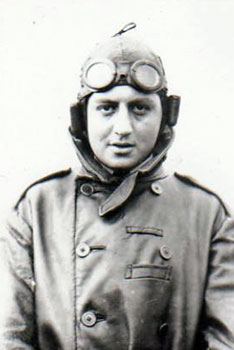
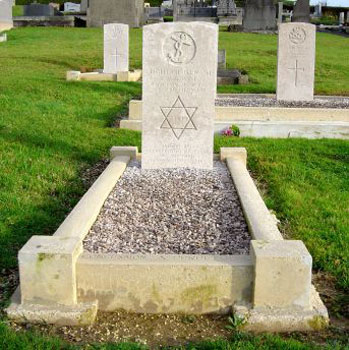
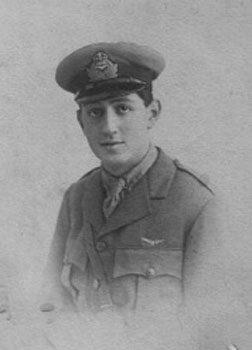
Louis Weil's father Benjamin Weil was a well-known merchant and government contractor in the Cape Colony and he became famous for being "The Man Who Fed Mafeking" during the Defence of Mafeking. Louis and his parents were in Mafeking just before the Boer's attacked; Louis and his mother escaped on the last train leaving his father and the remaining townsfolk to defend the town from the Boer's attack. For his actions in the attack Benjamin Weil was awarded the Queen's South Africa Medal with the Defence of Mafeking Clasp. The following is a detailed biography of Louis Weil and his father, kindly supplied by Mrs Hilary Brookes, mentioned in the following account of the Seige of Mafeking: