DFW Arrow 154 at Scarborough Racecourse.
DFW Arrow 154.
On 10th August 1914 this aircraft was flying in the Scarborough area on the Daily Mail Circuit of Britain Race when it suffered a technical problem. The pilot was left with little option but to force land the aircraft on the nearby Scarborough racecourse which had been used as an aerodrome for some time. The aircraft had taken off from "The Enchantress" near Netley Abbey, Southampton Water at 06.00hrs and headed past Ramsgate and Yarmouth to Scarborough. Competitors would then fly all the way up to Aberdeen, then to Fort George, Oban, Dublin and then across to Falmouth. On making the landing at Scarborough there was some confusion as to what to do with the pilot as it was thought he was German due to the make of the aircraft, he was initially arrested and taken to the army barracks on Burniston Road in the town for questioning. It later became apparent that the aircraft was one which had been requisitioned by the UK government and the pilot was released. It was stated in the local newspaper that he was a naval serviceman and carried an army service revolver. His passenger on the aircraft was not detained at all and is named as "Dukinfield Jones" on one reference I have found. It is thought that after minor repairs were carried out the aircraft took off again. It later finished in second place in the race.
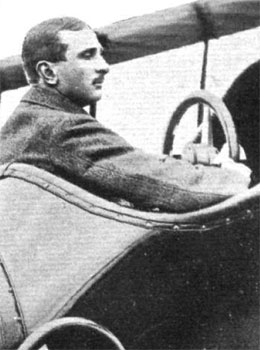
Probable Pilot - Lt Charles Herbert Collet RMA.
Passenger - Mr Alfred Dukinfield Jones?
Charles Collet almost certainly in the cockpit of the DFW Arrow (photographs: Flight Magazine). He was born on 4th February 1888 in Calcutta, India. Following training at the Central Flying School and Upavon, Wiltshire he gained his Royal Aero Club Aviator's Certificate on 21st October 1913 (Cert.No.666). He was called up for active service just prior to the incident at Scarborough, it appears that he flew from Brooklands before the War began. On the 22nd September 1914 Lieutenant Collet RMA led an aircraft attack on Zeppelin sheds situated at Dusseldorf and Cologne in Germany flying a Sopwith Strutter aircraft. Due to poor visibility only Collet managed to site his target at Dusseldorf and gliding down from 6000 feet to 1500 feet to drop his two 20lb bombs on the shed from 600 feet, Collet scored direct hits and made history as the first man ever to carry out a bombing raid, winning a DSO for his efforts. His own aircraft had been damaged by one projectile. Captain Collet lost his life on 19th August 1915 when the aircraft he was flying crashed soon after taking off from Imbros aerodrome, having climbed to 150 feet the engine cut out and the aircraft crashed and caught fire. Chief Petty Officer Michael Sullivan Keogh (HMS Ark Royal) attempted to rescue Captain Collet from the burning wreckage and sustained serious burns himself. He managed to drag the pilot clear but Collet had died of his injuries. For his bravery Chief Petty Officer Keogh was awarded the Albert Medal.
If Alfred Dukinfield Jones was on board the Arrow when it was landed at Scarborough then he too was a qualified pilot. He was born on 27th April 1886 in Brazil but by 1911 was living in Reigate, Surrey. After training at Waterloo, Liverpool he was awarded a Royal Aero Club aviators' certificate on 19th September 1911 (Cert.No.138). He was a passenger in the the first non-stop flight between Liverpool and Manchester in 1911, the pilot was Henry Melly, who ran the Liverpool Aviation School at Waterloo. Alfred died in 1976. His brother Harry Dukinfield Jones served in the 1st Btn, Honourable Artillery Company and was killed on 16th June 1915, he is commemorated on the Menin Gate.
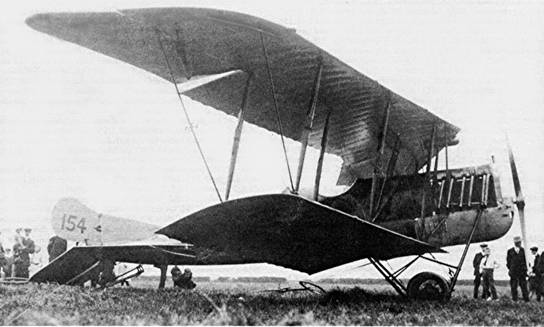
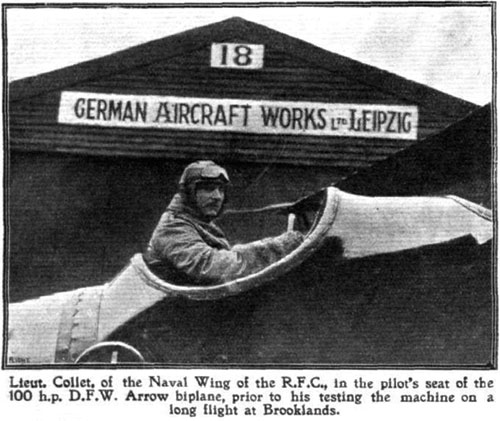
The Arrow was built by DFW (Deutsch Flugzeugwerke GMbH, Germany) and was purchased under contract no. C.P. 36909/14. On 17th March 1914 it arrived at Brooklands from Germany and was assembled before being tested on 25th March 1914 and accepted at Brooklands. On 13th May 1914 it suffered a repairable accident whilst on the flight from Porstmouth to Wick, flown by Lt C H Collet RMA, (who was it's regular pilot thereafter) with a supplimentary fuel tank installed, the 100 h.p. Mercedes engine failed which resulted in a forced landing at Jenning's Farm, near Donna Nook, Lincolnshire. On 3rd June 1914 the aircraft was delivered to R.N.A.S. Eastchurch, possibly on arrival at Eastchurch it was re-engined with a Beardmore 120 h.p. engine. By 8th Augsust 1914 it had been allotted to the R.N.A.S. Eastchurch defence and became part of the Eastchurch (Mobile) Squadron. There is no record of it's arrival at Scarborough Racecourse on 10th August 1914 but it did arrive at Skegness on 11th August 1914 so it must have been quickly repaired. The Mobile Squaron were based at R.N.A.S. Immingham from 9th August 1914, moving to R.N.A.S. Skegness on 11th August, moving back to Eastchurch on 24th August. For some reason No.154 was left behind at R.N.A.S. Killingholme, and it was back at R.N.A.S. Immingham on 28th August, again flown by Collet. Whilst stationed at Immingham in October 1914 it was grounded for identification reasons. It was dismantled at Immingham on 6th October and then transported to R.N.A.S. Eastchurch on 8th October. It was deleted from R.N.A.S. records on 20th February 1915 and parts were sent to R.N.A.S. Killingholme and Wormwood Scrubs on 19th June 1915.