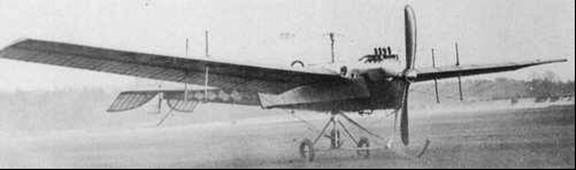
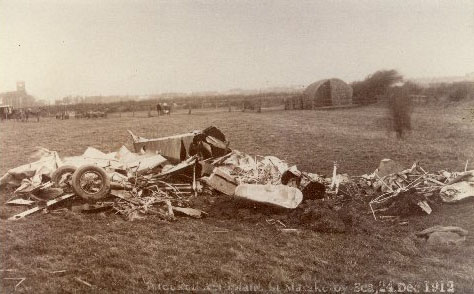
On 24th December 1912 the pilot of this aircraft was attempting to be first man to fly non-stop from London to Edinburgh. He left Brooklands at 09.10hrs and as he left it was already windy. The pilot had apparently set himself a task of completing this flight before Christmas sometime previously but because of various things which had got in the way this was the first time he had attempted it. He was an experienced pilot at the time of his flight. The gale became worse the more northerly he got, the assumed route was that he followed the coast-line which was probably one of the few ways for easy navigation at that time. When he was about at the top of the stretch of the Yorkshire coast-line the gale was severe and when he arrived in the Marske area at about 500 feet it was a strong south-westerly gale. Flight Magazine of the period stated that witnesses thought that he had found himself drifting out to sea in the wind which was blowing off the Cleveland Hills and that the crash occurred when he was attempting to force land the aircraft on the sands. They claimed that the front skid of the aircraft dug into the sand, and the aircraft was sent back into the air by about 40 feet. The same magzine also quote from the crash report which then makes no mention of a force-landing attempt. The report stated that the aircraft lost height to 400 feet, and then rose again, it's wings then collapsed. The pilot was now no longer in control and the aircraft slipped sideways and crashed into the ground sadly killing him instantly. The police were criticized as they had immediately removed much of the wreckage and burnt much of the wooden parts preventing a detailed examination being carried out.
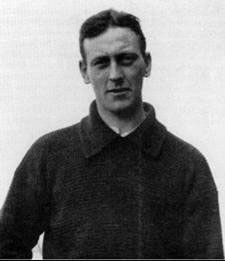
Pilot - Mr Edward Petre, aged 26. Buried Fryerning Churchyard, Ingatestone, Essex.
Edward Petre and a postcard showing the crash site. I thank Mr Jim Rutland for the photo of the pilot and Mr Dave Williams for the copy of the crash site photograph.
The Petre family were from the Ingatestone area of Essex. Edward Petre was born on 27th April 1886 at Ingatestone. He and his brother Henry Aloysius Petre became interested in aviation following Bleriot English Channel crossing in 1909 and they built their own aircraft and displayed it at the 1910 Olympia Aero Show, after which it was flown at Brooklands where one of the brothers crashed it. Edward was granted a Royal Aero Club Aviator's Certificate on 24th July 1912 (Cert.No.259) at the Handley Page School at Fairlop. Edward joined Handley Page and worked on their monoplane and appears to have made test flights in the new aircraft. Up until his death he worked for the Martin-Handasyde aeroplane company acting as a pilot to their machines at Brooklands. A memorial was erected in Exeter's Catholic Church, taking the form of oak choir-stalls.