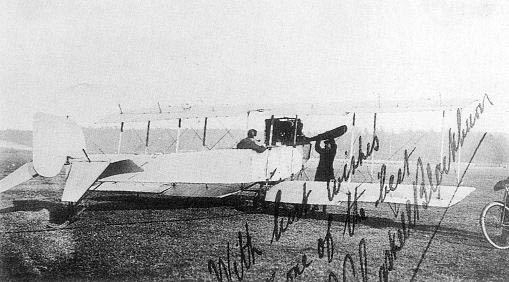
Flanders B2 bi-plane between Leeds and York, location uncertain.
On 22nd July 1914 the first day of three of the Yorkshire Show took place in the grounds of St.Mary's Manor, Bradford. Passenger carrying aeroplanes were still very much in their infancy and two local men, Harold Blackburn and Sydney Pickles, who were test pilots for Robert Blackburn's Blackburn Aeroplane Company, hosted passenger flights between an airstrip at the Quarry Old Gap sports ground at Bradford to the military field at Roundhay, Leeds. During the three day event at Bradford regular flights took place between the two cities using two aeroplanes. One used was definitely the Blackburn Type I (two seat monoplane), what the second aeroplane was is unclear other than it had a 70 H.P Gnome engine and was a bi-plane and fits perfectly as being Vivian Gaskell-Blackburn's Flanders bi-plane.
As part of the planned flying events Vivian Gaskell-Blackburn was due to bring a two-seater Flanders bi-plane to the event and for use with the passenger flights. It suffered engine trouble earlier in the day which delayed some of the flights but was later fixed. This aeroplane is pictured above. On 22nd July 1914 newspaper reports state that Gaskell-Blackburn's biplane was being flown from York to Bradford; towards the Yorkshire Show, when it suffered some form of technical issue between York and Leeds so had to be force landed. The ground on which the aeroplane was landed was certainly very soft and waterlogged, so much so that the newspapers referred to the ground as being a swamp. Exactly where and when the landing was made is not known. What I would suggest happened is that once the passenger flights were taken care off the bi-plane left Roundhay and flew to York and to give the engine a test with it to then be flown to Bradford ready for the second day of passenger flights. During the York to Bradford leg the engine again began to fault so it was force-landed. As part of the passenger flight arrangements between Roundhay and Bradford some form of workshop and hanger facility was set up at Roundhay and various ground mechanics operated from there to keep the two aeroplanes servicable. One of Harold Blackburn's mechanics, Walter Goodchild, appears to have been one of those working at Roundhay on 22nd July 1914. Once the flights were complete the newspaper reports state he was driving from Leeds to York when he "came across" the force landed aeroplane between the two cities. The newspapers perhaps over-egg him stopping to help. I believe he would have known the pilot and owner already and was simply sent to help. Both Gaskell-Blackburn and Goodchild spent some considerable time trying to get the aeroplane going again. The bi-plane would later fly to the Yorkshire Show so their efforts were successful. Mr Goodchild appears to have been working in the cold and water for too long on 22nd July 1914 and became seriously unwell. The events between him being taken to Harold Blackburn's house in Horsforth (Bank House?) are unknown but, over the course of the next few days, his condition worsened and so much so that on 25th July 1914 he was taken to a nursing home in Leeds. He then sadly then died on 26th July 1914 from acute paralysis. While techincally not a death related to a flying mishap his life and the events of the Yorkshire Show just before the outbreak of the First World War deserve a webpage.
Poor weather on 23rd July 1914 saw less flights at the Yorkshire Show but the other two days saw a combination of dignitary passengers and also lucky prize draw winners being given flights. Those who were unable to be offered the flights owing to the weather conditions were later offered flights from York Knavesmire on Friday, 31st July 1914. The six who arrived at York were given flights by Sydney Pickles in Gaskell-Blackburn's Flanders Bi-plane as Pickles had damaged his Blackburn Monoplane two-seater at the Knavesmire avoiding a cow earlier in the week. Gaskell-Blackburn then flew from York to Scarborough in the Flanders on 2nd August 1914 with a passenger, landing on the south bay sands before then flying it to Filey where Blackburns had had their hanger. Then came the First World War.
Pilot - Mr Vivian Gaskell-Blackburn.
Engineer - Mr Walter Goodchild. Aged 26, of Ipswich, Essex. Burial location unknown.
Vivian Gaskell-Blackburn was born in Leeds on 8th March 1891 and was the son of H. Gaskell-Blackburn, a chartered accountant of Leeds and Horsforth. Around 1910 he was involved with constructing his own aeroplane but very little is known about it other than it was constructed from parts of three older aeroplanes, namely The Champel, The Parsons and The Pashley Brothers' Sommer with it being powered by two engines with pusher propellers with it being tested in 1910 at Apperley Bridge, near Bradford. He later trained and then was awarded his Royal Aero Club Aviators' Certificate (Cert.No.617) at the Bristol School, Brooklands on 10th September 1913. In 1914 he purchased the only 70h.p. Flanders Bi-plane built as a two-seater and flew this in 1914 until it was requisitioned / purchased by the RNAS in August 1914 and registered as 918. Gaskell-Blackburn also applied to join the RNAS the same month but while his commission was considered he was allowed to fly his own Flanders B2 aeroplane. In December he took part in a naval air raid on Cuxhaven. He was awarded the DSC for service during the advance on Kut-el-Amara on 27th / 28th September 1915. The citation, from the London Gazette of 21st January 1916 reads.."Flight-Lieutenant Blackburn did excellent air reconnaissance work, and came under heavy fire on the afternoon of September 28th, whilst carrying despatches between the General Officer Commanding and the "Comet"." He was Mentioned in Despatches a number of times, Gazetted on 19th February 1915, 5th May 1916 and 13th July 1916. On 28th September 1916 he crashed Caudron GIII 3280 at Redcar. Later, "for distinguished service rendered during active operations in Iraq during 1920-21" Gazetted on 10th October 1922. He was awarded the Bar to the DSC, Gazetted on 17th May 1918 "for services in the advance and retreat from Ctesiphon, when he performed most excellent work." He was also awarded the AFC, Gazetted on 10th October 1919. Vivian Gaskill-Blackburn was finally placed on the Retired List as a Group Captain in 1947 and died in October 1956. His medal set sold at auction in 2007.