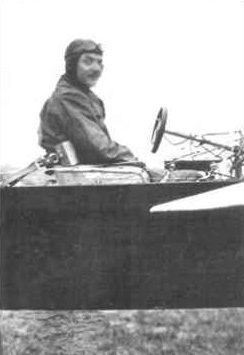
Blackburn Mercury at Grange Farm, East Heslerton.
Bentfield Hucks seated in a Blackburn Mercury.
On 14th July 1911 the pilot of this aircraft was attempting a challange set by a Leeds businessman, Mr Stuart Hirst, to be the pilot of the first Yorkshire-built aircraft to fly into Leeds and who would then be awarded £50. The aircraft took off from Filey at 11.41hrs and the pilot made two circuits over Filey to test the aircraft, the pilot then headed towards Leeds. All went well for the opening part of the flight, the aircraft reached speeds of 50 mph and climbed to 2000 feet. While in the Heslerton area the aircraft's engine began to misfire, the pilot was left with no option but to try and land the aircraft which he did on land belonging to Mr J.Coverdale, at Grange Farm, East Heslerton. The field he selected had cows in it which the pilot attempted to avoid. Following the landing the aircraft sustained damage but the pilot escaped uninjured and after a short time in the area he managed to borrow a bicycle from a Mr Edwin Owston and rode back to Filey! The aircraft was later rebuilt, the undercarriage was said to have been the only thing to have sustained serious damage. This incident occurred a week before the planned Daily Mail Circuit of Britain air race. This pilot had already made many flights around the Scarborough area in the week leading up to the crash at Heslerton. Many of these flights are detailed in the local Scarborough newspaper of the day and also in Flight magazine (now on the internet).
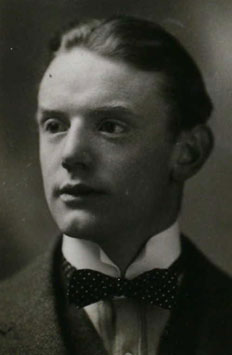
Pilot - Mr Bentfield Charles Hucks.
Bentfield Hucks was born on 25th October 1884 at Bentfield End, Stanstead, Essex and was the youngest son of William and Kate Hucks. Benny Hucks became a well known and famous aviator of his day, he was one of the greatest pilots in British aviation history. He took his Royal Aero Club aviators' certificate at Filey on 30th May 1911 in a Blackburn Monoplane, to whom
he had flown with since 1910. He was the first person to loop the loop and fly upside down. He joined the RFC at the outbreak of the First World War and flew in France until pleurisy put an end to his fighting days. He took up a roll testing aircraft with the Aircraft Manufacturing Company, where he became their chief test pilot but was still attached to the RFC however. He also invented the 'Hucks' Starter, a transportable aircraft engine starter. Captain Hucks died on the 7th November 1918 of pneumonia as a result of having Spanish Flu and was buried in Highgate Cemetery, London. He was still only 34 years old. Perhaps the most fitting tribute to him was given in his obituary published in Flight Magazine, which stated "there will never be another Hucks".
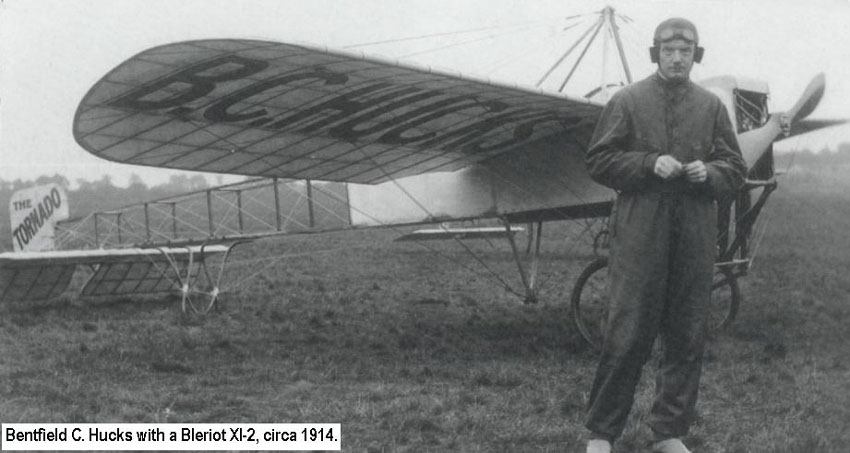
Bentfield Hucks and his personal aircraft (photograph via Mr Graham Sharpe).