On 24th October 1940 the crew of this 20 O.T.U. aircraft were undertaking a night cross country training flight when that used turning points of Brechin, Kinnairds Head, Inverness before returning to base of Lossiemouth. They had flown the vast majority of the navigation exercise and were in the process of returning to Lossiemouth having navigated to Inverness. The aircraft then flew off track considerably south and at 21.00hrs, while flying in the Braemar area, the aircraft flew into the side of Beinn a'Bhuird mountain which was covered in snow at the time. The pilot believed that he was flying into a bank of cloud rather than the ground. Upon striking the ground on Bruach Mohr, just south of the South Top of Beinn a'Bhuird, the aircraft ploughed its way up hill and came to rest on a reasonably flat part of the mountain. The two airmen who died as a result of this accident.
Pupil Pilot (at the controls) - Sgt Alfred Wilson Milroy RAFVR (745713).
Second Pilot – P/O Herbert Martin Coombs RAFVR (84954). Aged 28, of Westbury-on-Trym, Bristol. Buried Dyce Old Churchyard, Aberdeenshire.
Wireless Operator / Air Gunner (U/T) - Sgt Frank Hutson RAFVR (975183). Buried Sheffield (Crookes) Cemetery, Yorkshire.
Pilot (Instructor) - P/O Douglas Veale Gilmour RNZAF (36240), of Epsom, Auckland, New Zealand.
Navigator - Sgt Kenneth Winchcombe Bordycott DFM RAFVR (755783). Injured.
? - Sgt George Ronald Lyon RAFVR (970987). Injured.
Air Gunner - Sgt John Adam Sparks RAFVR (970251).
Herbert Coombs received a commission to the rank of P/O on probation on 7th September 1940.
Douglas Gilmour's father was of Scotish descent but his parents (Douglas' Grandparents) had moved to New Zealand before he was born. Douglas Gilmour enlisted into the RAF in the late 1930's and was granted a commission to the rank of P/O on 17th January 1940. Following this accident in Scotland he recovered from his injuries and completed his training and is believed to have flown a Tour with Bomber Command. He rose to the rank of F/O (war subs) on 17th January 1941. He was later posted to 24 Squadron and Mentioned in Despatches prior to being killed on 16th December 1941 while flying Hudson V9115 from England to Gibraltar. His body was never found and he is commemorated on the Runnymede Memorial. He was twenty six years old.
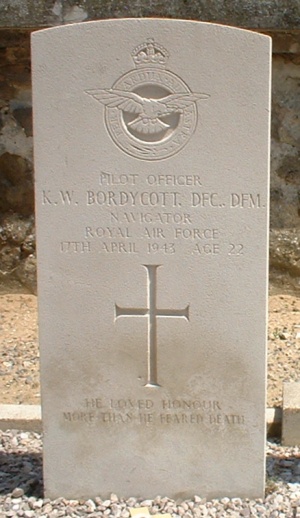
Alot is known about Kenneth Bordycott thanks to "www.156squadron.com" where the photograph above was found. He was born in Ramsbury, Wiltshire on 2nd May 1920. He joined the RAF in the Summer of 1939. Following the accident near Braemar he recovered from his injuries and completed his training. He was posted to 150 Squadron in June 1941 at Snaith where he flew a Tour on Wellingtons. For this service he was awarded the DFM, Gazetted on 26th May 1942. The citation for his DFM reads.. "F/Sgt Bordycott has participated in sorties over Germany, Italy and enemy occupied countries, including a daylight attack on the Scharnhorst and Gueisenau. He has shown outstanding ability as a navigator, and has on many occasions navigated his aircraft successfully during extremely bad weather."
After this Tour he probably acted as an instructor at a training unit before begining a second Tour and posting to 156 Squadron PFF in October 1942. He received a commission to the rank of P/O (emergency) on 19th March 1943 (back dated to 23rd November 1942). He was sadly killed on 17th April 1943 while serving with 156 Squadron when Lancaster W4854 was shot down over France on Ops to Pilsen. He was twenty two years old and is buried in Brimont Churchyard, France. He was awarded the DFC after his death, Gazetted on 18th September 1945 but back dated to 16th April 1943. The citation reads.."This officer has completed numerous operational sorties since the award of the DFM. He is now serving on his second tour of operational duty and has taken part effectively in raids on many strongly defended targets. He has at all times displayed navigational skill of the highest order and by his courage and by his courage has been responsible for the sucess of many missions."
Alfred Wilson Milroy received a commission on 9th September 1942 to the rank of P/O on probation (emergency) (135870). On 9th March 1943 he rose to F/O on probation (war subs) and on 9th September 1944 he rose to F/Lt (war subs).
John Sparks recovered from his injuries and was posted to an operational squadron after completeing his training. He was sadly killed on 20th August 1942 while flying with 218 Squadronn when Stirling BF319 on a mine laying flight in Kiel Harbour. He hailed from Aberdeen and was twenty five years old. He is now buried in Hamburg Cemetery after initially being buried more locally at Neuminster.
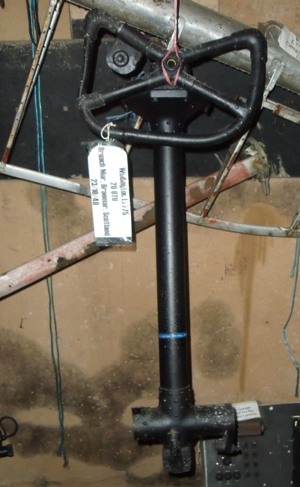
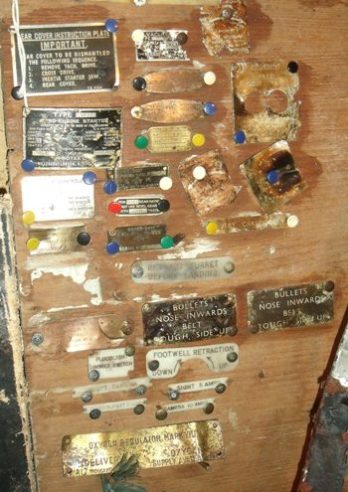
Veteran aircraft part collector Mr Ken Ward visited the site many years ago almost certainly before the site was more well known and recovered the control column, the rare under-fuselage "dustbin" turret, part of the tail rudder and a large number of plates and aircraft labels. Since this time a number of others have removed large sections of the aircraft. An engine is now in Brooklands Museum, the tail section is now at Moreton in Marsh and two wing sections are housed at East Kirby Museum. Ken Ward's "dustbin" turret may well be the only remaining one in existance and needs properly preserving in a proper museum.
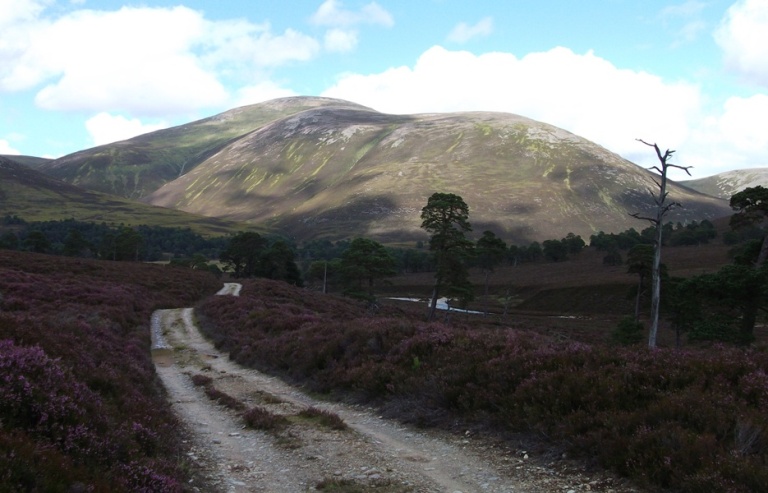
The crash site is in the shadow towards the summit in the centre of the photograph above. I visited the crash site in August 2011 on the final day of a holiday, I visited this site while back-packing on Ben Avon and Beinn a-Bhuird. The scar created as a result of the crash is still visible to this day with a large area containing small items of the aircraft being the highest up the mountain. The aircraft appears to have been chopped up and buried in the scar and in handy hollows nearby. Some of the aircraft must have been badly damaged as a result of the crash other parts seems to have escaped reasonably well and were un-damaged. Various recovery operations in the 1980s probably resulted in the best items being recovered though there are still some interesting smaller items left at the site, remarkable considering it has been well picked over.
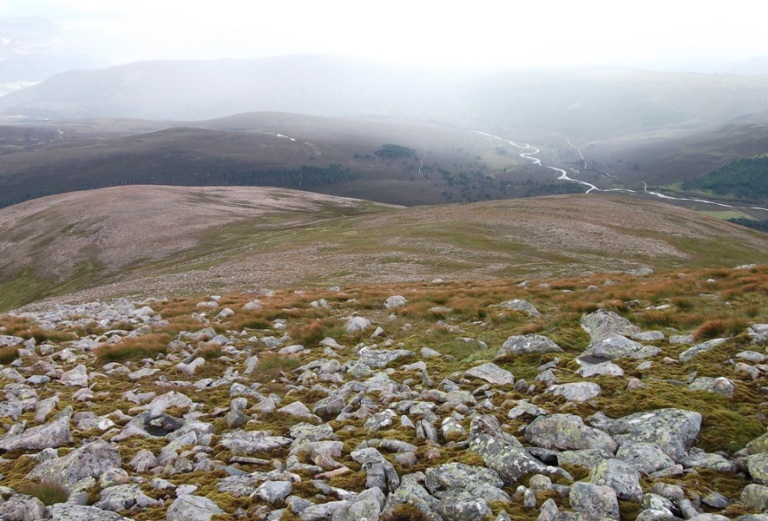
A view down to the crash site from the South Top of Beinn a'Bhuird down to Bruach Mohr with a shower of rain coming over (above).
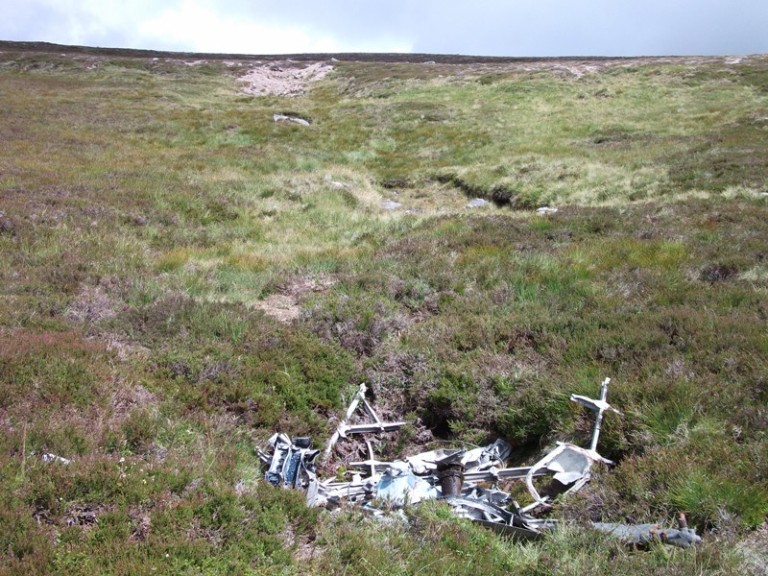
The photograph above shows the scar made as a result of the crash with items of the aircraft being found in the full length of it. There also appears to be still a lot buried in the sandy area at the top of this photograph (above).
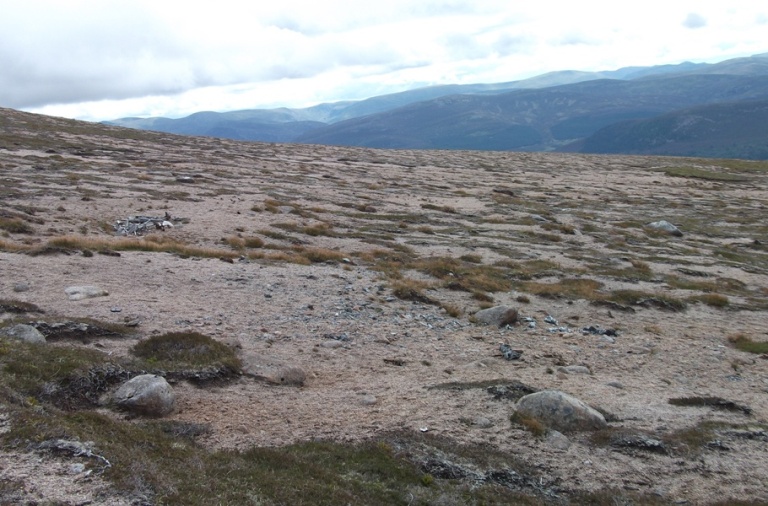
The area where the aircraft ended up (above).
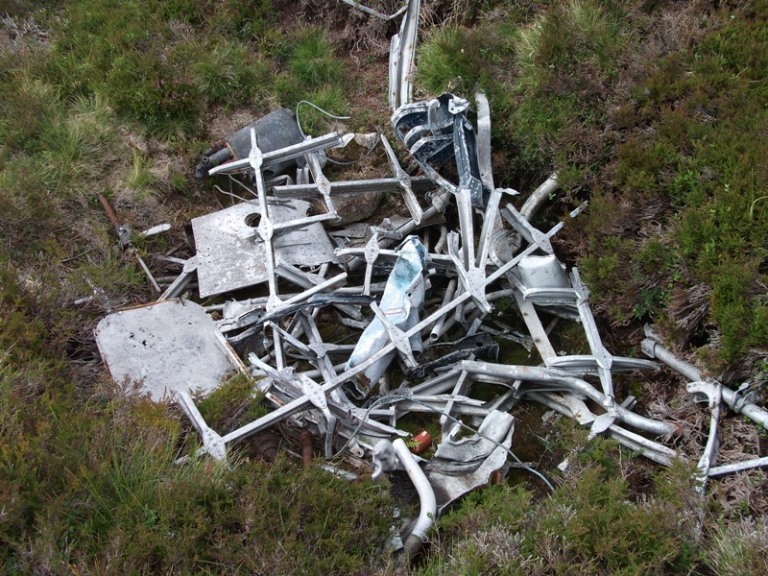
A collection of bits of the aircraft lower down the mountain side.
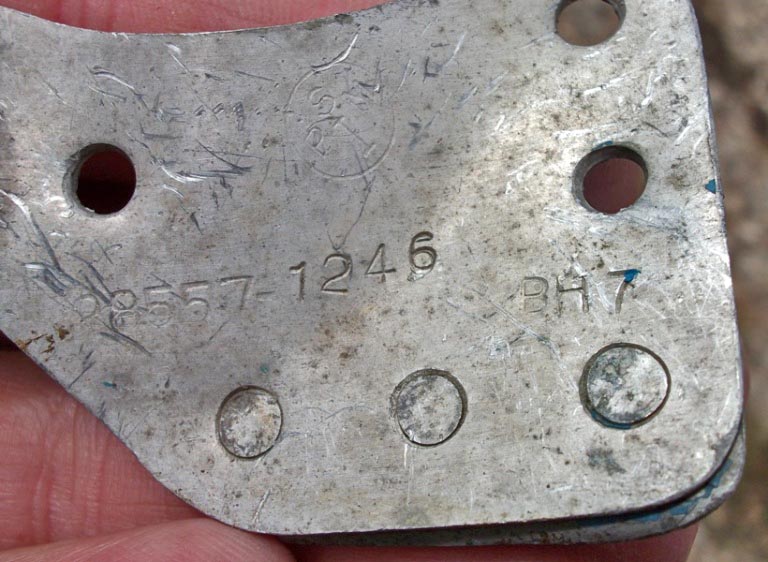
A typical Wellington part number.
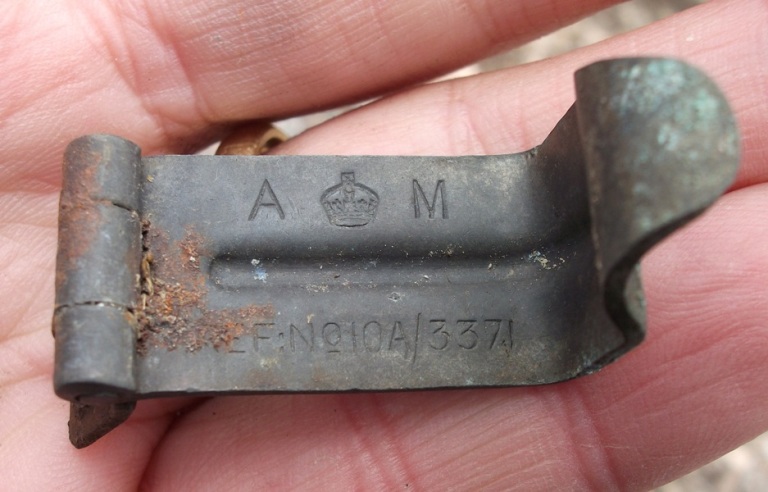
An Air Ministry clasp from an unknown piece of kit. A.M.Ref.No. 10A/3371 is possibly one of the lid securing clips from the remote Contactor box, part of the I.F.F. system.