The R34 Airship.
During the early part of 1920 the USA decided to buy the R.38 airship and it was planned that it would be flown over the Atlantic after purchase. A crew was therefore sent to Howden to learn how to fly a large airship. The R.34
was used to train these American visitors and they may have been on board when this incident occurred in January 1921. Unfortunately during August 1921 the R.38 was lost in The Humber with many deaths occurring.
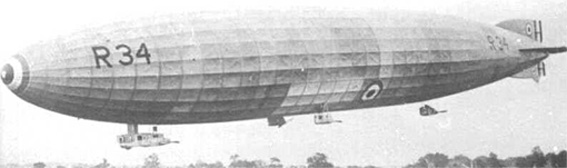
On 27th January 1921 the R.34 airship was test flown after a major overhaul and a period of inactivity. Newspaper reports stated that it had a crew of 32 men. The flight also was combined with a instructional exercise involving a number of navigational trainees. The R.32 airship
flew in company with the R.34. The precise route the airship took after being untethered from Howden is not known other than it headed generally north. By 16.00hrs the R.32 had returned to Howden and was moored. When the R.34 was
somewhere just off the Yorkshire / Durham coast the weather turned bad and with visibility reduced the airship drifted in land, towards higher ground. It struck high ound south of Guisborough at around 1200 feet above sea level
but took a glancing blow. A sudden downdraft had pushed the airship onto the Moors at 00.10hrs on 28th January, the airship then bounced off the moor and back into the air. The captain then ordered the engines to be stopped
whilst the damage was inspected. The front gondola had been badly smashed and had heather stuck in it, it's engine had been made useless and the aft car similar damage having had it's propellers damaged. A distress signal
was made and two destroyers, HMS Wrestler and HMS Walker were ordered to proceed from Harwich to stand by incase R.34 drifted out to sea. A tug from Hull also stood by in the Humber should it be ditched nearer Howden. The
R.33 was also sent up from Howden to search for the R.34. Unfortunately the wind became a problem. At around 13.00hrs on 28th January the R.34 passed over Hull but then crossed The Humber and stuck close to the Lincolnshire
side for some time. Only the two engines on the wing cars controlled the flight and with the wind this was a struggle. Eventually the crew were able to bring it back across the water and it reached Howden. As it came into
view there appeared to be little damage other than it was missing two of the propellers. By around 16.30hrs the tethering began at Howden but the wind was a huge problem with all available men called to help. It was towed
towards the shed with little daylight left but as it was pulled across the ground by around 400 men into position in front of the shed entrance the wind caused the nose and tail to rise and fall which saw the nose and tail
gondolas hit the ground. The crew were still inside the gondolas and they hastily climbed down. Many of the landing party who were holding onto the ropes and gondolas were also lifted into the air as it rose. Several men
were injured during this time including one who sustained broken ribs. As darkness fell getting the R.34 into the shed was abandoned and it was decided to attempt to tether it in the open, either on pre-existing ground
tethering points or by using trees. It was towed towards the anchorages and was eventually tethered it but was considerably damaged. Some of the crew appear to have remained on board but during the night the tethering
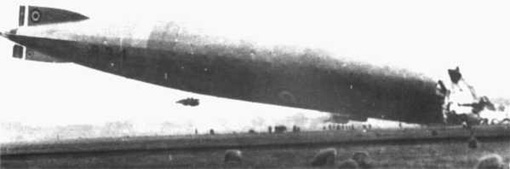
failed and the airship began to bump the ground again. All jumped from the gondolas during the night with the captain the last to leave. The next morning the airship was found to be extensively damaged. The nose of the
airship had completely broken off and was on the ground. The forward part of the remaining airship was touching the ground with the tail lifted into the air. Several of the internal ribbing supports had broken which
gave the appearance that the airship had broken it's back. Over the coming days the airship was stripped and then dismantled prior to being scrapped.
I do not know who was on board the R.34 for this final flight. Only the captain is confirmed.
Captain - F/Lt Hedley Vicar Drew AFC RAF.
Possibly the following.
F/O Harold F Luck.
S/Ldr Gaskell?
AC W Johnson
Possibly Fred Brodie, of Chippenham.
The R.34 was given the nick-named "Tiny". It had made the first ever trans-oceanic airship flight in mid-1919 when it flew to Mineola, New York, USA and back. It had then been overhauled at Howden and then crashed on the first flight since overhaul. It was later said that had it been modified to have a nose tethering mast anchorage point fitted then the damage that resulted back at Howden would probably have been averted.
Acting Lt Drew AFC was removed from the Admiralty List on 27th January 1920 and was transferred to the RAF as an officer. Between September and November 1924 he served in Iraq and was awarded the OBE for service. Nothing more is known other than he was promted to S/Ldr on 29th May 1929 and W/Co on 1st January 1936.