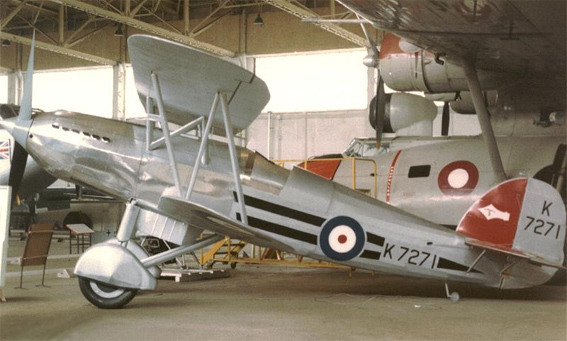
When I first visited this crash site the details of what aircraft it was and when it came down were not known to myself nor appear recorded anywhere in the history books. This is rare as most other incidents I research involve a specific aircraft, with a known serial number, squadron, crew, fate of aircraft, fate of crew, etc, then the crew and crash site locations are usually researched prior to a site visit. Researching this plane is completely the opposite. All that was confirmed is that an aircraft crashed at this exact location and that it occurred before the Second World War with nothing more known other than it was believed the pilot had survived.
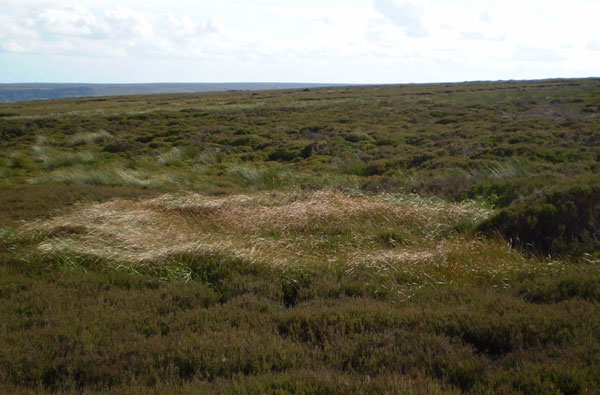
The aircraft crashed onto what is now the grass area shown on the photograph above. I was taken to the crash site in December 2004 by Mr Andy Hunter, who in turn had been shown the site in the 1980s by a local Rosedale gentleman. Very little remained at the site in 2004, only a small scattering of thin glass, some tiny pieces of wood and alluminum and a shallow depression in the ground shows where it crashed. Two small stainless steel parts of the aircraft were located and both were in remarkable condition (though as one would probably expect from anything made of good quality stainless steel). In the 1980's silver coloured doped fabric was present at the site as well as wing struts. Mr Ken Ward, of Bilsdale, is known to have recovered many of these parts for his collection. A fuel tank was also reported to be have been apparently dragged away from the site but left on the moor, if it still remains on the moorland then it is yet to be located. Before Bill Cowley invented the Lyke Wake Walk this part of the North Yorkshire Moors was a fairly inaccessable and remote place. As the Lyke Wake Walk gained popularity a good path now runs within a hundred metres of the crash site.
After recording what was found at the site an intensive period of research was carried out. With the research being reversed I have reversed my usual webpage format to show how this research was carried out and how I came to my conclusions. I returned to the site a number of times since the first visit and have found a few other tiny pieces of the aircraft on the moor but only one other piece contained a similar Hawker inspection stamp.
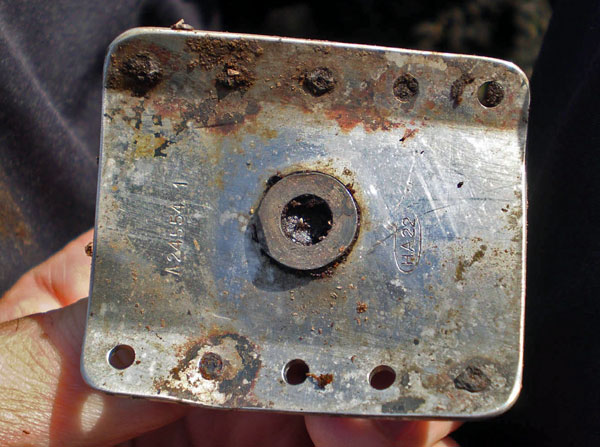
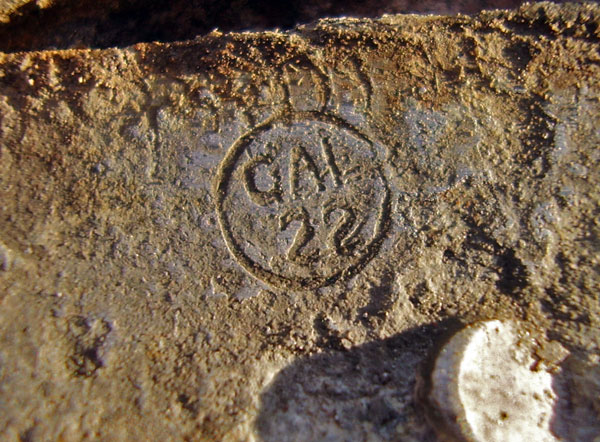
On my first visit to the crash site in December 2004 with Andy Hunter and John Skinn one good stainless steel piece was located and this contained an identification stamp of "H.A.22" which I believe is a Hawker inspection stamp (photograph shown above). An exact same piece was found at a Hawker Hector crash site in the Lake District in 2011 which does seem to suggest that the aircraft had something to do with Hawker aircraft. A few other small fragments of the aircraft were located and are shown below and at the time they seemed insignificant though were photographed.
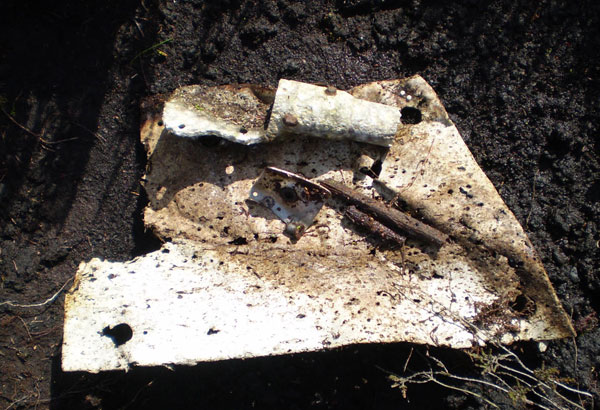
The largest of the pieces shown above is a panel measuring around 40cm by 30cm and is in very poor condition and in 2004 I gave this piece hardly a second glance because of its condition. Upon closer inspection in May 2011 a makers inspection stamp was located on it after gentle cleaning showing "G.A.L." markings. This refers to the part being manufactured by the General Aircraft Limited company who built a batch of 89 Hawker Fury MkII's on contract from Hawker aircraft. This was G.A.L.'s only contract with Hawker to manufacture their aircraft so it is a reasonable suggestion that the aircraft crash site is a Hawker Fury MkII.
Of the batch of Fury's the only aircraft that really fits the bill is Fury K8221. Fury K8221 was built to contract 419059/35 by General Aircraft Ltd at Hanworth. It was issued directly to 9 FTS at Thornaby on 24th July 1936. A Thornaby based "Steerman" aircraft is rumoured to have crashed in the "Rosedale Head" area before the War, as it stands this site (if it actually exists) is yet to be discovered. I would respectfully suggest that this "Steerman" (which were never used at Thornaby) is it fact the Fury near Shunner Howe, at the head of Northdale, an off-shoot of Rosedale.
Fury K8221 was being flown on a training flight on 2nd January 1937 when it encountered a very thick layer of fog which had covered much of the North Yorkshire Moors and the surrounding area. The aircraft crashed on high ground whilst descending through a layer of cloud. The pilot (names below) survived the crash, he is not thought to have baled out however which Mr Hunter's guide suggested. The accident record card states that the aircraft was initially given Cat.R damage (meaning it was deemed repairable), any repairs seem very unlikely to have been carried out as it was written off in March 1937 and since a sizable amount of wreckage is known to have been left at the site it is doubtful that they the whole of the aircraft was ever recovered. What wreckage did remain at the site was only removed in the 1980s when Mr Ken Ward recovered it for his collection. Having said that, it is not to say that the engine, cockpit and main fuselage were recovered and the smashed wing sections and other broken sections left at the site. Many pre-WW2 aircraft were repaired even though in todays era one may consider the damage to have been too great.
A press report has been found in the Whitby Gazette and confirms that the aircraft crashed near Shunner Howe on 2nd January 1937. It states that the Thornaby-based pilot was undertaking an altitude test and had flying at 1,000 feet when the aircraft entered a bank of cloud, the pilot descended through a layer of cloud but was met with a hillside infront of him so to avoid crashing he force-landed on moorland and the aircraft was badly damaged. The weather on 2nd January 1937 was horrendous, at least five other aircraft force landed in the North Yorkshire Moors area on this day due to the thick fog. The details of the others are something I am very keen to document and I don't believe that it has ever been done yet. I am still uncovering details of others, the number of those involved on this day may increase in due course.
Pilot - Acting P/O Bonar Roy Whaley RAF (37919). Of Dauphin, Manitoba, Canada. Slightly injured.
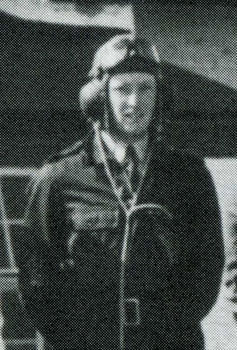
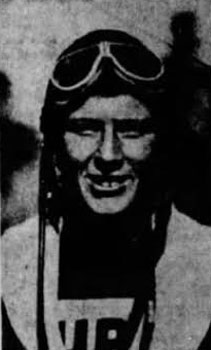
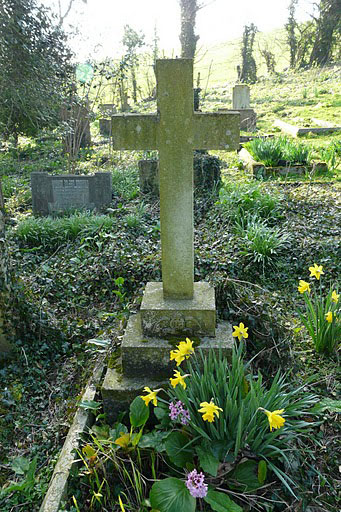
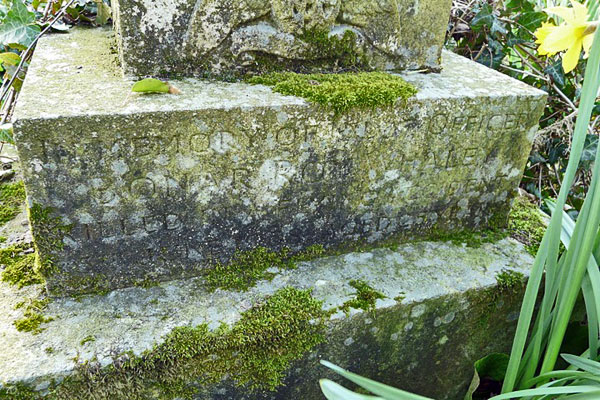
The left photograph is credited as being as a "Sgt Walley" who was flying with 25 Squadron's Hendon display team in 1937. The photograph of Bonar Whaley shown on the right was taken from his obituary in the Winnipegg Tribune newspaper and kindly shared with me by Darryl Toews. Both photographs appear to show the same person. Bonar Whaley the son of George and Ida Whaley and was born in Vancouver, Canada in 1913 but he and his family moved to Manitoba when he was young. As a young man he lived in Dauphin and worked for the Bank of Nova Scotia there. He learnt to fly at the Brandon Flying Club in 1932 and there he gained his Private Pilot Licence. He received his short service commission to the rank of Acting Pilot Officer on probation in the RAF on 21st July 1936, he was posted to 9 F.T.S. at Thornaby on 18th July 1936. Following his incident in January 1937 he resumed his 9 F.T.S. training. On 8th February 1937 he was flying a Fury from Thornaby to Catfoss with two other 9 F.T.S. when poor weather forced all three to make forced landings east of York. Whaley landed in a field along side the York to Hull road at Barmby Grange, Pocklington without damage or injury. He later completed his training and was posted to 25 Squadron at Hawkinge on 21st February 1937. He was graded as a Pilot Officer on 11th May 1937, Gazetted on 8th June 1937. P/O Whaley was killed in a flying accident on 25th June 1938 at Holywell, near Folkstone. He was the pilot of 25 Squadron Demon K3798 with P/O Charles Connell Law as a passenger. He was twenty five years old and is buried in Old Hawkinge Churchyard, Kent. The photographs of his grave shown here were found on the internet and I credit "Hastingsleigh" with uploading them. He is commemorated on the Dauphin "1939-1945" War Memorial dispite loosing his life in 1938. On the same War Memorial is F/O Frank Myers RCAF, killed in the crash of Halifax NP793 at Hutton le Hole, on the North Yorkshire Moors in 1945 (an incident detailed on this website).
Mr Ken Ward recovered many of the remaining parts from the crash site in the 1980s and were seen in his collection in 2010. He allowed me to photograph many of these small parts from this aircraft. The three photographs I include here are some of those parts. Two of which are stainless steel parts, the lower photograph is of a strut which would have been located between the Fury's two sets of wings.
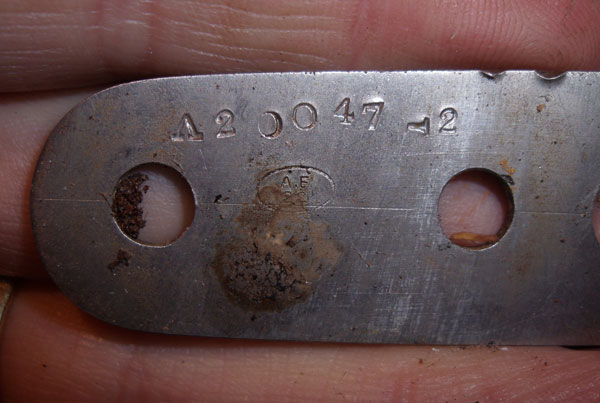
A currently unidentified "A.E." inspection stamp.
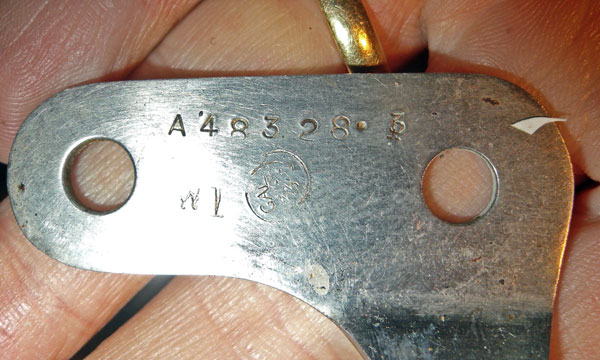
A further "G.A.L." inspection stamp from the General Aircraft Limited company.
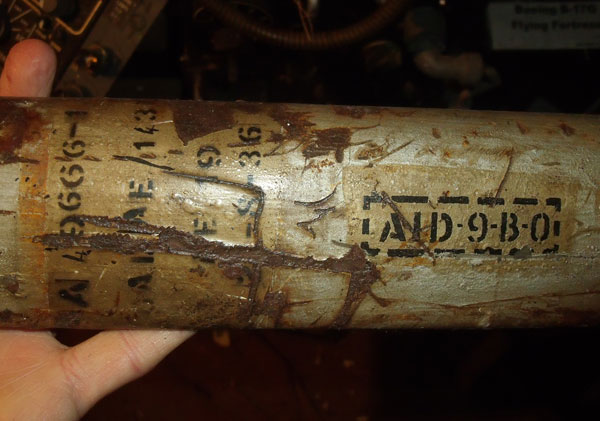
This piece is in remarkable condition after some fifty years on the moor. The metal strut is painted in olive and then stencilled with the lettering which is still readable.