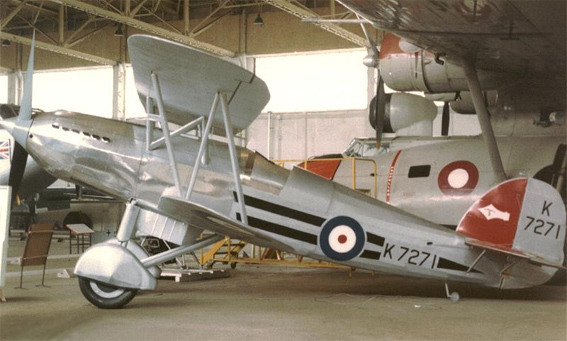
A Hawker Fury II.
On 14th May 1937 this No.9 Flying Training School aircraft was being flown on a training flight when the pilot became lost having flown into a bank of sea fog in the Whitby area. Prior to the crash he was seen to
fly over the harbour area and then head north to attempt a landing, narrowly missing the west pier lighthouse. The pilot then turned it around and attempted to land flying south on the sands but stalled during the turn
then it hit the sea wall head on. It narrowly missing workmen above it. The pilot was found still strapped into his cockpit but was trapped in the badly damaged aircraft. He sustained serious injuries to his head which
was said to include to an eye, he also had a broken leg. After he was freed he was taken to the promonade via the cliff lift and then to the Whitby Cottage Hospital. The incident was partly blamed on the formation leader who this pilot
had presuambly lost sight of, reasons for this are unclear due to an unreadable A.M.Form 1180 record card. Two other RAF crashes that day were attributed to the same foggy conditions.
Fury K8220 was built to contract 419059/35 by General Aircraft Ltd at Hanworth and delivered directly to No.9 Flying Training School at Thornaby on 24th July 1936. Following this incident it was originally
assessed and given a Cat.R/FA damage assessment but after re-assessment it was given as Cat.W/FA and struck off charge on 18th August 1937.
Pilot - Acting P/O Stephen Austin Levenson RAF. Injured.
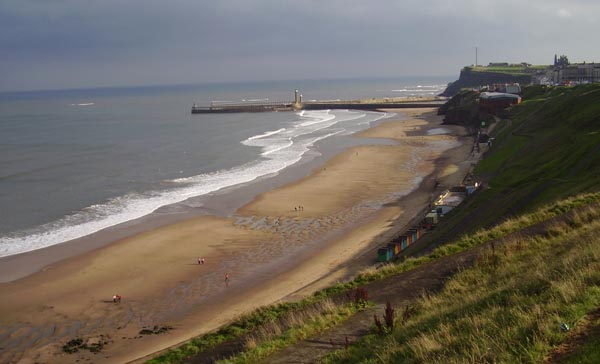
The description in newspapers would suggest that the incident crashed onto this part of the beach. A photograph shown in the Yorkshire Post
has Sandsend in the background, this could be down to it being brought off the sands there.
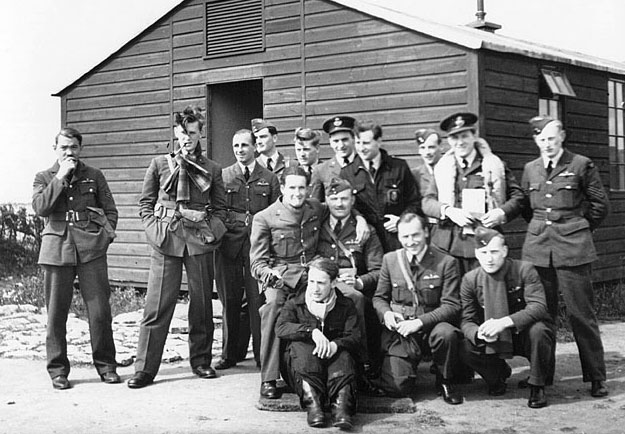
He re-joined the RAFVR prior to WW2 and when war was declared he was recalled to the RAFVR. He later joined 611 Squadron in 1940 and on 27th April 1940 he was the pilot of Spifire N3063 which crashed near Grantham after he had become caught in a searchlight beam, having climbed to try and evade the light he was blinded, the aircraft entered a spin and baled out, the aircraft crashed near Kilvington, Nottinghamshire. The photograph shown above was found on the internet and he is shown with a group of other pilots at Digby; he on the back row, far left. During the Battle of Britain on 11th September 1940 he was the pilot of Spitfire P7321 that crashed on landing at Bletchingley. On the same day he was credited with destroying a Junkers Ju88. By the end of September 1940 he was posted away to the Central Flying School to undertake an instructor's training course.
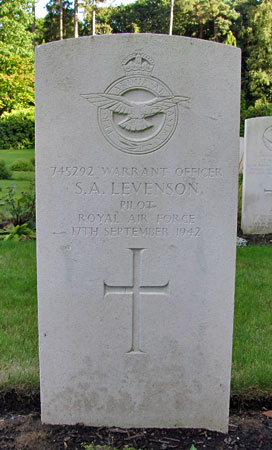
He later re-trained as a bomber pilot. By September 1942 he had risen to Warrant Officer and had been posted to 214 Squadron. On 19th September 1942 he was the pilot of Stirling R9350 flying Ops to Essen when his aircraft was shot down by a night-fighter and crashed in Belgium. He and four of his crew died while two became PoW's. W/O Levenson was buried in Heverlee War Cemetery, Belgium. He left a wife Margaret Macallum Levenson (nee Melville), of Taynuilt, Argyllshire. My thanks to Mr Ade Harris for the photograph of Stephen Levenson's gravestone.
Stephen Levenson was the son of Alexander and Agnes Levenson (nee Fretwell), he was born Wandsworth, London in 1918. He was granted a short service commission in the RAF as acting P/O on
probation on 24th August 1936. He trained at 10 FTS at Perth prior to posting to 9 FTS at Thornaby where he gained his Wings around Christmas 1936. Prior to the crash at Whitby he had clocked
up a total flying time of 144 hours of which 12 hours were in the Fury type. He was graded as P/O on probation on 26th November 1937, posted to 66 Squadron the following day and was confirmed
in the rank of P/O on 27th February 1938. He was certainly injured as a posting on the RAF Commands forum website by his niece stated that his sister visited him in hospital following his eye injuries.