This aeroplane was one of a twelve of Hawker Harts returning to their home base of Montrose on 12th April 1937 after their unit, No.8 Flying Training School, had been on a three week detachment to the ranges at Sutton Bridge, Lincolnshire for training exercises. Before taking off the crews were warned about patchy fog further north and to close up in a tight formation should they encounter problems with visibility. It seems likely this aircraft had landed at Catfoss to refuel before continuing north following the coastline. This was a route known to be flown in the 1930s when navigation aids were poorer than what came in the decade after. Catfoss aerodrome was close enough to the coast to be used for refuelling purposes. After take off from Catfoss the fog closed in and was severely effecting visibility, as ordered the pilots formed a tight formation with the aim of sticking close to each other to fly through the cloud and emerge later further up the coast. As the aircraft were flying so closely one aircraft got too close to another leaving the pilot of this second aircraft to climb to avoid it and as a result out of the fog but now alone at around 7,500 feet. Having now climbed out of the fog this aircraft had now lost his formation and having only qualified as a pilot six months previously the pilot opted to find his formation by descending again into the cloud. A risky move not knowing if they were over land or sea and a move which would cost many an experienced airman his life in the War which would come only two years later. In this case the Hart levelled out above the sea and visibility was only fifty feet at that height. The observer/mechanic in the rear seat had worked out by the position of the sun that they were flying in a roughly north-easterly direction and they should head west to pick up land again. They had to pull up to avoid cliffs on land-fall near Robin Hoods Bay and soon afterwards pull up again to avoid two men with pitch forks on a haystack and the steeple of a church nearby. A force-landing had to be made because of the fuel running low and a further circuit of the village was made before the pilot put the aircraft down on the cliff top where upon it clipped a fence on top of a railway cutting and ended up on steep ground ajoining the railway. Both airmen were uninjured and made their way to the a nearby farm and it then became apparent where they were. The aircraft came to rest almost buried in a cornstack below Bay Ness Farm, Robin Hoods Bay. A happy ending to this incident is that a young lady at Bay Ness Farm where the two airmen found their way to fell in love with the observer and two years later they were married at St Stephen's Church, the church which the aircraft had narrowly missed before landing.
Pilot - Acting P/O Michael James Beaumont Young RAF (39152).
Observer - AC Neil Campbell RAF.
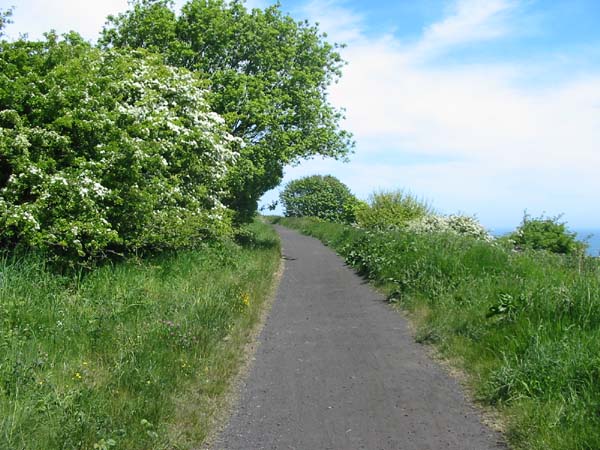
The aircraft came to a halt in this area, my thanks to Mr Mike Richardson, nephew of the observer (and grandson of the owner of Bay Ness Farm) for contacting me, for making me aware of this incident and for the information and photograph he has been able to provide to ensure it is documented on this website.
Michael Young was the son of Major Reginald Young and was probably born in the Romford area of Essex in 1916. He was granted a short service commission in the RAF as Acting P/O on probation on 31st August 1936 and gained his Wings at 8 FTS at Hamble on December 1936. He was posted tto 98 Squadron on 24th April 1937 and graded as P/O on 13th July 1937. He was posted to 98 Squadron after completing his training and on 5th June 1937 he was the pilot of Hind K5444 which was force landed at West Freugh airfield in poor weather, he escaped injury but the aircraft was badly damaged. He was promoted to F/O on an unknown date and almost certainly married in the Basford area of Nottinghamshire in 1939. He was later promoted to F/Lt on 3rd September 1940 but by this stage had transferred to the RAFO. He was awarded the DFC on 1st July 1941 but the unit he was service with is not yet known. He later rose to become Commanding officer of 540 Squadron from October 1942 to May 1943 and was promoted to S/Ldr (war subs) on 23rd April 1943. As Acting W/Co he was awarded the Bar to the DFC, Gazetted on 20th April 1943, for service with 540 Squadron. The citation for his Bar to the DFC reads.."Since being awarded the DFC Wing Cdr. Young has completed 36 sorties. For the past nine months he has commanded a flight." Post-WW2 he transferred to the RAF Reserve on 17th May 1950 as S/Ldr, retaining the rank of W/Co. He probably died in the Grantham area of Lincolnshire in 1979.
Hawker Hart K4409 was built by Gloster Aircraft Ltd at Hucclecote to contract 322854/34 and although it was ordered as an Audax, it was completed as a Hart (Special). It was initially taken on charge by 40 Squadron at Abingdon on 15th November 1935 before being transferred to No.8 F.T.S. at Montrose on 5th May 1936. Following the forced landing near Robin Hoods Bay on 12th April 1937 Cat.M/FA damage was the damage assessment which appears to have seen a repair on site being made and it being flown out once repaired. If it was taken out by road there is no information available to state where it was repaired. On 21st February 1938 it sustained a second accident when it overturned at Catfoss. Again, Cat.M/FA damage was the damage assessment and was again appears to have been repaired on site and returned to the unit. On 25th October 1938 it transferred to No.1 F.T.S. at Netheravon. On 20th November 1939 it passed to No.7 F.T.S. at Peterborough. It then went to 24 M.U. at Ternhill on 22nd February 1941 where it was stored until it was converted into instructional airframe 2702M on 30th September 1941. After this conversion nothing more is known.