Airspeed AS.1 Tern BGA.190 glider at Sutton Bank.
In late-July 1932 the well known pilot Edward Mole was invited to Yorkshire with the aim on adding to both the British distance and endurance records, both had previously been achieved in Yorkshire. He was loaned the Airspeed Tern by Neville Shute Norway of Airspeed Ltd, Piccadilly, York. The pilot later wrote a detailed account of his flying in Yorkshire which was published in Sailplane and Glider magazine on 12th August 1932, he also wrote of the flights in his auto-biography "Happy Landings".
The first few of the flights were made at Sutton Bank but any record attempts were cut short when the flying conditions changed. The group then re-camped to Ingleby Greenhow and flights were made from the hills above Ingleby Greenhow with the aim of attempting to beat the endurance record of 21.5 hours in the air. The Ingleby Greenhow site was one of a number of gliding sites used on high ground in North Yorkshire during the 1930's in the early days of popular gliding. Flares (for landing at night), food, water and a barograph were loaded into the glider and a launch was made after rounding up a number of walkers to assist in the tow launch. After around an hour in the air storm clouds blew in but the glider had reached a maximum of 1,450 feet above the start level, with the previous British record a meer 780 feet. The pilot landed on the Moors after 3 hours 45 minutes because of poor weather but because of the weather and being unable to work out their position on the ground, the pilot and his assistants spent the night on the moorland sheltering under the wing of the Tern. The glider was later taken down from the hill and transported back to Sutton Bank.
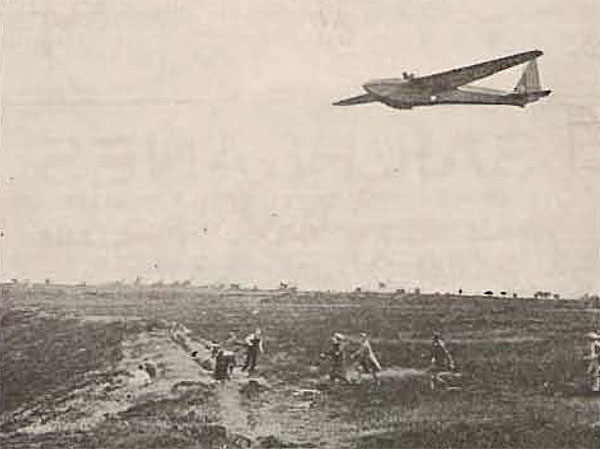
Another attempt at the endurance record was the made a few days on Monday, 25th July 1932 but the group did not have enough people to assist with the launch so resorted in stopping cars on the Thirsk road to ask if people could help, they ended up trying to launch with just five men on each of the bungees and this time farmers, road workers, motorists and walkers were asked to help! The glider flew at around 500 feet and rose to 800 feet but after four hours flying the wind dropped and a landing had to be made on the landing ground fearing a forced landing in the fields below. The photograph above shows the Tern taking off at Sutton Bank for this flight (photograph Sailplane and Glider magazine). Later they launched the Tern again but did not have enough people to hand to man the bungees, the glider did not have enough speed to take off and it struck a fence post hidden in heather on take-off at the Sutton Bank gliding site. The glider sustained damage to the fuselage and any further flights were called off. The Tern was transported back to the Airspeed factory in York where repairs were carried out.
Pilot - "Mr" F/O Edward Lucas Mole.
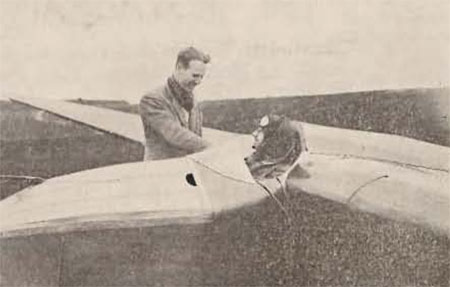
Edward Mole seated in the Tern at Sutton Bank (photograph Sailplane and Glider magazine). The pilot was a serving RAF Officer and was a well known and successful glider pilot of the early 1930s. In many of his gliding exploits he is refered to as "Mr Mole".
Edward Mole was granted a permanent commission in the RAF as a P/O on 14th January 1928. He rose to F/O on 14th July 1929, and to F/Lt around 1934 and to S/Ldr on 1st August 1937. He served in the RAF throughout the Second World War and rose to G/Cpt by 1945.
On 2nd August 1931 he achieved a record time of 6hrs 10mins for staying in the air while flying in his Proffessor glider
and in 1933 he achieved a further record of 6hrs 55mins flying a Willow Wren. Flight Magazine of the day carries many articles of
his gliding and soaring exploits. G/Cpt Edward Mole BSc later wrote the book "Happy Landings" (published by Airlife in 1984).
On 24th August 1931 Herr Carli Magersuppe flew it in a record breaking flight from Ravenscar to Scarborough. Carli Magersuppe was one of a number of young German glider pioneers who sought work in England. He would later make the first Channel crossing in a glider and hold further records. On 30th August 1931 he piloted the Scarborough Gliding club's "Scarboro" Kassel Hercules two seat glider on the same route with Mr Fred Slingsby as passenger and there by claimed the first two-seat gliding distance record between Stoupe Brow and Scalby Nabs.
Airspeed Ltd added the following to their publicity material following the first record breaking flight over the North Yorkshire Moors and coast..."On August 24th the "Tern" piloted by Herr Magersuppe, flew from Ravenscar to Scarborough under B.G.A. record conditions, a distance of 8.3 miles from taking off
place to alighting place. The flight took 33 minutes, the course being along the cliff edge in a north easterly wind. For this flight a distance record for a British built sailplane has been claimed. The flight was actually the second soaring flight made by the "Tern," the first being a 15 minute test flight." The photograph shown
at the top of this page shows the Tern being launched at Stoupe Brow for this record attempt.
Flight Magazine of the day stated that "the distance covered was 8.3 miles from a point at Stoupe Browe, Ravenscar, to a point on Scarborough North Beach. Although other distance flights have been made on a sailplane in this country, i.e., Herr Kronfeld from Lewes to Portsmouth (70 miles) and F/O Buxton from Dunstable to Luton Hoo Park (16 miles),
"The Tern's" flight is the first British Official Distance Record to be recognised by the British Gliding Association. It is expected that this record will be broken in the very near future, as this flight has stimulated keen rivalry among the British sailplane pilots."
On 27th September 1931 the Tern was flown by Major Henry A Petre DSO MC from the Ingleby Greenhow gliding site who set an official British altitude record of 780 feet above starting point. Henry Petre's brother Edward was killed in a flying accident at Redcar in 1912. Given these successes it is strange why only one Tern was ever completed.
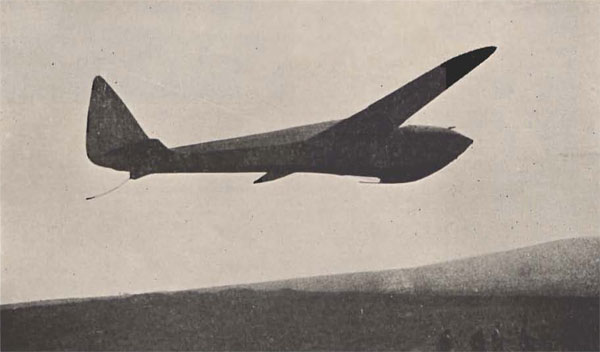
Only one Airspeed Tern was ever built and I will try to give as much information as I have researched about it below. Edward Mole spoke very favourably of it stating that
"no other sailplane that I have tried possessed quite the ease and certainty of control, which was a most pleasing revelation."
The following is taken from publicity material from Airspeed in Summer 1931 - "the Tern is a cantilever monoplane, of straightforward and robust design. Span 50 ft. ;
wing area 201 sq. ft. : Loading 2.06 lbs. sq. ft. The wings are of two spar construction, tapering in plan throughout their length. Ball bearing controls are utilised
throughout, in accordance with the most modern aircraft practice. We claim that the "Tern" is the most easily erected and dismantled sailplane yet produced. Each wing
is removed by withdrawing two large bolts, no attention whatsoever being necessary to the aileron control. Each tail plane is removed as a unit with the elevator by
with drawing two large bolts, no attention being necessary to the elevator control. It is very easily possible for three men to erect or dismantle the machine completely
in ten minutes. The "Tern" is fully equiped for auto-towing, and an airwheel undercarriage with 7 foot track can be supplied if desired. The skid is sprung on rubber
blocks and well faired to the body with leather. Owing to the absence of wing struts, the "Tern" is aerodynamically very clean, and has a theoretical gliding angle of
1 in 25. The machine has a B.G.A. certificate of airworthiness, and has been stressed for aeroplane towing at 70 m.p.h." Airspeed offered them for sale at £248 in August 1931.
Airspeed AS.1 Tern BGA.190 was built by Airspeed Ltd, York and was registered to them as BGA190 in August 1931. As a result of the mishap at Sutton Bank on 25th July 1932 the damaged glider was returned to Airspeed for repair. In 1933 the glider was at R.F.Dagnall’s in Guildford before being sold to the South Down Gliding Club members Graham Andrew Little , Alan Herbert Reffell and Dr Alan Fleming McGlashan in May 1933. Damage resulted at Sutton Bank on 3rd September 1934 and was repaired and back flying again less than a week later only to be damaged again there on 9th September 1934. It was later registered to G.A.Little in 1935 and remained in his possession, including during the Second World War, when it was placed into store. In June 1946 it was registered to the North Somerset Gliding Club at Westonzoyland before moving to the Bristol Gliding Club at Lulsgate. It suffered a flying accident at Lulsgate after which it was sold to Andy Coulson at Newcastle for spares. After this nothing more of the glider is known.