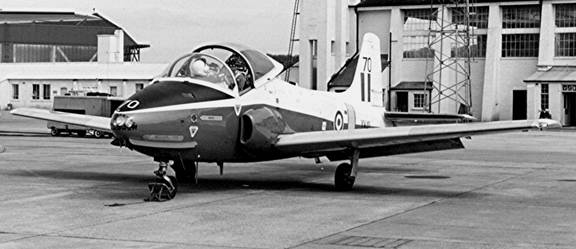
On Friday, 6th June 1986 crews of two Jet Provosts were undertaking training flights with No.7 Flying Training School over North Yorkshire as part of their Refresher Flying Squadron training. During a formation tail-chase and while roughly over Helmsley the pilots lost visual contact with each other's aircraft. The lead pilot then noticed the other aircraft had got ahead of him but was unable to avoid a collision. The aircraft collided in the skies just north of Helmsley, XW411 skimmed the canopy of XW407 and also removed the tail of XW407, but possibly from behind. The tail may not have totally detached following the collision but perhaps bent forward. All airmen ejected and the two aircraft came down around two miles north of Helmsley in thick woodland.
Pilot - F/Lt Brian Ronald Iddon RAF (8141030). Seriously injured.
Brian Iddon was born in 1956 and was appointed a permanent commisision in the RAF as F/O on 20th July 1978 (but with seniority back-dated to 11th July 1978). He was promoted to F/Lt on 11th January 1982. He later set up Iddon Aviation Services Ltd.
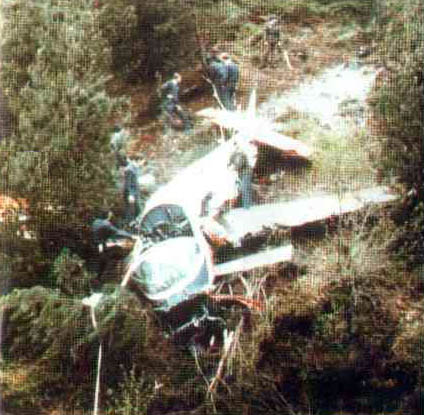
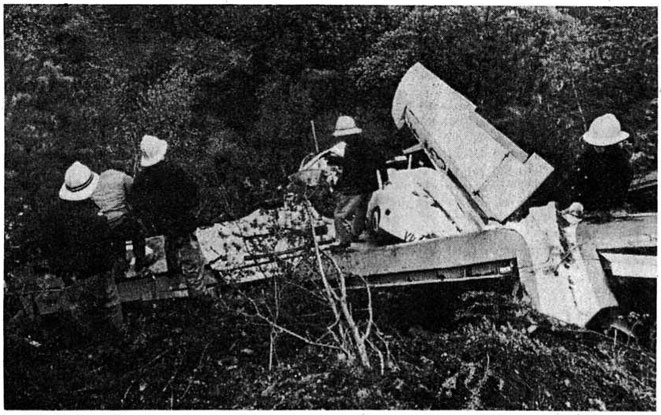
The colour photograph above shows one of the crashed aircraft in woodland between High Baxtons and Ouldray Farm; this photograph is believed to be from an RAF magazine of which I was given a copy of the photograph during the early years of my research, unfortunately I do not have the name of the publication to credit it properly.
The black and white photograph was found in the Yorkshire Post newspaper and may be a photograph of the same aircraft or possibly the other aircraft. The black and white photograph shows the tail of the aircraft with the first two numbers of the code "-133" visible. On virtually an identical photograph sourced in another newspaper the aircraft serial "XW4.." is visible and it appears to show the numbers "XW411" though the "11" could well be the sides of the number "0" which would refer to "XW407". If these photographs show different sites and as both are on steep wooded hills they could show both crashes or just one and the same aircraft.
This was one incident I remember happening as I was a boy growing up in Helmsley and have since been able to speak to a number of people who remember the incident. In 2005 John Skinn and myself began the difficult task of trying to find where XW407 and XW411 had crashed and searched a huge area of woodland over a period of weeks. In Summer 2006 we located the site of where one aircraft had crashed which I now believe is Jet Provost XW411. In December 2020 I eventually located where the other Jet Provost (XW407) had crashed. At both sites several small fragments of each aircraft were located to confirm the locations.
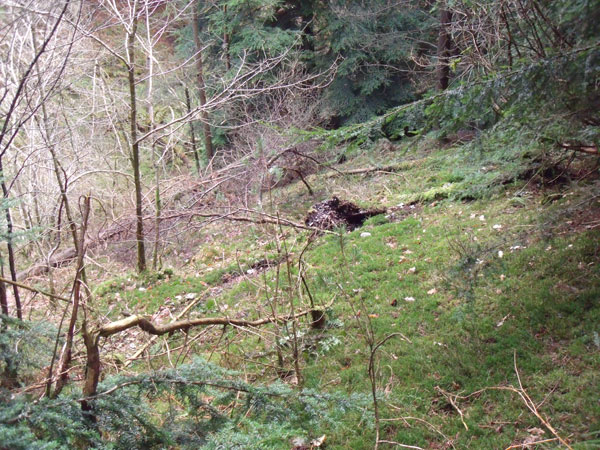
In 2010 I revisited what I believe to be the crash of Jet Provost XW411. It is the most northern of the two sites and was the one that the majority of local people were unable to get near to at the time in 1986 after a crash guard had been placed on the area. I returned to this site after the long winter and before the plants had begun to sprout again. A small tree had been up-rooted and a number of tiny flakes of bright red paint were found in the grass and in the roots of this tree. Several pieces of aircraft alluminium were also found, one baring a part number and inspection stamp.
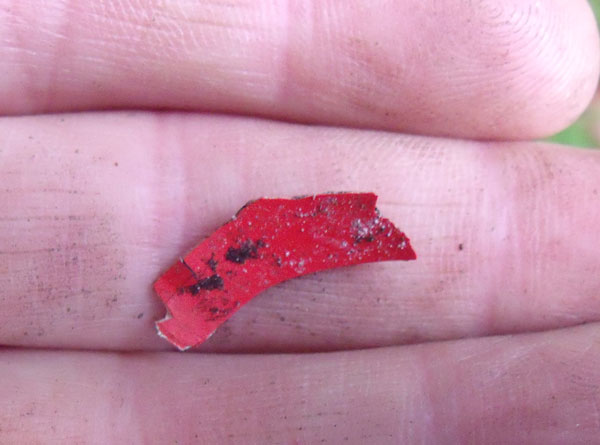
One of a number of flakes of red paint found at the crash site. The underside of this type of training aircraft was painted in a bright red scheme.
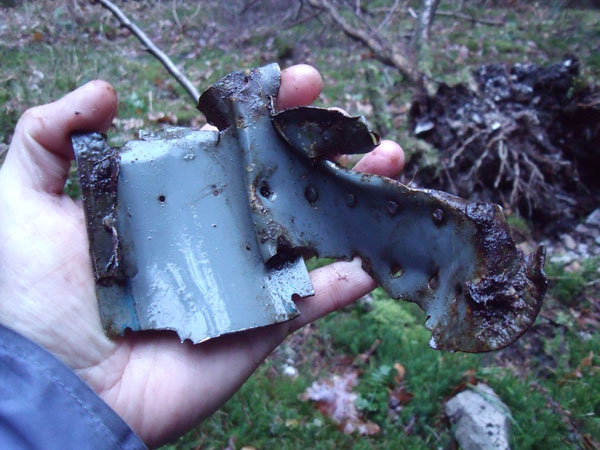
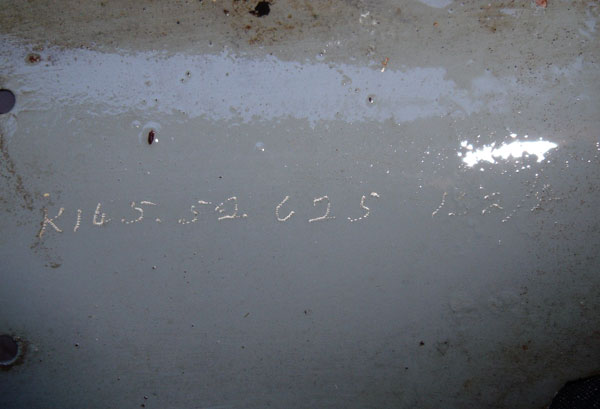
The etched number sequence (shown below) was found on the peice (shown above).
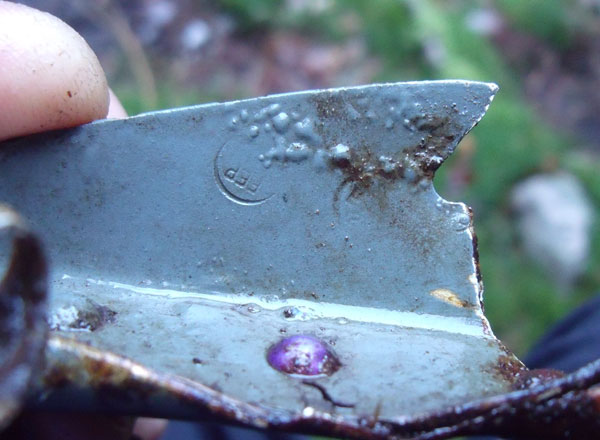
The EEP inspection stamp found on one of the parts at the crash site. This number confirms the site as being an aircraft crash site. This one small stamp tells a story of aircraft manufacturing in Great Britain and why a BAC built aircraft would carry EEP stamps. EEP refers to the English Electric company based near Preston, English Electric were part of BAC (British Aircraft Corporation) which formed in 1960 from what remained of Hunting, Vickers-Armstrong, English Electric and Bristol. Under the new name BAC built the Jet Provost. English Electric clearly were still manufacturing parts under their old identity. BAC later merged with Hawker Siddeley and Scottish Aviation and is now know as Brish Aerospace (BAe).
Jet Provost XW411 was built to contract KC/E/124 by B.A.C. at Luton and ready and awaiting collection on 19th August 1971. It was issued to RAFC Cranwell on 23rd August 1971 and coded "-70". It was taken to BAe for conversion to a T5A on 12th November 1974 and was ready and awaiting collection on 1st March 1975. It returned to RAFC Cranwell on 3rd March 1975 where it was still coded "-70" and it is also recorded as having been re-coded "-16" by 7th August 1975. It went to RAF Wyton on detachment on 1st November 1977 but returned to RAFC Cranwell, still coded "-16" on 20th January 1978. It again went with a Jet Provost detachment to RAF Wyton on 10th March 1978 and returned to RAFC Cranwell 30th July 1978, still coded "-16" and again back to RAF Wyton on 1st September 1978 and returning to RAFC Cranwell in December 1978, still coded "-16". It was loaned to 1 FTS at Linton on Ouse on 20th November 1979 and returned to RAFC Cranwell on 29th November 1979. It was then transferred to 7 FTS at Church Fenton on 27th September 1984 and was re-coded "-133" only to be destroyed with Cat.5(s)FA damage being recorded in the incident at Helmsley in June 1986. After assessment it was struck off charge on 27th June 1986.