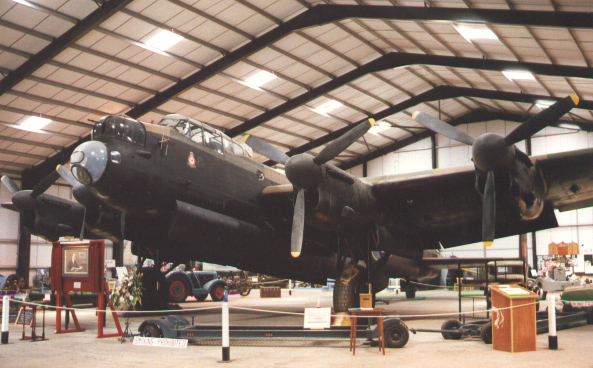
The East Kirkby Lancaster "Just Jane".
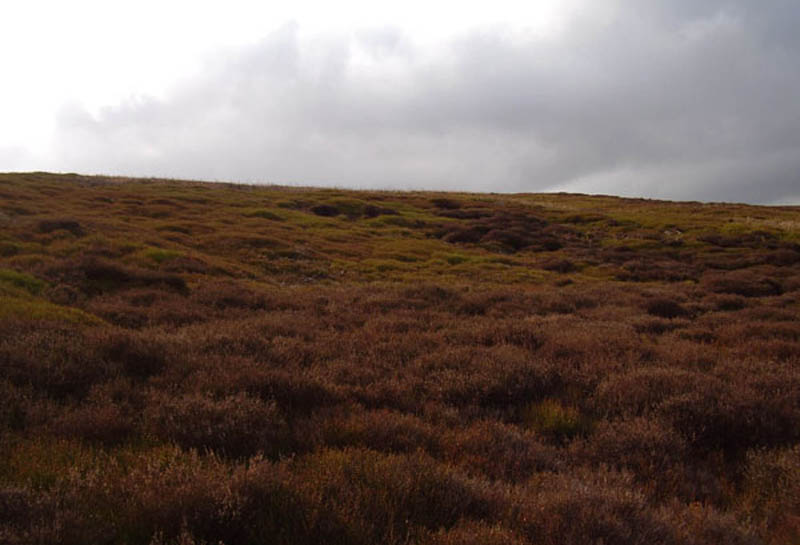
Lancaster NF961 crashed into high ground in the early hours of 18th October 1944 after the pilot lost control while flying in cloud whilst on night cross-country training flight. The crash investigation believed that the aircraft may have suffered from the effects of ice forming on the aircraft after it entered cumulonimbus cloud. This phonomena was reasonably common and at worst aircraft would fall out of the sky and this would appear to have been the case with Lancaster NF961. The resulting explosion was said to be massive, a local farmer thought that the aircraft must have been carrying a bomb load which all blew up on impact. This explosion made a huge crater and scattered wreckage over a wide area with the tail wheel being found near the bottom of the hill, I have also been told that the rear turret was also blown off and was found at the bottom of the hill in a hedge. The seven crew, who had only just been posted to 630 Squadron earlier in the month, were killed instantly in the crash. The RAF claimed to have "cleared" the site but more likely half-buried the wreckage at the site at the time by simply pushing the majority of the large pieces into the crater which later became grown over. Some years later young local boys were exploring the moor and they discovered the wreckage-filled crater and began routing about in it. They discovered a lot of un-spent .303 bullets which they took away to show friends at school. A near perfect Merlin engine was found at the bottom of the crater with only a hole in the rocker cover. Word eventually got out that these boys had found live ammunition at the site so the local policeman was informed and the RAF visited the site, they removed everything from the crater and filled the hole in. A propeller blade from this aircraft was also found by these children but was too heavy for them to carry far, it was abandoned in a hedge somewhere near Swainby but it's exact where-abouts have yet to be found.
Lancaster NF961 was built to contract ACFT/239 by Armstrong Whitworth Ltd at Baginton and was completed in July or August 1944. Elsewhere on the internet people have suggested that NF961 was initially taken on charge by 218 Squadron in early August 1944 who were in the process of converting from Stirlings to Lancasters and while at 218 Squadron it carried the squadron code "HA-D". I believe this to be an error. Lancaster NF916 was issued to 218 Squadron and carried the code "HA-D" until transfer to 15 Squadron later in the year. With the closeness of NF916 and NF961 I believe someone has made the error in switching the two last digits. The published Air Britain history of NF961 after completion states that it was taken on charge by 630 Squadron in early September 1944. It was certainly was used operationally by them on the night of 11th/12th September 1944 so must have been delivered to them a few days prior to that. It was written off with "Cat.E2/FA Burnt" damage following the above incident on 18th October 1944. The loss gets a brief mention in Leeming's ORB which states: "02.30hrs. Halifax crashed into hill at Osmotherley. All killed." There appears to have been problems in identifying the aircraft type down the destruction of the aircraft.
Pilot - F/O Dennis Archibald Brammer RAFVR (151568), aged 24, of Clayton, Newcastle-under-Lyme, Stafffordshire. Buried Stone Cemetery, Staffordshire.
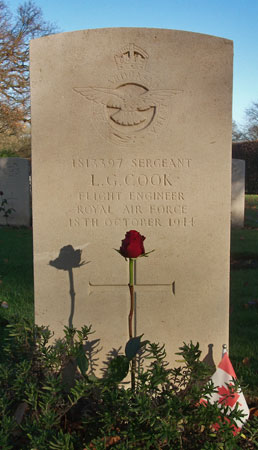
Flight Engineer - Sgt Leonard George Cook RAFVR (1813397), aged 20, of Paddington, London. Buried Harrogate Stonefall Cemetery, Yorkshire.
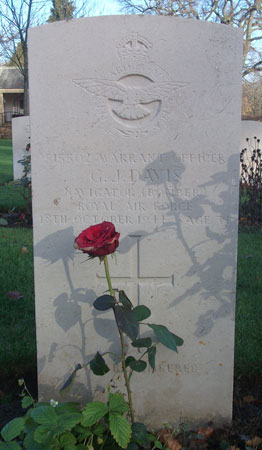
Navigator / Bomber - W/O Gerald Joseph Davis RAF (515502), aged 34, of Sunderland, County Durham. Buried Harrogate Stonefall Cemetery, Yorkshire.
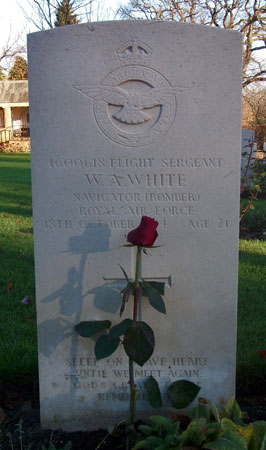
Navigator / Bomber - Sgt William Albert White RAFVR (1600618), aged 21, of Enfield, Middlesex. Buried Harrogate Stonefall Cemetery, Yorkshire.
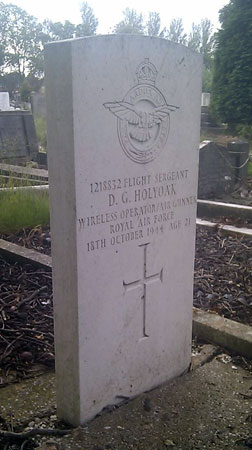
Wireless Operator / Air Gunner - Sgt Dennis Gordon Holyoak RAFVR (1218832), aged 21, of Birmingham. Buried Birmingham Yardley Cemetery, Warwickshire.
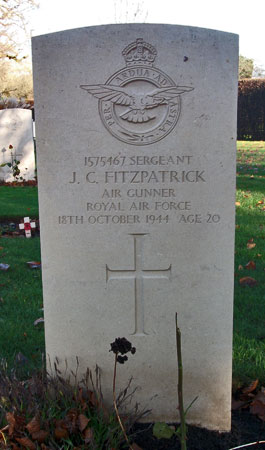
Air Gunner - Sgt John Christopher Fitzpatrick RAFVR (1575467), aged 20, of Doveridge, Derbyshire. Buried Harrogate Stonefall Cemetery, Yorkshire.
Air Gunner - Sgt Clifford John Evans RAFVR (1312674), aged 35, of Bridgend. Buried Bridgend Cemetery, Glamorganshire, Wales.
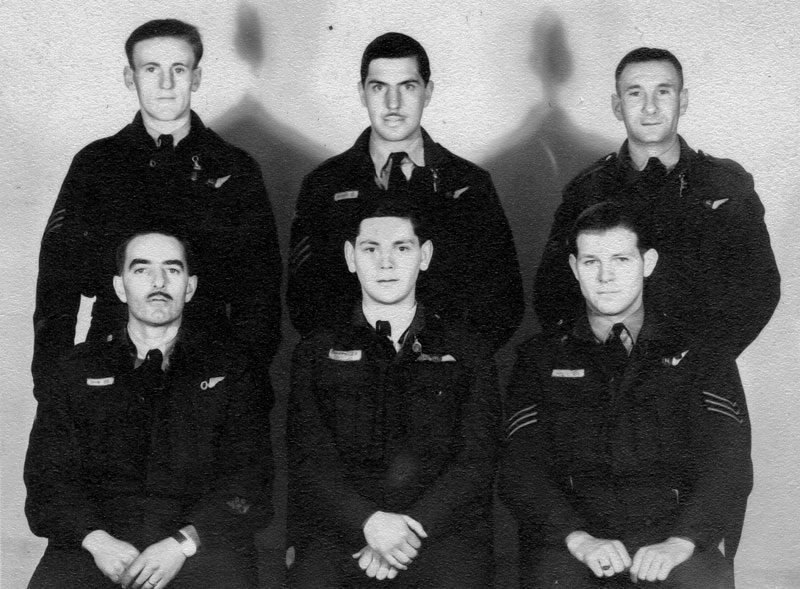
Six of the seven airmen killed in the accident near Swainby. Pictured are (Back row) Fitzpatrick, Cook, Evans, (front row) Davis, Brammer, White. I express my thanks to Sgt William White's niece Mrs Rina Kennedy for this photograph.
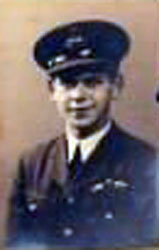
Dennis Brammer (pictured above) was granted a commission in the RAF as P/O on probation (emergency) on 19th March 1943, he rose to F/O on probation on 19th September 1943. His medal set and various documents sold on Ebay in 2007.
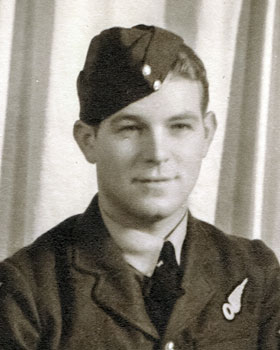
Sgt William White and his gravestone in Harrogate Stonefall Cemetery. Bill White was educated at Enfield Central School in Middlesex and was working for Gestetner Corporation in the Engineering Department when he volunteered for RAF service. After basic training in South Africa he was eventually posted to East Kirby in 1944. I thank his niece Mrs Rina Kennedy for contacting me in September 2014 and for kindly arranging (through her father/Sgt White's brother) for the crew photograph to be shown above and the photograph of her uncle shown here.
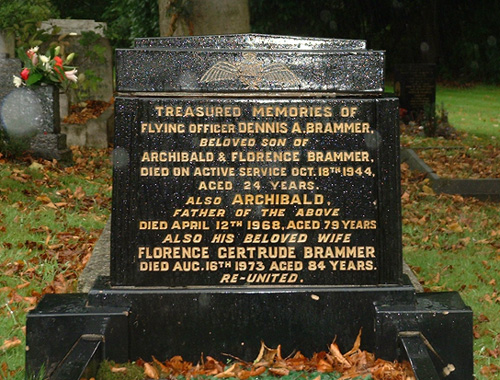
P/O Brammer's gravestone at Stone Churchyard and three others at Harrogate Stonefall Cemetery, and Sgt Holyoak's gravestone in Yardley Cemetery, Birmingham. I thank Mr Dave Williams for kindly supplying this photograph of Sgt Holyoaks's grave for inclusion on this webpage. Very little is known about any of those killed as a result of this accident.
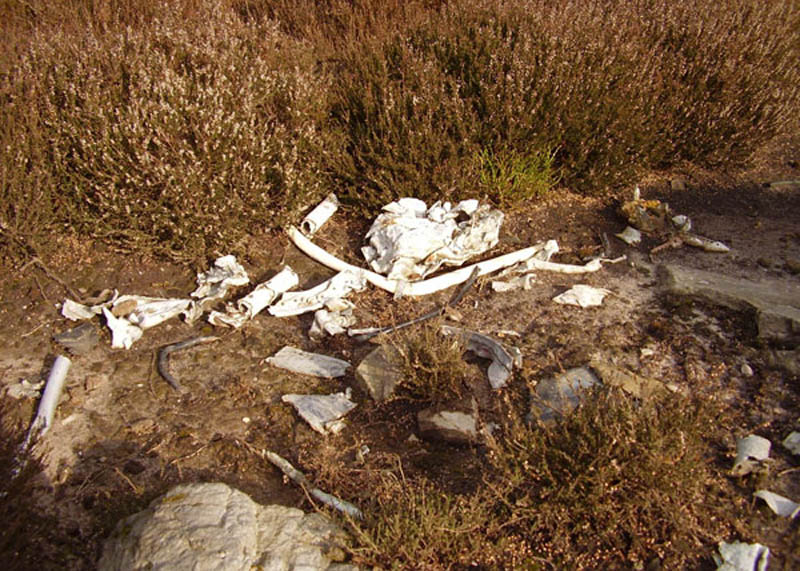
John Skinn and I first visited the site in March 2003 and only a little wreckage remained at the site. The majority of what did remain was within a small area but a little more was found some way up the hill but as already stated much of what did remain was cleared away in the 1970s by the RAF after local children appeared in school with live ammunition from the site. I revisited the site in September 2003 and located a couple more interesting items, firstly one of the aircraft's fuel gauge dials which is in suprisingly good condition and secondly a half crown coin dated from before the crash. It is more than likely to have come from a pocket of one of the aircrew who perished in the crash.
The few remaining parts of Lancaster NF961 at the crash site in 2008.
My thanks to Mr Tony Hodge for recounting his memories of this incident, he lived in Swainby at the time and visited the crash at the time as a boy.