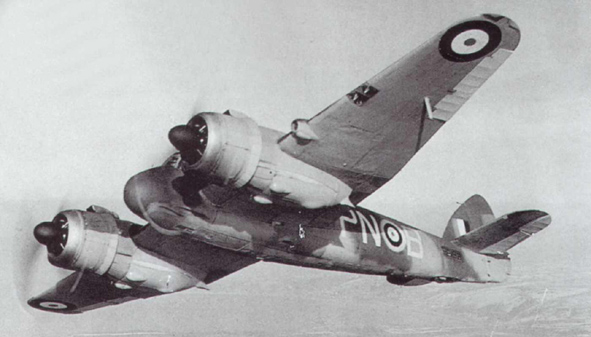
During the night of 28th / 29th April 1943 the crew of this No.2 (Coastal) Operational Training Unit aircraft were undertaking a night cross-country training exercise in good weather. Having left Catfoss at around 22.30hrs the flight took them across the North Yorkshire Moors, at 23.16hrs the aircraft struck the highest section of ground in the area on Urra Moor. Rarely for these losses there was no cloud reported covering the Moors at the time and it was thought the reason for the crash was that they simply were not flying high enough to clear the high ground while flying at night. Sadly both airmen lost their lives and the aircraft was destroyed after catching fire and later burning itself out.
Beaufighter R2152 was built to contract 983771/39 by The Bristol Aeroplane Company Ltd at Filton. On 19th November 1940 it initially went to the Director General of Research and Development (D.G.R.D.), Airframe and Armament Experimental Establishment but on 29th December 1940 it passed to 32 MU at St.Athan. It was then taken on charge by 252 Squadron at Chivenor on 2nd January 1941. This unit was the first fully equipped Coastal Command Beaufighter squadron. The aircraft was then used by the Coastal Command Development Unit (C.C.D.U.) at Carew Cheriton. On 1st February 1941 it was slightly damaged when it overshot the runway at Carew Cherition. Cat.Ac/FA damage was the damage assessment and it was repaired on site. On 8th April 1941 the aircraft was transferred to 272 Squadron at Chivenor. On 24th May 1941 this unit left for the Middle East and R2152 remained behind. Where it went until being taken on charge by No.2 (Coastal) Operational Training unit at Catfoss on 2nd August 1941 is not clear. It crashed on Urra Moor on 28th April 1943. Cat.E2/FA damage was the damage assessment and it was struck off charge the following day. The photograph above shows Beaufighter R2153 in its early life with 252 Squadron, the sister of R2152.
Pilot - F/O Peter Ewart Davison RAFVR (127323), aged 20. Buried Thornaby on Tees Cemetery, Yorkshire.
Navigator / Wireless Operator - Sgt Eric Norman Sykes RAFVR (1100677), aged 27. Buried Thornaby on Tees Cemetery, Yorkshire.

Peter Davison was the son of Myles Cooper and Blanca (nee Llewellyn-Jones) and was born on 24th October 1922 at Prenton, Birkenhead, Cheshire. His parents had married at Santiago, Chile in June 1921. He and his family left England for Brazil in 1924 returning in 1928, then leaving again in 1930. His father worked as a telegraph engineer / manager in various countries across The Atlantic. Peter later returned to England to attend Rossall School, Fleetwood before taking up a place at Downing College, Cambridge to read Law. He also was a member of the college rowing team. Aged sixteen, in August 1939 he sailed to Barbados, returning in October 1939 with his address given as Bromley, Kent. When he enlisted into the RAF is not yet known. He received a commission to the rank of P/O on probation on 31st July 1942 and was later promoted to F/O on probation on 31st January 1943. His father was living in Santiago, Chile in 1943 when his son died.
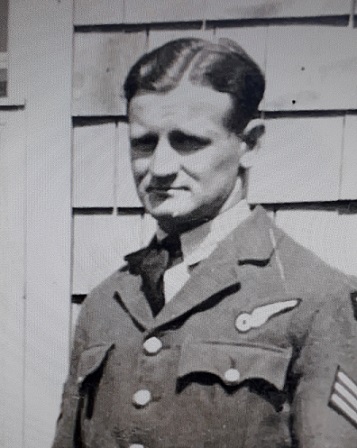
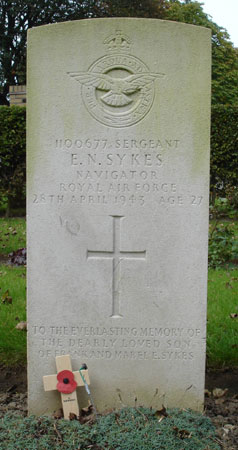
Eric Sykes was born on 16th March 1916 at Cheadle Heath, Stockport, Cheshire and was the son of Frank and Mabel Elizabeth (nee Harris) Sykes. He was baptised at St.Augustine's Church, Brinksway, Cheadle Heath on 23rd July 1916. The family later moved to Chorlton-cum-Hardy, Manchester. I have not located the family on the 1939 Register.
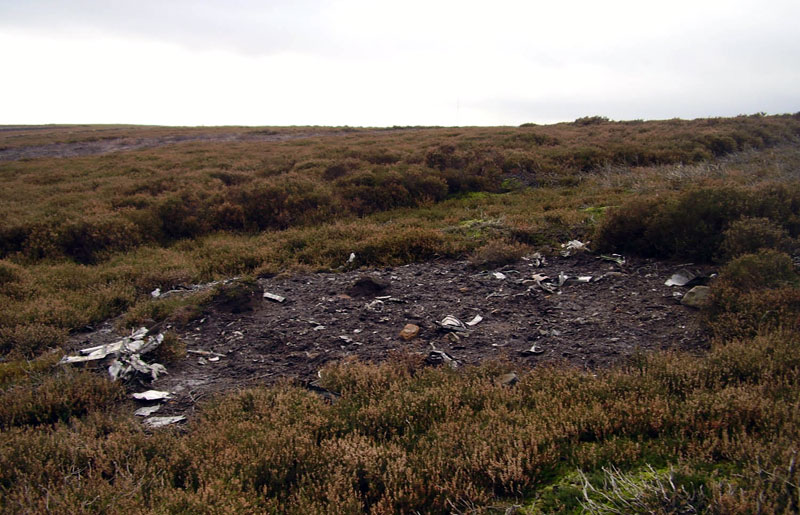
I first located the crash site in 2003. Rumour had it that this aircraft first clipped the ground somewhere else and this damaged the aircraft causing it to crash in the location shown in the photograph above but John Skinn and I have covered a huge area of Urra Moor searching for the other crash sites and have yet to find a secondary Beaufighter crash site to back these rumours up.
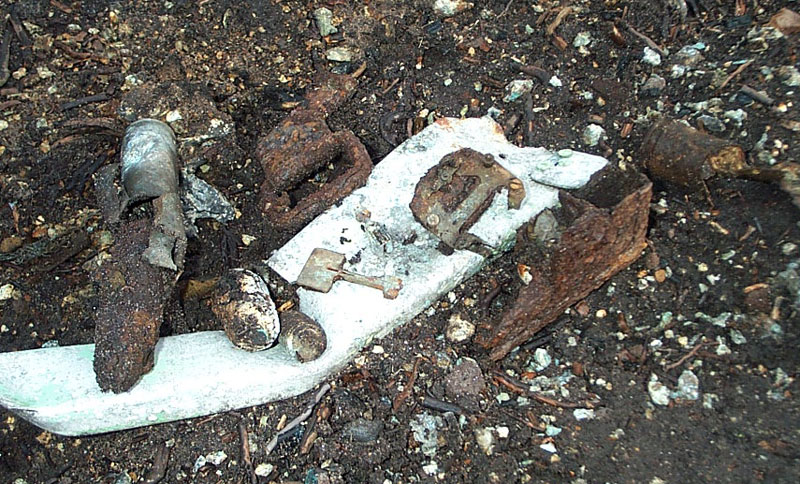
Small pieces of the aircraft are still to be found at the crash site. A large number of 20mm canon shells which remained at the site were sadly taken by someone, probably for their scrap value in or around 2008.

A colourful Urra Moor in August 2010.
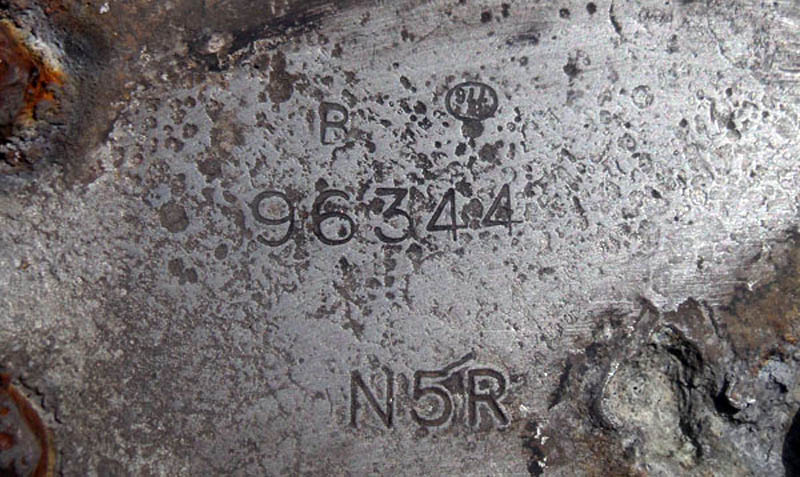
A number of parts at the crash site still show part numbers but as yet have do not know how Beaufighter number sequences work to be able to identify any of them. The piece above shows a clearest part number and a tiny "Bristol" inspection stamp.