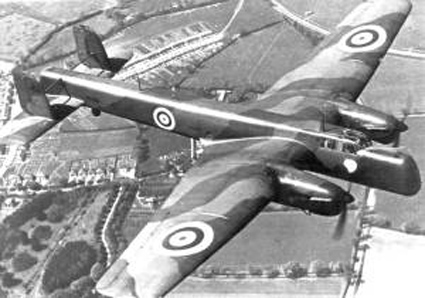
Whitley P4957 damaged in the air, landed at Cold Kirby on return.
10 Squadron's ORB is very poorly written for this date with the scribe appearing to have dated too many pages "17th / 18th September 1940" after the operations flown on this night, the operational flights flown on the 20th / 21st September 1940 are then added to these pre-dated pages. The ORB technically states that on the night of "17th / 18th September 1940" the crew of this aircraft were tasked with undertaking Ops. However the same pilot, second pilot, wireless operator and rear gunner also flew Whitley T4130 on Ops on the "real" 17th / 18th September 1940 so there is clearly an error in the ORB and T4130 is included on this website as damage was sustained on this date. I include reference of this error here to try and explain the situation in researching these battle damage incidents when the only available information is the squadron ORB's and the errors contained there in.
On the night of 20th / 21st September 1940 this crew were tasked with attacking various railway marshalling yards and storage sidings with Hamm, Soest and Ehrang being selected. They took off from Leeming at 21.19hrs and while making an attack on the primary target of Ehrang the aircraft was possibly slightly damaged by an accurate burst of flak, the captain believed that the aircraft had sustained damage to the ailerons. This was later found not to be the case however so the crew proceded to drops the rest of their bombs on a town, believed to be Cologne. The aircraft was then struck by flak in the rear turret, starboard rudder and starboard wing. Because of bad weather on their return to Yorkshire the pilot made a successful landing at Cold Kirby on the dispersal site / dummy airfield near the top of Sutton Bank on the North Yorkshire Moors. The aircraft was later flown back to base by F/O R V Warren later the same day and repairs were carried out at base.
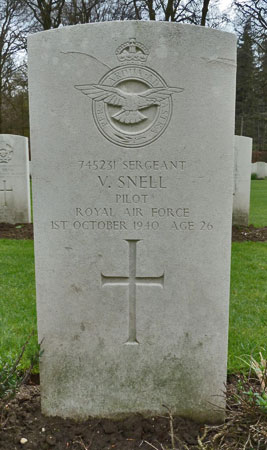
Pilot - Sgt Victor Snell RAFVR (745231).
Second Pilot - Sgt John Eustace Rowlett RAFVR (741334).
Observer - P/O Roy Stanley Boast RAFVR (81066).
Wireless Operator - Sgt Robert Edward Nicholson RAF (611204).
Air Gunner - Sgt Alexander Strachan Shand RAF (630244).
In the early hours of 9th September 1940 Snell, Nicholson and Shand were flying in Whitley P5094 when it crashed near Leeming on return from an operational flight.
On the night of 17th / 18th September 1940 Snell, Rowlett, Nicholson and Shand were flying in Whitley T4130 on Ops to Hamburg when their aircraft was damaged by flak and Sgt Snell was able to make a safe return to land at Leeming. On 24th / 25th September 1941 all were again flying Whitley T4130 when the aircraft possibly made a forced landing on return from Ops but the location where this may have occurred is not known, it is possible that the crew returned safely to base. On the night of 30th September / 1st October 1940 Sgt's Snell, Shand and Nicholson were flying Whitley T4130 on Ops to Berlin, the aircraft crashed near Badbergen, Germany. Sgt Snell was killed and Sgt's Shand and Nicholson were taken prisoner of war. Victor Snell was twenty six years old and is buried in Reichswald Forest War Cemetery. I thank Graham Sharpe for the photograph of Sgt Snell's gravestone.
Robert Nicholson was born on 20th September 1919 at Sunderland, Co.Durham and was the son of William James and Beatrice (nee Turnbull) Nicholson. He enlisted for RAF service on 20th April 1938. He was awarded the DFM for service with 10 Squadron, Gazetted on 26th August 1941, but effective from 29th September 1940. He died in Middlesex in 1992.
Alexander Shand was born on 24th March 1921 at Fyvie, Aberdeenshire and was the son of Lochart Forbes and Barbara (nee Strachan) Shand. He enlisted for RAF service on 5th January 1939 and was working as a farm labourer at the time. He died in 1985.
Victor Snell was born on 24th May 1913 at Brighton, Sussex (though his name was actually George Victor) and was the son of Arthur Patrick and Beatrice Elizabeth (nee Sparks) Snell. His father was a schoolmaster. He attended a boy Scout troop in Cambridge as a boy and later studied architecture at Cambridge as a young man. When he applied to attend the University College of London in 1935 he signed his name as "V.Snell". He is also commemorated at Winchester College suggesting he had also attended there. On probate his name is given as George Victor Snell. CWGC list him purely as Victor Snell.
Roy Boast was born at Shoeburyness, Essex on 21st December 1920 and was the son of Henry and Frances Ann (nee Baldwin) Boast. He received a commission to the rank of P/O on 16th June 1940. He was confirmed in his appointment and was promoted to F/O (war subs) on 16th June 1941 and then to F/Lt (war subs) on 16th June 1942. As Acting S/Ldr he was awarded the DFC for service with 405 PFF Squadron, Gazetted on 22nd May 1945. He was appointed to a permanent commission in the RAF to the rank of F/Lt on 1st September 1945 and received promotions to S/Ldr on 1st January 1949, W/Co on 1st January 1956, G/Cpt on 1st July 1961. He was granted the OBE on 11th June 1960 in The Queen's Birthday Honours list and later the CBE on 1st January 1964. He retired from the RAF at his own request on 24th July 1965. He died in the North Walsham area of Norfolk in December 2005.
John Rowlett was born on 1st October 1914 at Birmingham, Warwickshire and was the son of Eustace and Ethel Hunter (nee Gristwood) Rowlett. When the 1939 Register was compiled he and his family were living in the Droitwich area and he was already serving in the RAF. He learned to fly at the civilian Cambridge Aero Club and gained his Royal Aviators Certificate (Cert.No.18857) on 26th June 1939. He was killed on 16th January 1941 when 10 Squadron Whitley T4220 failed to return from an operational flight to Wilhelmshaven. He has no known grave and is commemorated on the Runnymede Memorial. He is also commemorated on the Ombersley War Memorial in Worcestershire.
Whitley P4957 was built to contract 75147/38 by Armstrong Whitworth Ltd. at Baginton and was awaiting collection in mid-April 1940. It was allotted to 10 Squadron on 19th April 1940 and was taken on charge by them at Dishforth on 8th May 1940. It was involved in a mishap while taking off from Dishforth on 17th May 1940 when one of the crew accidentally raised the undercarriage. Cat.M/FA damage was the assessment and it was repaired on site and returned to the unit. The aircraft's AM Form 78 states that on 1st June 1940 it sustained Cat.I damage and the repair was complete on 6th June 1940. What this relates to isn't exactly certain. It may relate to the minor damage sustained at Cold Kirby two weeks earlier though it does seem a long time to be sat in limbo. The tail of the aircraft was again slightly damaged by flak on 2nd July 1940 but the pilot was able to return to Dishforth where repairs were carried out. It was again damaged by flak 21st September 1940 and was repaired on site at Leeming. On 30th October 1940 the aircraft flew into high ground on return from Ops to Wilhelmshaven on moorland three miles from Slaggyford, Northumberland and thankfully its then crew all survived. Cat.W/FB damage was the damage assesement and it was struck off charge.