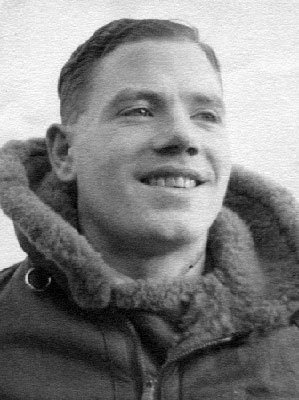
Thomas Moir was born in Edinburgh on 16th September 1917. He was working as a clerk for a metal merchants there when he joined the RAF in 1938. After completing basic training he was posted to Marham airfield as a wireless
operator in September 1939 but was posted to train as an air gunner at Manby soon after arriving, he then returned to Marham to join 115 Squadron and begun his operational flying. He was posted with the squadron to Kinloss on attachment to Coastal Command in early 1940 and then returned to Marham in April 1940 when they re-joined Bomber Command. He appears to have been the regular rear gunner of Rod Gibbes' crew at 115 Squadron by the time the crash at Rosedale occurred. Following the incident at Rosedale he was granted ten days leave but after only five days he was recalled when the squadron cancelled all leave.
On the night of 17th / 18th May 1940 he was flying in Wellington P9300 with all four who survived the crash at Rosedale plus two replacements, they were returning from an operational flight when
weather prevented them landing at Marham. They were instructed to divert to Mildenhall and then two other airfields but the thick fog prevented them landing. Running low on fuel F/O Gibbes made a
wheels-down forced landing in a field near Marks Tey, Essex without injury to any of the crew, the aircraft was later flown out from the field after being made lighter. On the night of 20th/21st
May 1940 he was again flying operationally with 115 Squadron with Gibbes, Petersen and Stone in Wellington P9283 and while the aircraft making a bombing run it sustained flak damage seriously injuring
the front gunner. The aircraft became caught in the beams of searchlights and the aircraft was fired upon by machine gun, AC1 Moir received a bullet wound to the foot but was able to return fire and
scored hits on the searchlights. The aircraft made a safe return to base but he was admitted to Littleport Hospital to be treated for the wounded foot.
Notification that he was awarded the Distinguished Flying Medal was printed in the London Gazette on 7th June 1940 for his actions the previous month. The Citation reads.. "One night in May 1940
the aircraft in which this airman was wireless operator air gunner was heavily engaged by enemy ground defences which incapacitated the front gunner and Aircraftman Moir was himself hit in the foot.
Despite this, he continued to engage the enemy ground defences and succeeded in extinguishing a searchlight after which the remainder were switched out. As the aircraft was still over enemy territory,
this airman remained at his post until loss of blood compelled him to leave to have his wound dressed. As rear gunner this airman has displayed a high standard of devotion to duty on three previous
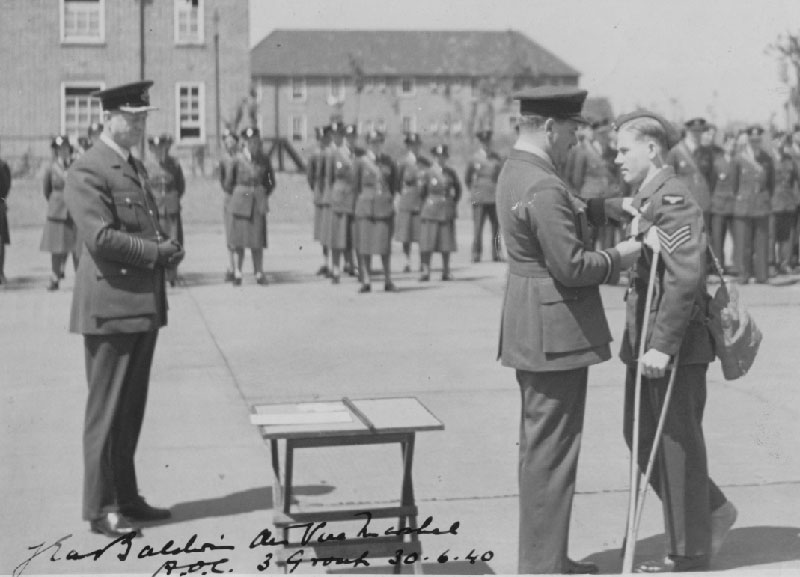
flights during the past month." The photograph above shows him receiving his DFM on 30th June 1940, probably at Marham and still suffering from his injuries sustained in the action that won him his
immediate DFM. The incidents referred to in this citation refer to the crash on the North Yorkshire Moors when he was flying as rear gunner and to the landing in Essex.
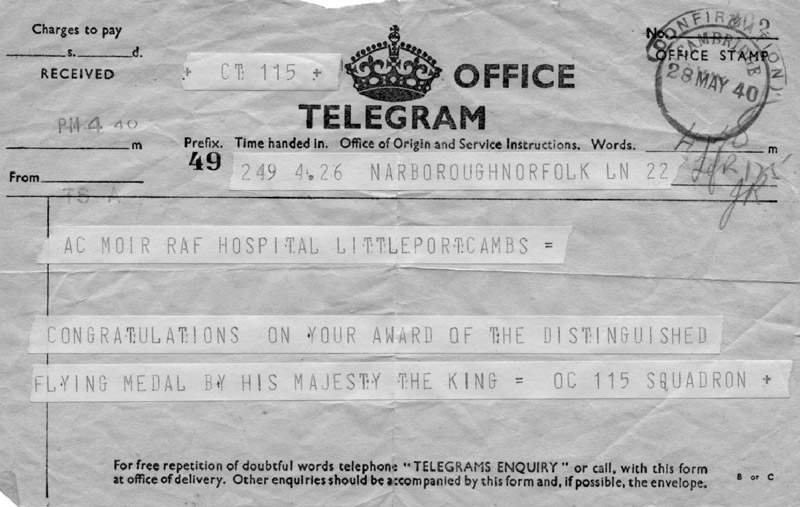
The telegram Thomas Moir received informing him that he was to be awarded the DFM while in hospital from his commanding officer at 115 Squadron.
He returned to operational flying in October 1940 and completed his tour with 115 Squadron. In early 1941 he took a posting to the North Africa and joined 37 Squadron, he arrived back in England
in December 1941 and was posted to 23 OTU but was then grounded in May 1942 with deafness. His grounding probably meant that he was never granted a commission. He spent the rest of the war on station
signals duties until being discharged from the RAF in 1946. After he was discharged he became a Civil Servant with the MOD and briefly became a Labour councillor in Edinburgh. I thank his daughter Lesley Syme for contacting me in February 2014 and kindly supplying all the photographs shown on this webpage.
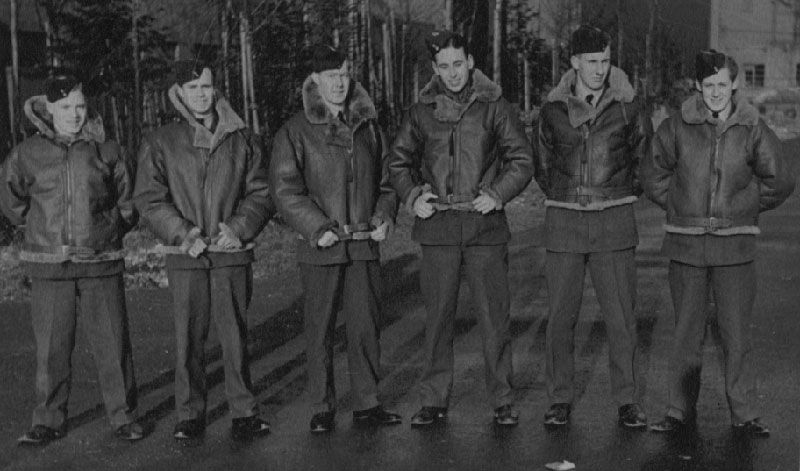
Both these photographs were probably taken at Marham, the one above shows with Thomas Moir (far left) and five other airmen, it is possible that some of those shown here were members of his crew around
the time the incident at Rosedale occurred. 4th left looks to be LAC Stone (from the photograph below).
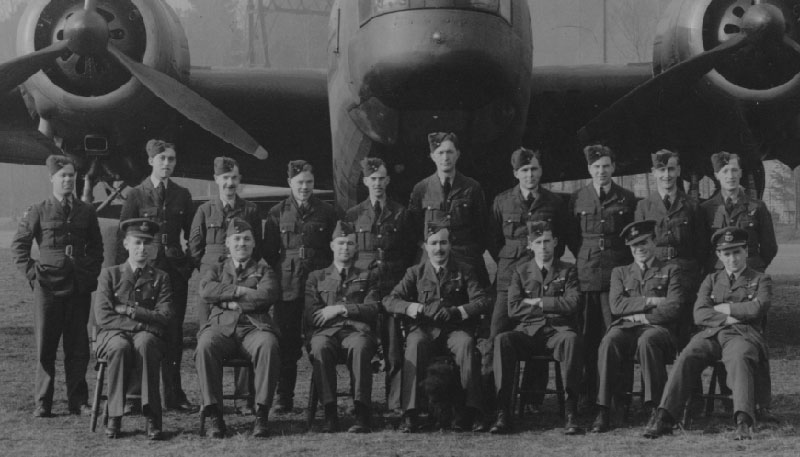
This photograph shows a Wellington aircraft and B-Flight of 115 Squadron taken in April 1940. Those shown on this photograph are (back row l-r) Cpl Pilgrim, LAC Stone, Sgt Petersen, AC Moir, Sgt Stowe, Sgt Ruffle-Hazel, LAC Kemsley, AC Johnson, AC Robertson, AC Butler. (from row l-r) P/O Marsham (probably Marshman), F/O Clark, F/O Gibbs, F/Lt Pringle, F/O Donaldson, P/O Gerry, P/O Evans. I thank Mr Reg Mulder for contacting me to identify those shown after locating the information and another copy of the same photograph at the RAF Marham Aviation Heritage Centre. I also thank the curator of the RAF Marham Aviation Heritage Centre for contacting me.