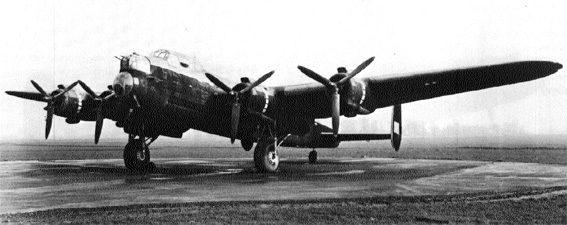
On the night of 7th / 8th October 1943 this aircraft was one of 343 Lancasters en route to bomb Stuttgart, it was also the first 408 Squadron operational flights since the squadron converted to flying the Lancaster type. Lancaster DS724 took off from Linton on Ouse at 20.59hrs and soon after setting out the flying controls jammed. With some difficulty the pilot managed to climb the aircraft to 4000 feet where the crew abandoned it, it crashed soon after with a full bomb load on board close to Manor Farm, Spaunton at 21.08hrs. On impact it exploded causing a massive blast and carrying a full bombload the explosion was heard for many miles, it is noted in a Scarborough's ARP war diary so one assumes it was heard at least twenty miles away. Sadly there was one fatality involved the farmer at Manor Farm, Mr George Strickland. He and his sister were at the farm at the time and both were in the side passage to the house when the explodion occurred. Unfortunately the explosion caused the heavy farm door in on him which crushed him. His sister found herself also covered in debris but appears to have escaped injury. In some cases that involved the crashing of fully ladened aeroplanes, the aeroplane crashed but then some of the bombs would explode moments later, this may have been the case here. Upon speaking to local people they recall that a number of other houses in Spaunton sustained slight damage, evacuees living in some of them had their homes wrecked and had lucky escapes. I understand that a local man was in bed at the time of the crash when the gable end wall of his house fell down in the blast, he was lucky to survive. Of the crew on board DS724 all but one of the crew landed safely within a few miles of the crash location, stretching back towards Pockley. The mid upper gunner sustained injuries to his ribs and shoulder, dislocating the latter landing in an apple tree.
The post-crash investigation found that severe icing on the surfaces of the aircraft was considered to have been a factor in the control of the aircraft having been lost. However the main theory for control being lost almost immediately after take-off was suggested to have been down to the aircraft's auto-pilot being accidently switched on prior to take-off and this went un-noticed. The Squadron had just converted to Lancasters in the weeks prior to this accident and though the pilot had a total of 331 hours flying time at the time of the crash, only 37 of his hours were on Lancasters. This flight was the pilot's first operational flight in a Lancaster, he may have knocked the lever in his pre-flight preparation or it was moved by ground crew accidentally. The pilot went on to be one of the best pilots 408 Squadron would have.
Lancaster DS724 was built to contract AC239 by Armstrong Whitworth Ltd at Baginton. It was delivered to MU storage in October 1942 but was held there
until being taken on charge by 408 Squadron at Linton on Ouse on 1st October 1943. It was
destroyed in the incident at Spaunton on 7th October 1943 with Cat.E2/FB(Burnt) damage being the damage assessment that saw the aircraft then struck off charge on 25th October 1943.
Pilot - F/Sgt John Douglas Harvey RCAF (R/141147).
Flight Engineer - Sgt H J Branton RAF. (Possibly Sgt Henry John Branton RAFVR (1604002)).
Navigator - Sgt Eric James Hurd RCAF (C/18877).
Bomb Aimer - F/O Stephen William Dempsey RCAF (J/21039).
Wireless Operator / Air Gunner - P/O George Ernest Ray Butchart RCAF (J/18341).
Mid Upper Gunner- Sgt Stanley Enos Campbell RCAF (R/160645). Injured.
Rear Gunner - Sgt Kenneth Leslie Davison RCAF.
Civilian - Mr George Otterburn Strickland. Killed, buried Lastingham Churchyard, Yorkshire.
The grave of Mr George Otterburn Strickland who was killed when the door of his house blew inwards. The family still run the farm. Mr Strickland was born on 23rd June 1890 and died on 7th October 1943.
This photograph appeared as the front cover of "The Ryedale Historian" No.13, 1986. Spaunton Manor is in the centre of the photograph.
Spaunton Manor as it was in the 1960s (above) and in the 2005 (below). Not much has openly changed in the last fifty years. It is worth pointing out that this crash site is on private land and therefore I have not visited the site. The aircraft is believed to have crashed in the field ajoining the farm. Air histrians Ken Reast, Albert Pritchard and Eric Barton contacted the landowner in May 1999 and were able to do a surface metal detection of the general area, locating small fragments of the aircraft to confirm the crash location.
John Douglas Harvey (pictured above) was known by his middle name, he was born in Swansea, Ontario, Canada on 7th August 1922 where he lived prior to enlisting for RCAF service in Toronto on 7th November 1941. Following training in Canada and the UK he served with 408 Squadron. WO2 Harvey was still serving with 408 Squadron on the night of 15th / 16th February 1944 when his aircraft was hit by flak whilst on an operational flight to Berlin though he and his crew were able to return home. He was later commissioned in 1944 and was awarded the DFC as P/O (J/85081), Gazetted on 19th May 1944, the citation for his award reads.. "This officer has participated in very many sorties, involving attacks on most of the enemy's heavily defended targets. He has invariably displayed great skill and courage and his example in pressing home his attacks has been worthy of much praise. In the course of his tour, Pilot Officer Harvey has attacked Berlin on eleven occasions." Having taken part in the highest number of operational flights to Berlin for any pilot in 408 Squadron John Harvey was presented with a gold watch. He survived the War and returned home where he went to Toronto University. He later rejoined the RCAF before retiring in 1965 as W/Co and was also the executive director of the RCAF Association and a founding editor of Airforce magazine. He died in Victoria, British Columbia in January 1998. I would like to thank members of his family for their contact.
In one of his 1970's-era books Brian Rapier stated that one of the crew (given as the pilot) landed in the back garden of his brother's house in Hutton-le-Hole. This would seem highly unlikely because both his parents were born in Lancashire, England and had emigrated before they had children. John Harvey had one brother, Frank, who was born at Swansea, Ontario in 1920. I think this myth can be put to bed.
24th July 1943, Hamburg.
25th July 1943, Essen.
27th July 1943, Hamburg.
29th July 1943, Hamburg.
30th July 1943, Remscheid
2nd August 1943, Hamburg (detailed below).
7th October 1943, Stuttgart (did not complete, crashed at Spaunton).
18th November 1943, Berlin, landed at Tangmere due to being short of fuel.
22nd November 1943, Berlin.
26th November 1943, Berlin.
2nd December 1943, Berlin.
16th December 1943, Berlin.
20th December 1943, Frankfurt.
29th December 1943, Berlin.
1st January 1944, Berlin.
5th January 1944, Stettin.
14th January 1944, Brunswick.
20th January 1944, Berlin.
21st January 1944, Magdeburg, landed at Waterbeach on return.
27th January 1944, Berlin, flying Lancaster DS692, attacked by an Me110. Sgt Campbell returned fire and shot it down, he was awarded a DFC for this (see below).
28th January 1944, (Berlin, returned early so did not count as an Op for their Tour).
30st January 1944, Berlin.
15th February 1944, Berlin, hit by flak.
19th February 1944, Leipzig.
24th February 1944, Schweinfurt, landed at Westcott on return.
15th March 1944, Stuttgart, the rear turret failed on return.
26th March 1944,
Here-after no complete list has been found as yet but (I have yet to view squadron records)...
30th March 1944, Nurnburg, jettisoned bomb load as no indicators were seen. Landed at Moreton in the Marsh on return.
The Hamburg raid they were part of on 2nd/3rd August 1943 deserves further investigation. What is known is that the raid was a failure because of severe icing and thunder storms before they released their bombs. This particular aircraft iced up. All aircraft were ordered to bomb from between 15,000ft and 20,000ft and with control being limited the pilot, F/Sgt Harvey, ordered the crew to bale out. The wireless operator, Sgt Raymond Shire RAFVR (1394163), complied and was eventually made a PoW. What happened next is yet not known but the aircraft began to loose height and the rest of the crew were probably unable to get out. In the process the pilot had sustained some injuries and was unable to continue flying the aircraft. Initially trapped in his turret the rear gunner, Stan Campbell, and found himself acting as a stand-in pilot. The aircraft had lost approaching 10,000ft in height before control was regained, Stan Campbell then acted as pilot and guided the aircraft home with the remaining crew on board. This information was found in Stan Campbell's obituary, and whilst slightly biased towards him, there is no doubt some truth to these events however had he single handedly regained control of a crippled bomber and flew it home saving the life of his injured pilot then surely he would be put up for an award of the highest order; as he wasn't suggests had some part in the aircraft returning to the UK and the story was told in later years! He was nick-named "The Hamburg Kid" by his crew after this incident which does suggest some degree of truth to the matter. The crew named above were involved in this incident and following this having lost their wireless operator they were joined by F/O Butchart on future flights.


Eric Hurd was born on 20th May 1920 at Sawyerville, Quebec, Canada and was the son of Alonzo George and Evelyn Frances (nee Robinson) Hurd. He enlisted for RCAF service in London, England on 27th March 1942. He was commissioned in 1943 (one assumes later than the Spaunton incident in October 1943) and was awarded the DFC for service with 408 Squadron, Gazetted on 24th May 1944. There was no citation to his DFC as such other than "completed...many successful operations against the enemy in which [he has] displayed high skill, fortitude and devotion to duty." The recommendation for his award also states that "Pilot Officer Hurd has nearly completed his first tour of operations. As a navigator he has been responsible for directing his aircraft on many occasions to very distant targets in enemy territory, including over eleven trips to Berlin. He has at all times displayed great keenness and devotion to duty." He died in 1988 at Mapleleaf, Quebec, Canada. There is a list of all the operational flights he had taken part in upto the DFC recommendation being made. As a result almost certainly many of this crew flew these flights, they were..
Stephen Dempsey was born in 1920 and was the son of Robert James and Greta Eileen (nee Colton) Dempsey. In the 1921 Census of Canada the family were living at Ameliasburgh, Prince Edward, Ontario, Canada, which was probably where he was born. He enlisted into the RCAF in Toronto on 4th August 1941. Following his training
he received a commission in 1942. After service with 408 Squadron he was posted to 419 Squadron and was awarded the DFC on 19th May 1944 (The same date as Harvey). The citation reads.."As air bomber, this officer has completed a large number of sorties, including many against heavily defended and far distant targets. Throughout, he has displayed the greatest keenness and his example of courage and determination has been of a high order. He has proved himself to be a most valuable member of aircraft crew."
Stanley Campbell was born in Drumheller, Alberta, Canada on 3rd April 1921 and was the son of Stanley Enos and Catherine Nora (nee Sweet) Campbell. He enlisted in Calgary on 2nd April 1942. Following training he was posted to 408 Squadron. He was also awarded the DFC with 408 Squadron (effective from 16th June 1944), the citation for his DFC reads.."As air gunner, this officer has taken part in very many attacks on a variety of well defended targets including eleven on Berlin. On one occasion in an operation against the German capital his aircraft was engaged by a fighter. Although the enemy attacked with much persistence, Pilot Officer Campbell directed the necessary combat manoeuvres with great skill. Finally Pilot Officer Campbell delivered a well placed burst of fire and the attacker dived towards the ground enveloped in flames. He defended his aircraft with great coolness and confidence, qualities which have made him a most valuable member of aircraft crew." Stanley returned to Ottawa in October 1944, why this was the case is not yet known but it could have been that his broken arm he sustained in the bad landing near Spaunton did not heal properly and he his War was cut short and he was able to return home because of this. He was discharged from the RCAF and was placed in the Reserve. He returned to his native Drumheller and married Elizabeth on 18th February 1945. He worked for a large construction firm until retirement in 1988 before battling Parkinson's Disease for many years. He lost this fight in April 2002.
George Butchart was born on 22nd December 1912 at Tobermory, Bruce County, Ontario, Canada and was the son of George and Harriet Amelia (nee Adams) Butchart. He later lived at Wiarton, Ontario. He was known as "Slick" or "Rae". Post-WW2 he returned to Canada and was the postmaster at Wiarton, Ontario from 1949 until 1977. He died there in May 2002.
Ken Davison was born on 17th January 1924 at Fleming, Saskatchewan, Canada and was the son of Charles Raymond and Jean Margaret (nee Whitton) Davison. He enlisted for RCAF service in May 1942. In April 1944 he received a commission to the rank of P/O with service number being J/85692 thereafter. He later returned to Canada in early 1945 but was killed on the day before his 22nd birthday on 16th January 1946 when a car he was in was struck by a train.
One of the older members of this crew was Sgt H J Branton, after this incident Richard Koval's RCAF research reveals that he gave up his service as an airman,
possibly ending the war as a member of ground crew. He was replaced as flight engineer in Harvey's crew by Sgt A Mabon by December 1943. There was only ever one "H.J.Branton" who served in the RAF. This was the individual as named above. He was almost certainly one Henry Branton, born 16th January 1911. I cannot find his birth registration nor any mention of who his parents may be. He appears on the 1911 Census as Henry John Tomey, son of Henry Tomey and Lena Ellen (nee Gray, then Branton) Tomey. His mother appears to have been Lena Ellen Gray and had previously been married to (or was also married at the same time (?!)) to George Branton (at Shoreditch in 1905). More information is required. Henry Branton married Constance Violet Williams in Lewisham in 1930 and together they had three children. When the 1939 Register was compiled he was living in Lewisham, London and working as a tax officer for the Inland Revenue. His son John Henry Branton was killed in a motorcycling accident in London in October 1952. He died on 22nd August 1965 at a caravan park at Studd Hill, Herne Bay, Kent.
Mr Hugh Halliday's superb research into RCAF Awards has been drawn upon for the biog's of John Harvey, Stephen Dempsey, Stanley Campbell and Eric Hurd shown on this page and I thank him for crediting me with some of the information shown on a number of his accounts.